

How to Use This Reference
This glossary covers 40 common bodyweight movements grouped by primary muscle focus. For each exercise you'll find the muscles it targets, a short form cue, and a beginner-friendly alternative when one exists. Use it as a quick lookup - whether you encountered an unfamiliar term in a workout plan or want to understand what a movement actually trains before trying it.
Bodyweight training is one of the most accessible entry points to fitness because it requires no equipment and can be scaled to almost any ability level. If you're comparing it to equipment-based training, see our breakdown of free weights vs. resistance machines for context on how each approach fits different goals.
This Is General Fitness Information
The descriptions below are educational references, not personalized training prescriptions. If you have an existing injury, chronic condition, or are new to exercise, consult a qualified healthcare or fitness professional before beginning any new routine. Pain during movement is a signal to stop.
| Equipment needed | None (floor space required) |
| Muscle groups covered | Upper body, core, lower body, full-body |
| Suitable for | Beginners through intermediate exercisers |
| Common beginner modification | Reduce range of motion, add a support surface |
| Progressive overload options | Slower tempo, more reps, reduced rest, harder variation |
| Safety note | Stop if you feel sharp or joint pain |
Upper-Body Movements (Push Focus)
- Push-Up
- Targets: Chest, triceps, anterior shoulders, core. Cue: Keep your body in a straight line from head to heels; lower your chest to within an inch of the floor. Beginner alternative: Incline push-up with hands on a countertop.
- Wide-Grip Push-Up
- Targets: Chest (greater stretch). Cue: Place hands wider than shoulder-width; keep elbows at roughly 45° from your torso.
- Diamond Push-Up
- Targets: Triceps, inner chest. Cue: Form a diamond shape with thumbs and forefingers directly under your chest.
- Pike Push-Up
- Targets: Shoulders, upper chest, triceps. Cue: Start in a downward-dog shape and lower your head toward the floor between your hands.
- Archer Push-Up
- Targets: Chest and triceps unilaterally. Cue: Extend one arm straight to the side while bending the other; shift weight toward the bent arm.
- Decline Push-Up
- Targets: Upper chest, anterior shoulders. Cue: Elevate feet on a stable surface; maintain a rigid torso.
- Pseudo Planche Push-Up
- Targets: Anterior shoulders, chest, triceps. Cue: Lean your body forward past your hands; keep fingers pointing backward.
- Dip (Chair/Bench)
- Targets: Triceps, chest, shoulders. Cue: Keep hips close to the surface; lower until upper arms are parallel to the floor. Note: Avoid this if you have shoulder impingement.
Upper-Body Movements (Pull Focus) and Core
- Pull-Up
- Targets: Latissimus dorsi, biceps, rear deltoids. Cue: Start from a dead hang; pull until your chin clears the bar. Beginner alternative: Negative pull-up (jump up, lower slowly).
- Chin-Up
- Targets: Biceps, lats. Cue: Supinated (underhand) grip, shoulder-width apart; same pull pattern as pull-up.
- Inverted Row
- Targets: Upper back, biceps, rear deltoids. Cue: Lie under a sturdy table or bar; keep body rigid and pull chest to the surface. Excellent beginner pull alternative.
- Plank
- Targets: Deep core stabilizers (transverse abdominis), glutes, shoulders. Cue: Neutral spine - don't let hips sag or pike up; breathe steadily.
- Side Plank
- Targets: Obliques, hip abductors. Cue: Stack feet or stagger them; keep hips lifted throughout. Beginner alternative: Drop bottom knee to the floor.
- Hollow Body Hold
- Targets: Anterior core. Cue: Flatten lower back to the floor; arms overhead and legs extended - only shoulders and legs hover off the ground.
- Dead Bug
- Targets: Deep core, hip flexors. Cue: Lower opposite arm and leg simultaneously while pressing your lower back into the floor. Slow and controlled is key.
- Mountain Climber
- Targets: Core, hip flexors, cardiovascular system. Cue: Start in push-up position; drive knees alternately toward chest without letting hips rise.
- Superman
- Targets: Erector spinae (lower back), glutes. Cue: Lying face down, simultaneously lift arms and legs off the floor; hold briefly. Note: Avoid if you have lower back pain until cleared by a professional.
- V-Up
- Targets: Rectus abdominis, hip flexors. Cue: Lift legs and torso simultaneously; reach hands toward feet. Beginner alternative: Tuck-up (bend knees).
Lower-Body Movements
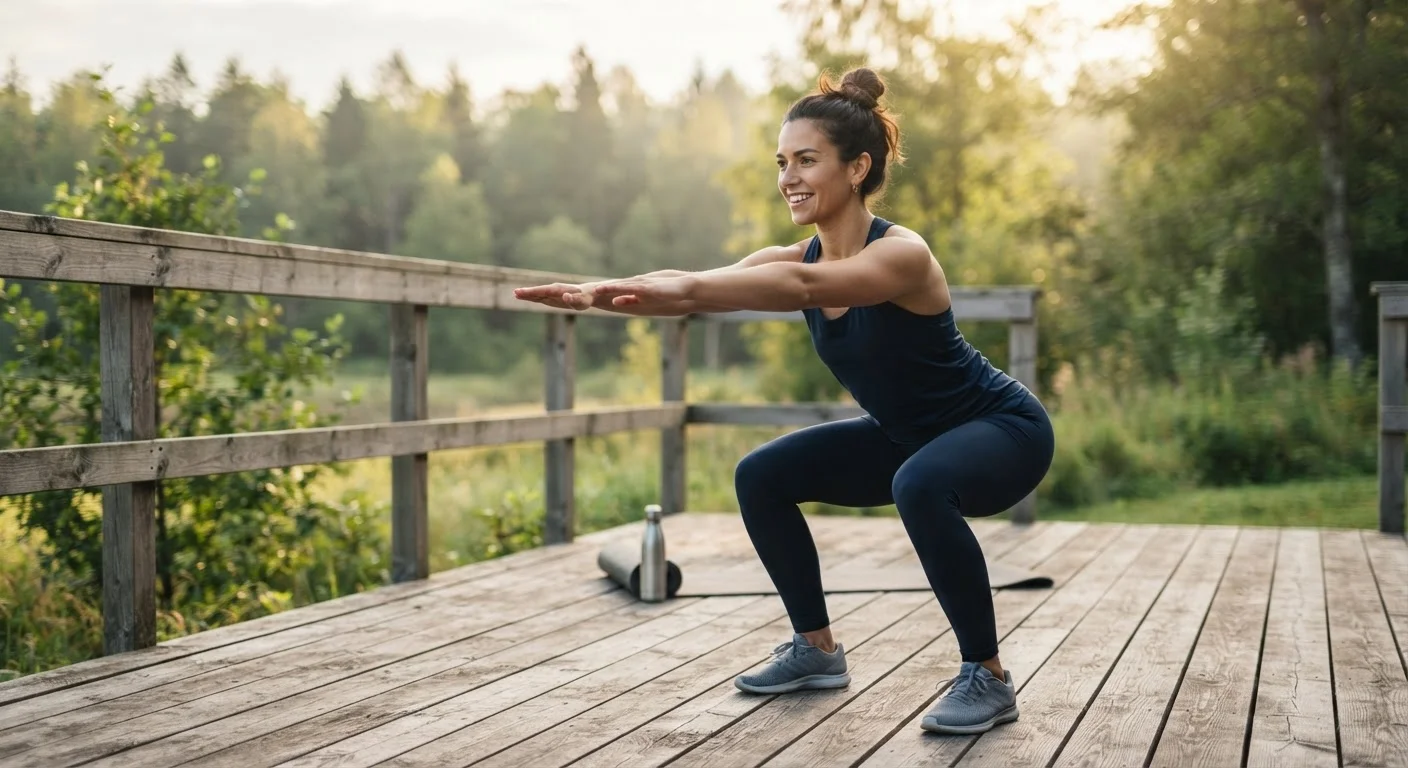
- Bodyweight Squat
- Targets: Quadriceps, glutes, hamstrings. Cue: Feet shoulder-width apart; chest up, knees tracking over toes as you lower until thighs are roughly parallel to the floor.
- Sumo Squat
- Targets: Inner thighs (adductors), glutes. Cue: Wide stance, toes angled out 45°; keep chest tall.
- Wall Sit
- Targets: Quadriceps (isometric). Cue: Slide back against a wall until thighs are parallel to the floor; hold position without resting hands on thighs.
- Reverse Lunge
- Targets: Quads, glutes, hamstrings (unilateral). Cue: Step back and lower the back knee toward the floor; keep front shin vertical. Easier on the knee than a forward lunge for many beginners.
- Forward Lunge
- Targets: Quads, glutes, hip flexors. Cue: Step forward; lower your rear knee to within an inch of the floor without letting your front knee cave inward.
- Lateral Lunge
- Targets: Inner thighs, glutes, quads (in a different plane of motion). Cue: Step wide to one side and sit your hips back; keep the opposite leg straight.
- Glute Bridge
- Targets: Glutes, hamstrings, lower back stabilizers. Cue: Lie on your back with knees bent; drive hips to the ceiling and squeeze glutes at the top.
- Single-Leg Glute Bridge
- Targets: Glutes, hamstrings (unilateral challenge). Cue: Same as glute bridge but extend one leg; keep hips level throughout.
- Hip Thrust (Floor)
- Targets: Glutes. Cue: Upper back on a sturdy surface, feet flat on the floor; drive hips up until torso is parallel to the ground.
- Step-Up
- Targets: Quads, glutes (unilateral). Cue: Use a stable step or low box; drive through the heel of the lead foot to stand up fully before stepping back down.
- Calf Raise
- Targets: Gastrocnemius and soleus. Cue: Rise onto the balls of your feet slowly; lower with control. Can be done on the edge of a step for greater range.
- Donkey Kick
- Targets: Glutes. Cue: On hands and knees, kick one heel toward the ceiling while keeping hips square and core engaged.
- Fire Hydrant
- Targets: Hip abductors, glutes. Cue: From hands-and-knees, lift one knee out to the side; keep your lower back from rotating.
- Good Morning (Bodyweight)
- Targets: Hamstrings, erector spinae. Cue: Hands behind head, slight knee bend; hinge at the hips and lower your chest toward the floor, then return upright.
Full-Body and Cardio Movements
- Burpee
- Targets: Full body plus cardiovascular system. Cue: Squat, kick feet back to a plank, perform a push-up (optional), jump feet forward, then jump or stand tall. Beginner alternative: Step feet back instead of jumping.
- Jumping Jack
- Targets: Cardiovascular system, hip abductors, shoulders. Cue: Land softly with slightly bent knees. Beginner alternative: Step-jack (step one foot at a time).
- High Knees
- Targets: Hip flexors, cardiovascular system, core. Cue: Drive knees to hip height alternately; stay on the balls of your feet.
- Skater
- Targets: Hip abductors, glutes, balance, cardiovascular system. Cue: Bound laterally and land on one foot; tap the other foot behind like a speed skater.
- Bear Crawl
- Targets: Shoulders, core, hip flexors, quads. Cue: Hands and feet on the floor, knees hovering an inch above ground; move opposite hand and foot together.
- Inchworm
- Targets: Hamstrings, core, shoulders (also a mobility drill). Cue: From standing, hinge and walk hands out to a plank, then walk feet back to hands and stand.
- Sprawl
- Targets: Full body, hip flexors, core. Cue: Drop hips to the floor from a standing position and shoot legs back flat - similar to a burpee but hips contact the ground.
For a broader look at how bodyweight training fits into an overall resistance training plan, see our introduction to resistance training - a useful next step once you're comfortable with the movements above. You can also explore the full Fitness & Movement hub for additional guidance on building consistent habits.
This article is for general informational purposes only and does not constitute medical or professional fitness advice. Consult a qualified healthcare or fitness professional before beginning a new exercise program, especially if you have any health conditions or injuries.
The content on this site is provided for informational purposes only and should not be considered a substitute for professional advice. While we strive to provide accurate and up-to-date information, we make no guarantees regarding its completeness or accuracy. Always consult a qualified professional for advice specific to your circumstances before making any decisions.