

Option A
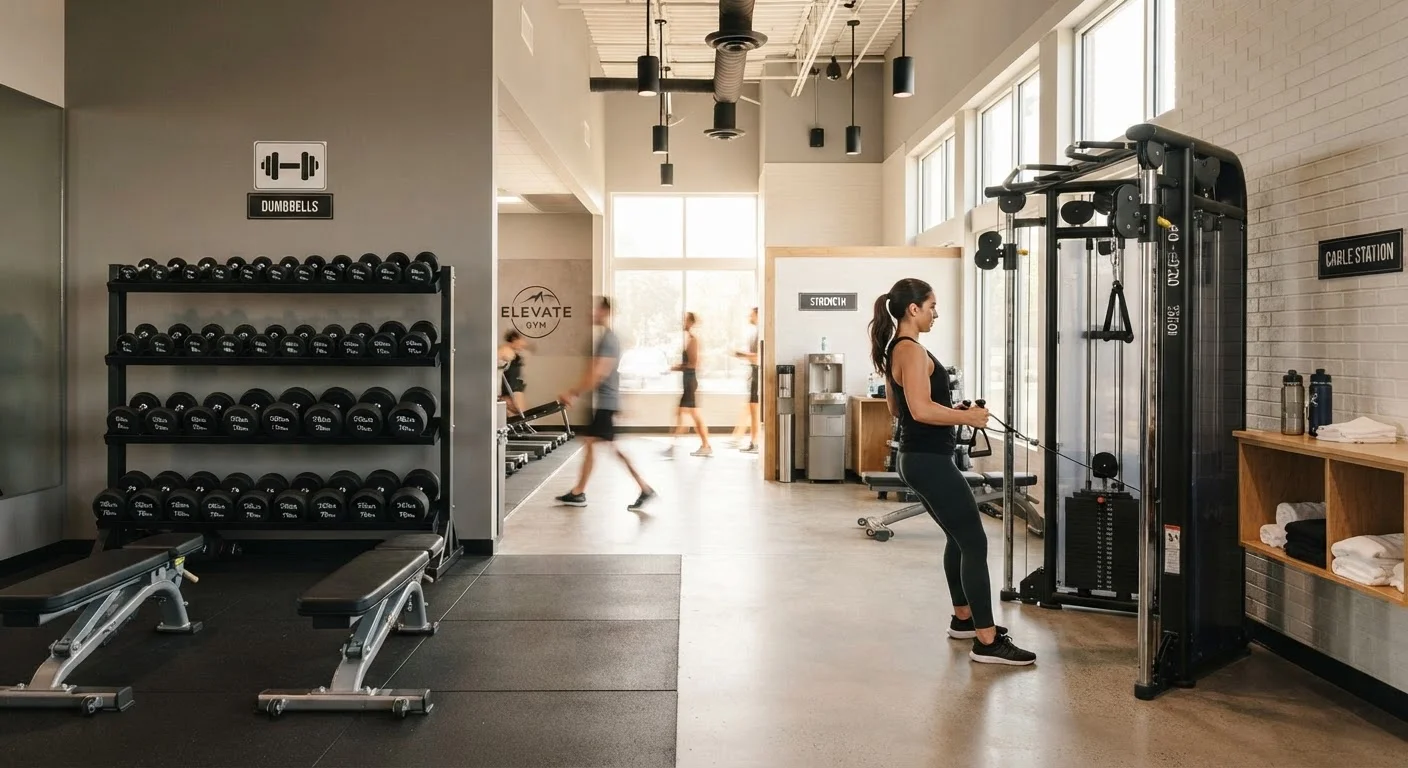
Free Weights
The versatile, functional strength-builder.
Best for: Lifters who want to develop balanced, real-world strength and have the time to learn proper form.
Option B
Resistance Machines
The guided, beginner-friendly option.
Best for: Anyone new to strength training, recovering from injury, or targeting a specific muscle group safely.
What Sets These Two Tools Apart
Free weights - including dumbbells, barbells, and kettlebells - require you to control the weight through space without external guidance. That means your muscles not only push or pull the load, but also stabilize your joints throughout the movement. Resistance machines, by contrast, keep the weight on a fixed track or cable path, reducing the demand on those secondary stabilizer muscles.
This is the core trade-off: free weights ask more of your body, machines do more of the structural work for you. Neither approach is inherently better. The right choice depends on where you are in your fitness journey and what you're trying to accomplish. If you're just starting out, our introduction to resistance training covers the foundational principles worth understanding before diving into either option.
| Criterion | Free Weights | Resistance Machines |
|---|---|---|
| Stabilizer muscle engagement | High - required throughout movement | Low - path is guided |
| Learning curve | Steeper - technique takes practice | Gentler - form is partially built in |
| Injury risk (beginner) | Higher without proper coaching | Lower due to fixed range of motion |
| Muscle isolation | Moderate - multiple muscles involved | High - targets specific muscles |
| Versatility | Very high - hundreds of exercises | Limited to machine's design |
| Solo safety | Requires care; spotter often helpful | Generally safe without a spotter |
| Cost (home use) | Moderate - adjustable sets available | High - machines are expensive |
| Functional carry-over | Strong - mirrors real-world movement | More limited to the gym context |
The Case for Free Weights
Free weights excel at developing what exercise scientists sometimes call functional strength - the kind that translates to everyday movement. When you perform a dumbbell lunge or a barbell row, your body must coordinate dozens of muscles simultaneously to control the load and maintain balance. This integrated demand can improve coordination, joint stability, and overall athleticism over time.
Free weights are also highly versatile. A single pair of adjustable dumbbells can cover exercises for nearly every major muscle group, making them a practical choice for a home setup. For more on building a practical workout environment, see our comparison of home gym vs. gym membership options.
The main limitation is the learning curve. Movements like the squat, deadlift, and overhead press require deliberate practice to perform safely. Rushing into heavier loads without proper technique increases injury risk - so patience and progressive overload matter.
~43%
More muscle activation in stabilizers
Research published in the Journal of Human Kinetics found free-weight exercises produced meaningfully greater stabilizer activation compared to machine equivalents in trained subjects.
2-3 sessions/week
Recommended resistance training frequency
The U.S. Department of Health and Human Services Physical Activity Guidelines recommend adults engage in muscle-strengthening activities at least two days per week.
The Case for Resistance Machines
Machines shine in two specific contexts: when you're new to lifting and when you need to isolate a muscle group with precision. Because the movement path is fixed, beginners can focus entirely on feeling the target muscle work rather than dividing attention between balance, coordination, and the load itself. That's a meaningful advantage when you're still building body awareness.
For people managing joint issues or returning to exercise after an injury - always in consultation with a qualified healthcare provider - machines can allow targeted strengthening with less stress on surrounding structures. A leg press, for instance, can build quad strength while placing different demands on the knee compared to a free-weight squat.
Machines are also safer for solo training. Without a spotter, heavy free-weight exercises carry a real risk of being pinned under a load. Most machines allow you to simply stop and step away. For a broader look at how your training environment affects safety and results, see our home workouts vs. gym training breakdown.
How to Combine Both in Your Routine
Most experienced lifters don't choose one exclusively - they use both strategically. A common approach is to anchor workouts around free-weight compound movements (exercises involving multiple joints, like squats or rows) and finish with machine-based isolation work targeting specific muscles. This structure lets you capture the functional benefits of free weights while using machines to add volume safely.
For example, a lower-body session might open with barbell squats, progress to dumbbell lunges, and finish with a leg curl machine. Each tool contributes something the other doesn't. Understanding how strength training fits alongside other exercise types can help you plan smarter - our overview of strength training vs. cardio is a useful companion read.
This article is for general informational purposes only and does not constitute medical or fitness advice. If you have an injury, chronic condition, or are new to exercise, consult a qualified healthcare or fitness professional before starting a new training program.
The content on this site is provided for informational purposes only and should not be considered a substitute for professional advice. While we strive to provide accurate and up-to-date information, we make no guarantees regarding its completeness or accuracy. Always consult a qualified professional for advice specific to your circumstances before making any decisions.