

Our Verdict
Home gyms suit self-directed individuals with reliable space and the discipline to train without external structure. Gym memberships tend to work better for people who thrive on variety, community energy, or the commitment a paid membership creates. Most people can build meaningful fitness results in either setting, provided the environment genuinely supports their consistency.
Ideal for readers who are ready to commit to regular exercise and want to identify which environment - home or commercial gym - will realistically sustain that commitment over months, not just weeks.
Why This Decision Is More Personal Than Financial
The home gym vs. gym membership debate is often framed as a math problem - add up monthly fees, compare them to equipment costs, and pick the winner. But the financial angle, while real, misses the bigger driver of fitness outcomes: whether you actually show up consistently.
Before treating this as a budget exercise, consider your honest patterns. Do you train more reliably when you have a dedicated appointment to keep? Or do you work out best when there's zero friction between you and the equipment? Understanding your motivation style first makes the cost comparison far more meaningful. If you're newer to structured training, the key fitness concepts to understand before starting a program can help you set realistic expectations regardless of where you train.
The Case for a Home Gym
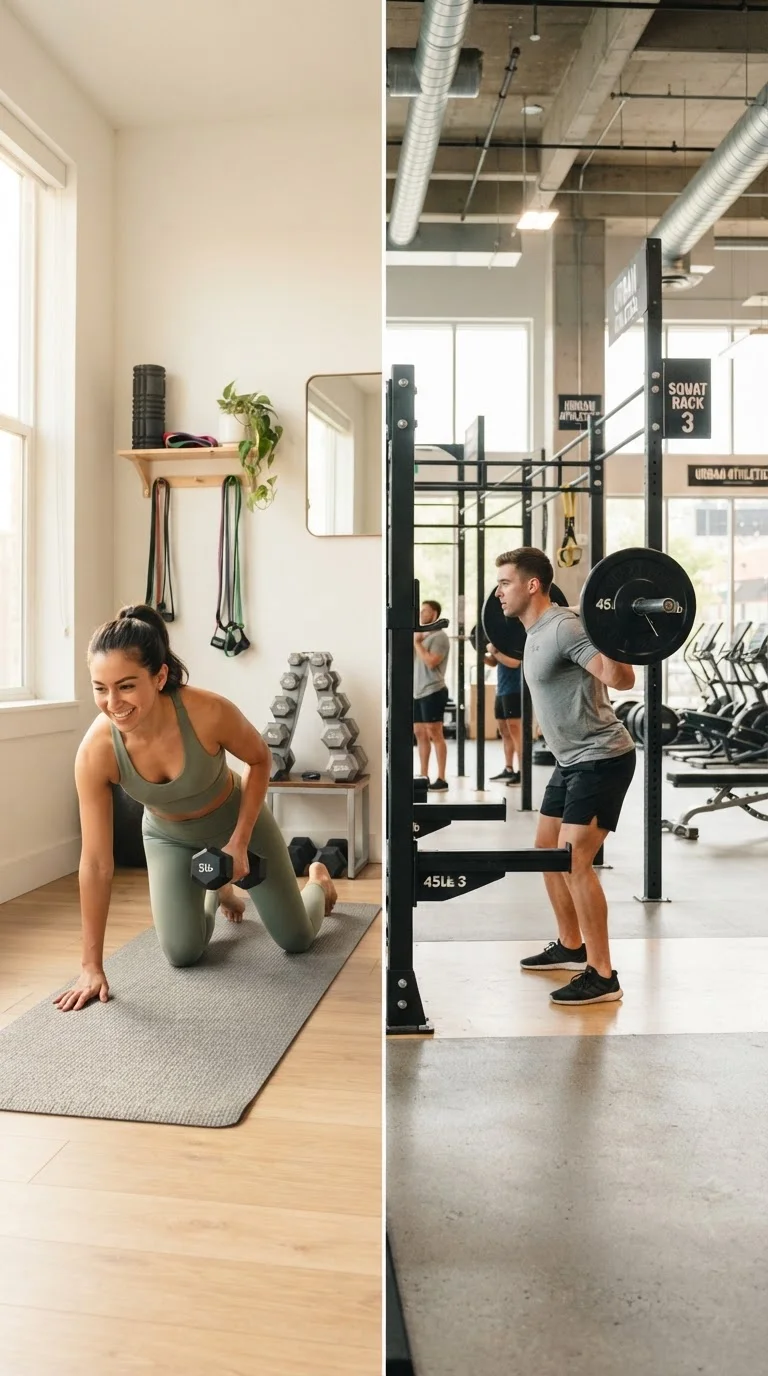
A home setup removes nearly every logistical barrier to exercise. No commute, no wait for equipment, no gym hours to work around. For parents, shift workers, or anyone with an unpredictable schedule, that convenience can be the difference between training three times a week and training zero times.
No commute or wait times for equipment
Training at home eliminates travel time and the frustration of waiting for machines during peak hours, making it easier to stick to a schedule.
One-time cost with no recurring fees
Once equipment is purchased, there are no ongoing monthly charges - a meaningful long-term saving for people who train regularly over years.
Available on your schedule, 24/7
Home gyms work around early mornings, late nights, and unpredictable days when a commercial gym would already be closed or inconvenient.
Privacy and comfort for self-conscious exercisers
Training at home removes social anxiety for people who feel intimidated by gym environments, which can improve consistency for beginners.
No membership cancellation hassle
Home equipment doesn't come with contracts, cancellation fees, or automatic renewals that can be difficult to exit.
The trade-off is upfront investment. A functional home gym - even a modest one with a set of adjustable dumbbells, a resistance band set, and a pull-up bar - requires spending before you see results. More complete setups involving a barbell, plates, a rack, and a cardio machine can run into the thousands. Space is the other constraint; not every home has a spare room, garage, or even a clear corner to dedicate to equipment.
For a broader look at free weights versus resistance machines, it's worth reading up on which tools actually match your goals before purchasing anything.
The Case for a Gym Membership
Commercial gyms offer access to equipment that would cost tens of thousands of dollars to replicate at home - cable machines, a full rack of dumbbells, specialty cardio equipment, and often group fitness classes. For someone who values variety in their training or is still figuring out which modalities they enjoy, that range is genuinely useful.
High upfront equipment and space investment
Even a basic functional setup requires meaningful spending before you begin, and a more complete home gym can represent a substantial financial commitment.
Limited equipment variety and progression options
Home gyms can become restrictive as fitness goals evolve, particularly for strength training that requires heavier loads or specialized machines.
No built-in accountability or social energy
Without the structure of a class schedule or the presence of other exercisers, motivation can be harder to sustain over the long term.
Recurring monthly fees add up over time
A gym membership that goes unused for even a few months costs real money, and many people find their usage drops without noticing the ongoing charge.
Commute adds friction on low-motivation days
Travel time to a commercial gym is one of the most commonly cited reasons people skip workouts, particularly during busy or stressful periods.
The social environment of a gym also matters for many people. Seeing others train can boost effort and accountability in ways a home setting simply doesn't provide. Some gyms offer personal training, coached classes, or community programming that adds structured guidance beyond what most people build on their own.
The downside is recurring cost and the commute. Monthly fees vary widely depending on the facility, but they accumulate. If a gym is 20 minutes away, that round-trip adds up - and on a busy day, it becomes the reason a workout gets skipped. To think through how to build a weekly movement plan you can actually stick to, it helps to map out your real schedule before committing to either option.
A Hybrid Approach Is Also Valid
Some people maintain a minimal home setup for convenience - resistance bands, a mat, a pair of dumbbells - while keeping a gym membership for access to heavier equipment a few times a week. This hybrid model can reduce the upfront cost of a full home gym while preserving flexibility. It does require managing two ongoing expenses, so it's worth weighing whether the added access justifies the combined cost for your specific training needs.
Comparing the Two: What Actually Matters
Rather than declaring a winner, it's more useful to evaluate both options against your specific situation. The comparison of home workouts and gym training often comes down to a handful of honest questions:
- Space: Do you have a dedicated, usable area at home, or will equipment create real friction with your living situation?
- Budget: Can you absorb a larger one-time cost, or does a predictable monthly fee fit your finances better?
- Schedule: Is your daily routine flexible enough that a commute won't become an obstacle?
- Motivation style: Do you work harder with others around, or do you prefer training privately at your own pace?
- Goal complexity: Are you training for general health and movement, or pursuing sport-specific or advanced strength goals that require specialized equipment?
There's no universally correct answer. Both environments are fully capable of supporting meaningful fitness progress when chosen with honesty rather than optimism.
~$500-$1,500
Typical starter home gym equipment cost
Consumer fitness surveys suggest a basic functional setup - including dumbbells, bands, and a mat - generally falls in this range, with full setups costing considerably more.
$40-$70/month
Average U.S. gym membership cost
Membership fees vary widely by facility type and region; budget gyms may cost less while full-service or specialty gyms can significantly exceed this range.
This article is for informational purposes only and does not constitute medical or fitness advice. Consult a qualified healthcare professional or certified fitness specialist before starting a new exercise program.
The content on this site is provided for informational purposes only and should not be considered a substitute for professional advice. While we strive to provide accurate and up-to-date information, we make no guarantees regarding its completeness or accuracy. Always consult a qualified professional for advice specific to your circumstances before making any decisions.