

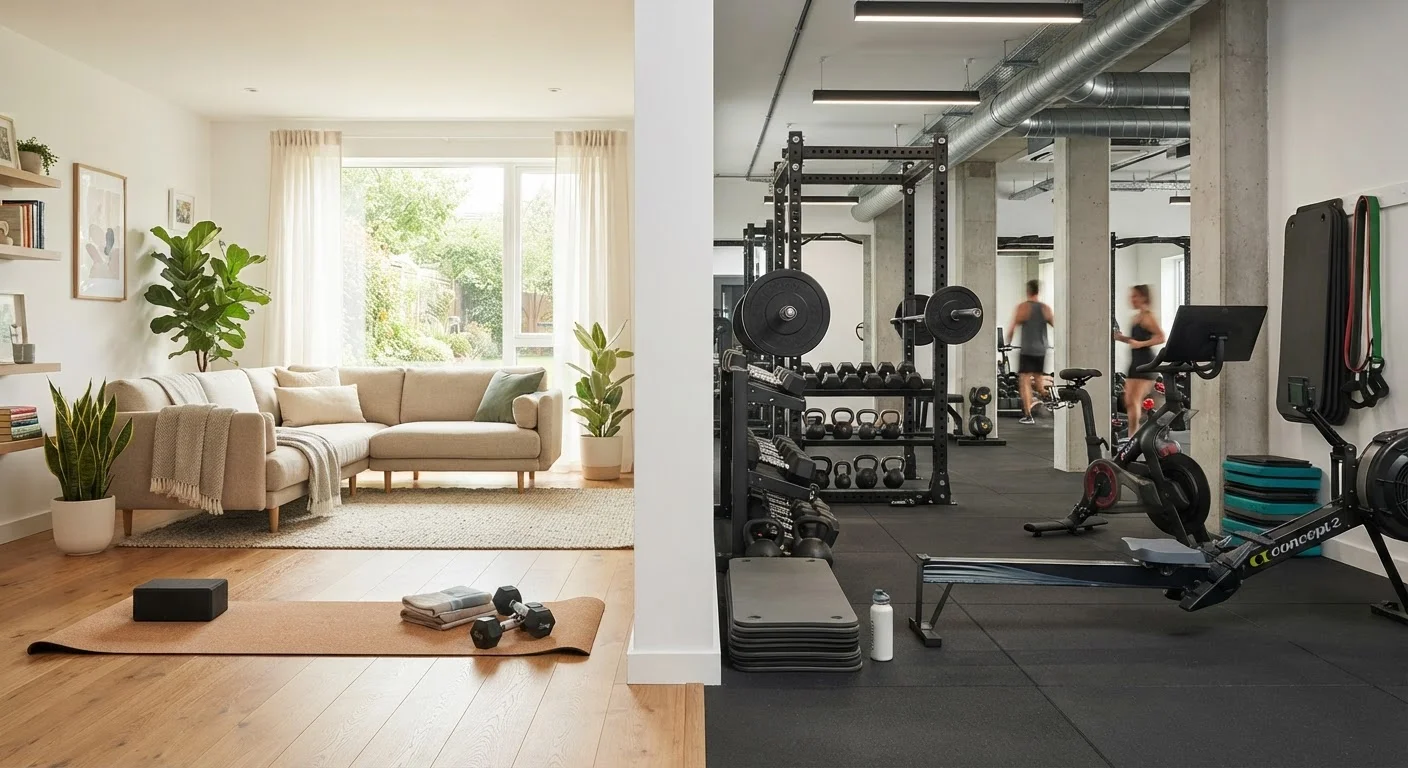
Our Verdict
Home workouts and gym training are both legitimate paths to fitness - the gap between them is smaller than the fitness industry often suggests. For most people, the deciding factors are personal: how much friction you can tolerate, what motivates you to stay consistent, and what your specific training goals require.
| Best for | Recommended |
|---|---|
| Those with limited time, budget, or reliable transportation | Home Workouts |
| Anyone pursuing serious strength, power, or sport-specific conditioning | Gym Training |
| Beginners building foundational movement habits | Home Workouts |
| People who train better with social accountability or professional coaching | Gym Training |
The Core Trade-Off: Convenience vs. Capability
The home-vs-gym debate often gets framed as a cost question, but the more meaningful tension is between convenience and capability. Home training removes almost every logistical barrier - no commute, no membership fee, no waiting for equipment. Gym training, in return, gives you access to tools and environments that meaningfully expand what you can do.
For general fitness - improved cardiovascular health, muscular endurance, flexibility - home workouts are fully sufficient. The wide range of bodyweight movements available requires no equipment at all and can challenge most fitness levels. The limitation appears when training goals grow more specific: building maximal strength, developing sport-specific power, or progressing systematically through heavy compound lifts all benefit from the load variety a gym provides.
Understanding key training concepts like progressive overload helps clarify this distinction - at home, incremental load increases require creativity or investment in adjustable equipment; at a gym, that infrastructure already exists.
What Home Training Does Well
Consistency is the single strongest predictor of fitness outcomes, and home workouts structurally support it. Removing the commute eliminates one of the most commonly cited reasons people skip sessions. Training can happen in fifteen minutes between other obligations, without planning ahead or packing a bag.
Cost is a genuine advantage. A modest investment in a few resistance bands or adjustable dumbbells can cover a wide spectrum of training needs. For people managing tight budgets, eliminating a monthly membership makes exercise financially sustainable long-term.
Privacy also matters for many people, particularly those who are newer to exercise and feel self-conscious in public settings. Training at home can reduce that psychological friction significantly, especially during the early months when movement habits are still forming.
Structure Matters More Than Location
Whether you train at home or at a gym, following a structured program produces better results than improvising session by session. Even a simple plan that gradually increases volume or intensity over weeks gives your body a clear adaptation signal. Written programs designed for your setting - bodyweight progressions for home, periodized lifting plans for the gym - are widely available and free to find.
The main challenge at home is engineering enough variety and load progression over time. Without planning, sessions can plateau. Pairing home workouts with a structured program - not just improvised movement - addresses this effectively.
What Gym Training Does Well
Gyms provide an environment optimized for training in ways that are simply hard to replicate at home. Access to barbells, cable machines, squat racks, and cardio equipment opens programming options that bodyweight or light resistance alone cannot match. If your goals include building significant muscle mass or improving strength relative to cardio capacity, a gym's equipment depth matters.
Social environment plays a meaningful role for many people. The presence of others training, access to personal trainers, and the sense of a dedicated fitness space can increase motivation and accountability. Research on exercise adherence consistently identifies social support as a meaningful factor - though whether that takes the form of a gym community or a home workout partner varies by individual.
Gyms also offer access to professional guidance. A certified trainer can assess movement quality, correct form, and help design programming in ways a fitness app or video program cannot fully replicate. For people managing injury history or navigating complex goals, that access has real value.
| Home Workouts | Gym Training | |
|---|---|---|
| Upfront Cost | Low to moderate (equipment optional) | Membership fee required |
| Convenience | High - no commute or schedule constraints | Moderate - travel and hours dependent |
| Equipment Variety | Limited without investment | Extensive - barbells, cables, cardio machines |
| Progressive Overload | Requires planning or equipment upgrades | Straightforward with available load options |
| Social Accountability | Low unless self-structured | Higher - community and trainer access |
| Privacy | Complete | Shared public space |
| Best For | Consistency-focused, budget-conscious | Strength goals, structured coaching |
Making the Right Call for Your Situation
The practical question isn't which setting is objectively better - it's which one you'll actually use. A gym membership you don't use costs money and delivers nothing. A home setup you ignore collects dust. Both are only as effective as your adherence to them.
Consider your friction points honestly. If driving to a gym after work reliably kills your motivation, home training removes that obstacle. If isolation at home leads you to cut sessions short, a gym environment may provide the external structure you need.
Budget matters but may be more nuanced than it appears. A home setup can scale in cost significantly once you move beyond bodyweight, and some gym memberships at public recreation centers or community facilities are quite affordable. The cost and space factors behind choosing a home gym versus a membership deserve careful thought before committing either way.
Finally, goals evolve. Many people start at home, build foundational habits, and later add a gym for expanded capability - or do the reverse after life circumstances change. There's no rule requiring a permanent choice.
This article is for general informational purposes only and is not a substitute for personalized advice from a qualified fitness or healthcare professional. Consult a professional before beginning any new exercise program, particularly if you have an existing health condition or injury history.
The content on this site is provided for informational purposes only and should not be considered a substitute for professional advice. While we strive to provide accurate and up-to-date information, we make no guarantees regarding its completeness or accuracy. Always consult a qualified professional for advice specific to your circumstances before making any decisions.