

Why Body Care Routines Fail (And How to Fix That)
Most body care routines fall apart not because of bad products, but because they're too complicated to sustain. When a routine feels like a chore, it gets skipped. The key is designing something simple enough to do consistently, even on busy days.
Think of your body care routine the same way you'd approach a simple skincare routine - start with the essentials, get those habits locked in, and build from there. For most people, that means three non-negotiables: cleansing, occasional exfoliation, and daily moisturizing.
Habit stacking is one of the most reliable ways to make new routines stick. Attach your body care steps to something you already do every day - like showering - and the routine becomes automatic rather than effortful. The steps below are built around that principle.
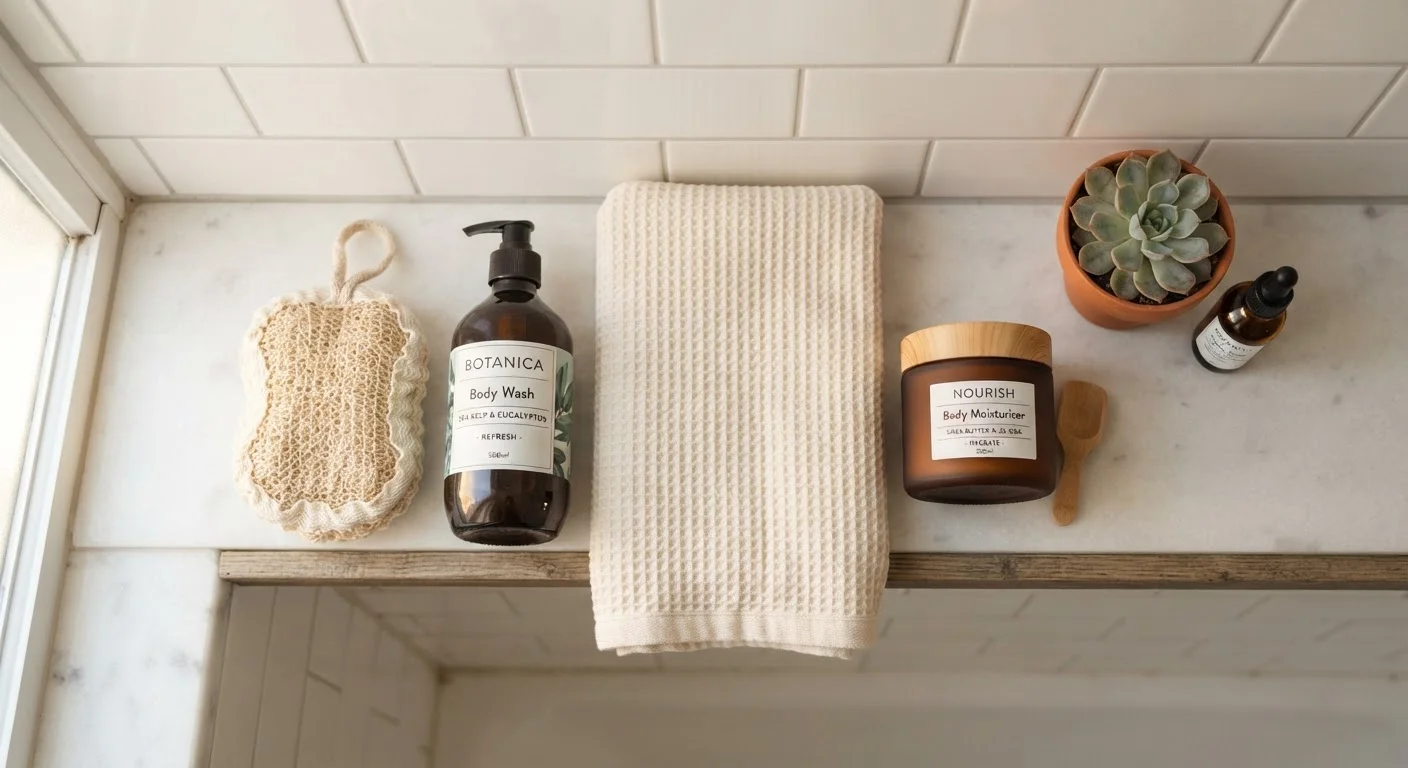
What you will need
Step-by-Step: Your Core Body Care Routine
The following steps form the foundation of an effective, low-maintenance body care routine. They're designed to work with your existing schedule without adding significant time.
Cleanse with intention
Use a gentle, pH-balanced body wash daily. Focus lather on areas that genuinely need it - underarms, feet, and the groin - rather than scrubbing every inch of your body, which can strip natural oils from drier areas like your arms and legs. Lukewarm water is easier on the skin barrier than hot water.
Exfoliate once or twice a week
Exfoliation removes the buildup of dead skin cells that can make skin look dull and prevent moisturizer from absorbing well. Use a physical scrub, a dry brush, or a chemical exfoliant - whichever feels comfortable for your skin. Limit this step to one or two times per week. More frequent exfoliation can compromise your skin's protective barrier, leading to irritation and sensitivity. For detailed guidance, see how much exfoliation is too much.
Moisturize immediately after showering
Pat your skin dry - don't rub - and apply moisturizer within two to three minutes of stepping out of the shower. At this point, your skin is still slightly damp, which helps the moisturizer seal in water rather than simply sitting on the surface. Work from your feet upward, giving extra attention to elbows, knees, and shins, which tend to lose moisture faster.
Address specific areas as needed
Hands and feet often need more attention than the rest of the body. Consider using a thicker cream on your feet at night and wearing cotton socks to help it absorb while you sleep. For the scalp and hair, those areas have their own distinct needs - scalp care habits worth adding weekly covers evidence-informed steps worth building in separately.
Pair your routine with a consistent wind-down habit
An evening body care routine pairs naturally with a broader wind-down schedule. Applying moisturizer as part of your nightly ritual - rather than as a standalone task - reinforces the habit and makes it feel purposeful rather than obligatory. If you're building other evening habits, a wind-down routine that supports sleep offers a practical framework to layer these habits together.
Consistency Beats Complexity
A three-step routine done every day will always outperform a ten-step routine done twice a week. When building habits, simplicity is a feature, not a shortcut. Start with the minimum effective routine and add steps only once the core habits feel automatic.
Adjusting Your Routine by Season
Your skin's needs shift with the weather. In winter, cold air and indoor heating reduce ambient humidity, which accelerates moisture loss - this is when heavier creams or body oils become more valuable than lighter lotions. If you're unsure which format suits your skin, comparing body oils and lotions can help you choose.
In summer, sweat and heat can make rich formulas feel uncomfortable. Lighter, water-based lotions tend to absorb faster and feel less heavy on the skin. Sun exposure also increases the importance of exfoliation - dead skin cells can interfere with how evenly self-tanner or sunscreen applies. For a full pre-season review, the pre-summer body care checklist walks through what to reassess before warmer months arrive.
Check in with your routine every time the season changes. Small adjustments - swapping a formula, adding an extra exfoliation session, or scaling back - keep your skin balanced year-round without overhauling everything from scratch.
This article is for general informational purposes only and does not constitute medical or dermatological advice. If you have a skin condition or persistent skin concerns, consult a qualified healthcare professional.
The content on this site is provided for informational purposes only and should not be considered a substitute for professional advice. While we strive to provide accurate and up-to-date information, we make no guarantees regarding its completeness or accuracy. Always consult a qualified professional for advice specific to your circumstances before making any decisions.