

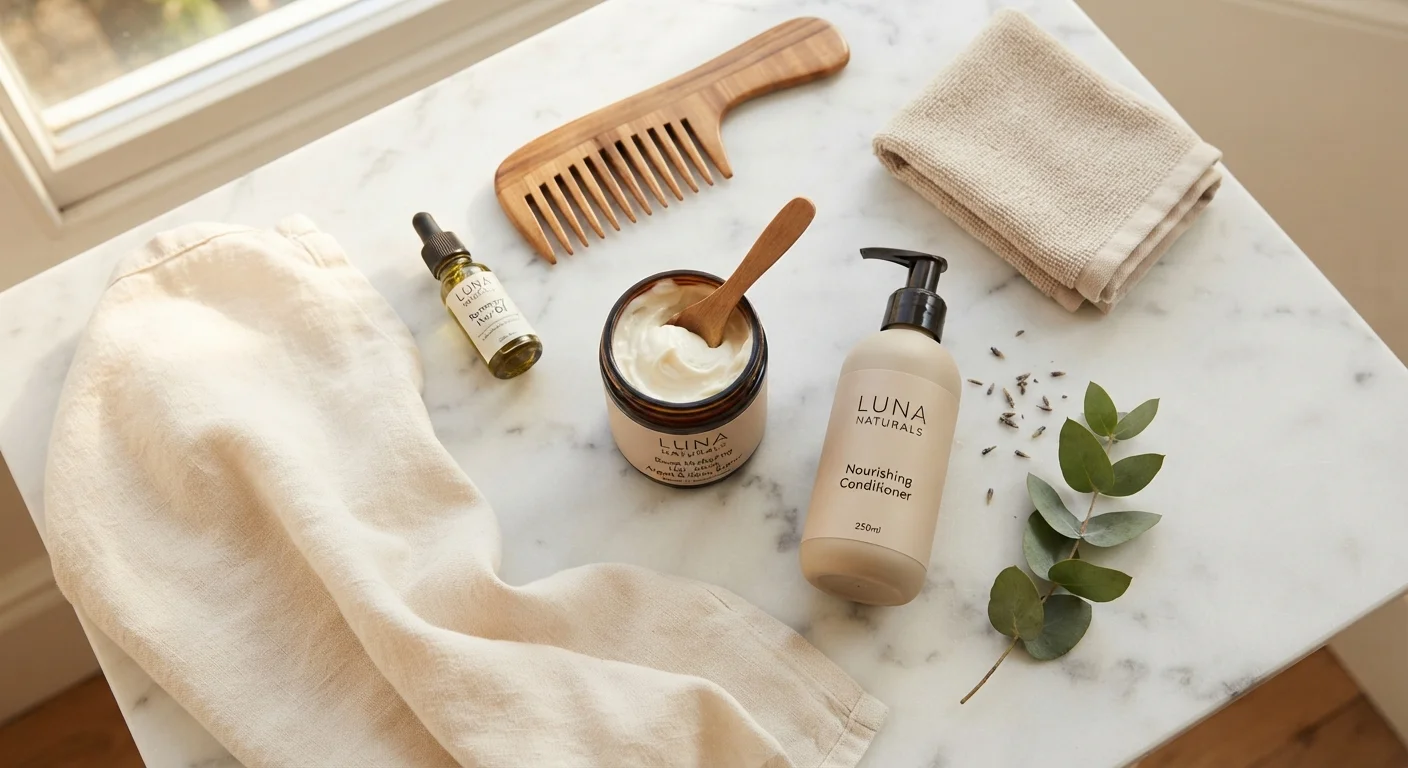
Option A
Conditioner
The everyday essential for smooth, manageable hair.
Best for: Daily or every-wash use to detangle, reduce frizz, and seal the cuticle after shampooing.
Option B
Hair Mask
The targeted weekly treatment for deeper repair.
Best for: Weekly or bi-weekly use to restore moisture, strength, or elasticity in damaged, dry, or chemically treated hair.
What Each Product Is Actually Designed to Do
Both conditioner and hair masks moisturize, but their formulations are built for different jobs. A standard rinse-out conditioner is designed for quick absorption - it coats the outer layer of each hair strand (the cuticle) to reduce friction, ease detangling, and add a temporary layer of smoothness. You apply it, wait one to three minutes, and rinse. That's the job it's built for.
A hair mask is a more concentrated formula. It typically contains higher amounts of emollients, proteins, or humectants - ingredients that work deeper into the hair shaft or that need extended contact time to be effective. Most masks sit on the hair for anywhere from five to thirty minutes, sometimes with heat to help the formula penetrate. To understand what those ingredients actually do, it helps to review common hair care ingredients and how they interact with your hair type.
| Criterion | Conditioner | Hair Mask |
|---|---|---|
| Primary purpose | Smooth cuticle, detangle | Deep repair or restoration |
| Leave-in time | 1-3 minutes | 5-30 minutes |
| Use frequency | Every wash | Once or twice a week |
| Formula concentration | Lighter, balanced | Richer, more concentrated |
| Best for | All hair types, daily manageability | Dry, damaged, or chemically treated hair |
| Penetration depth | Outer cuticle layer | Deeper into the hair shaft |
How Hair Type and Porosity Change the Equation
Not every hair type needs the same balance of these two products. Fine, straight hair that gets oily quickly may only need a lightweight conditioner on the ends, with a mask used sparingly - perhaps once a month. Thick, coarse, or highly textured hair often craves more moisture and may benefit from using a mask more regularly, potentially even in place of a rinse-out conditioner on wash days.
Porosity - how readily your hair absorbs and retains moisture - also plays a significant role. Low-porosity hair tends to resist product absorption, which means heavy masks can sit on the surface rather than penetrate. High-porosity hair absorbs quickly but loses moisture just as fast, making moisture-locking treatments especially useful. Understanding your hair's porosity is one of the most practical ways to decide which product to reach for and how often.
A Note on Protein vs. Moisture Masks
Hair masks generally fall into two categories: moisture-focused and protein-focused. Moisture masks use emollients and humectants to hydrate, while protein masks aim to temporarily strengthen the hair shaft. Using too many protein treatments too frequently can actually make hair feel stiff or brittle - a phenomenon sometimes called protein overload. If your hair feels hard or snaps easily after using a mask, it may signal you need more moisture, not more protein. Alternating between the two types, based on how your hair responds, is a sensible approach.
How to Use Both in a Realistic Weekly Routine
The most effective approach for most hair types is to treat these products as a team rather than alternatives. On every wash day, use a rinse-out conditioner after shampooing. Once or twice a week - or whenever your hair feels noticeably dry, brittle, or difficult to manage - swap that step for a mask instead.
Apply a mask on freshly washed, towel-blotted hair rather than dry hair, which can prevent even distribution. Focus application on the mid-lengths and ends, which are the oldest and usually most damaged portions of the hair. Avoid heavy application directly at the roots unless your scalp is extremely dry. Rinse thoroughly when time is up - residue from any conditioning product can lead to buildup over time.
If you're curious how similar decisions play out in body care, the comparison between body oils and lotions follows a similar logic: lighter formulas for daily use, richer treatments when skin needs deeper support.
This article is for general informational purposes only. If you have a scalp condition or significant hair loss concern, consult a dermatologist or licensed trichologist for personalized guidance.
The content on this site is provided for informational purposes only and should not be considered a substitute for professional advice. While we strive to provide accurate and up-to-date information, we make no guarantees regarding its completeness or accuracy. Always consult a qualified professional for advice specific to your circumstances before making any decisions.