

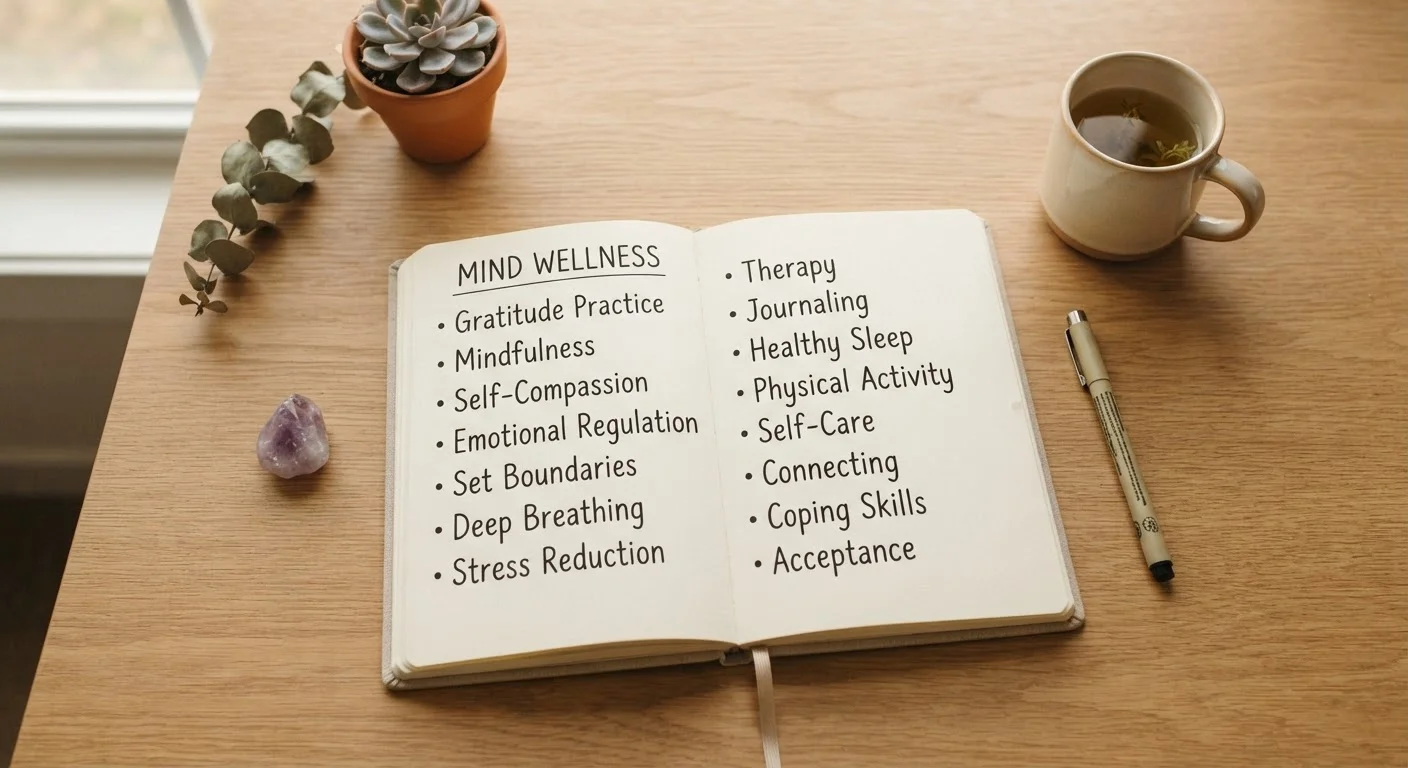
Why a Mental Health Vocabulary Matters
Mental health conversations are increasingly part of everyday life - in workplaces, schools, relationships, and media. But the language can feel unfamiliar or even intimidating, especially when terms like emotional dysregulation or somatic appear without explanation. Having a working vocabulary doesn't make you a clinician; it makes you a more informed participant in your own care.
This reference covers the terms you're most likely to encounter - in therapy, in articles, or in conversations with people you care about. Each definition is grounded in established clinical or research usage, and plain language replaces unnecessary jargon throughout.
If you're new to exploring this subject, this beginner's introduction to mental wellness is a useful companion read.
This Is General Information, Not Medical Advice
The definitions in this glossary are for educational purposes only. They are not intended to replace assessment, diagnosis, or guidance from a licensed mental health professional. If you have concerns about your mental health, please consult a qualified clinician.
Core Terms Defined
The glossary below covers twelve of the most commonly used concepts in mental health education and clinical practice. Whether you're encountering them in a therapist's office, a wellness article, or a conversation, these definitions offer a grounded starting point.
Many of these concepts overlap. For example, rumination can intensify cognitive distortions, and hypervigilance often involves difficulty with nervous system regulation. Understanding how these ideas connect - rather than treating each in isolation - tends to be the more useful approach.
For a practical way to apply some of these concepts to your own daily experience, see this mental health check-in guide. If you're curious how physical activity intersects with mood and cognition, this overview of exercise and mental health separates well-supported findings from emerging research.
Using This Vocabulary in Everyday Life
Knowing these terms is most useful when it helps you notice patterns in your own thinking or behavior - not as a way to self-diagnose. If you recognize something like rumination or emotional dysregulation in your own experience, that's valuable self-awareness. It is not a clinical assessment.
| Number of adults with a mental illness in the U.S. | Approximately 1 in 5 adults annually (National Institute of Mental Health (NIMH)) |
| Common setting where psychoeducation is delivered | Individual therapy, group therapy, and clinical programs |
| Cognitive distortions identified in CBT research | Over a dozen named patterns (Cognitive Behavioral Therapy literature) |
| Key predictor of therapy success | Quality of the therapeutic alliance (APA Division 29 Task Force on Empirically Supported Therapy Relationships) |
| Autonomic nervous system branches | Sympathetic (activating) and parasympathetic (calming) |
| Share of people with mental illness who don't receive treatment | More than half (NIMH, general estimates) |
Practices that support nervous system regulation - such as slow breathing, consistent sleep, and social connection - are broadly relevant regardless of whether a person has a diagnosed condition. Quiet daily habits can meaningfully support emotional balance over time without requiring major lifestyle changes. And if mindfulness or meditation come up in your reading, this side-by-side breakdown clarifies how those two practices differ in everyday application.
Finally, if you find yourself uncertain about what you're experiencing or want to explore any of these concepts more deeply, a licensed mental health professional - such as a psychologist, licensed counselor, or psychiatrist - is the right resource. No article can substitute for that relationship.
This article is for general informational and educational purposes only and is not a substitute for professional mental health assessment, diagnosis, or treatment. Please consult a qualified mental health professional for personal guidance.
The content on this site is provided for informational purposes only and should not be considered a substitute for professional advice. While we strive to provide accurate and up-to-date information, we make no guarantees regarding its completeness or accuracy. Always consult a qualified professional for advice specific to your circumstances before making any decisions.