

Why Calories Alone Don't Tell the Whole Story
For decades, public health messaging leaned heavily on calories: consume fewer, lose weight, feel better. But calorie counts alone tell you how much energy a food provides - not what that energy comes packaged with. A 200-calorie cola and a 200-calorie serving of cooked lentils both register the same on a calorie counter, yet deliver dramatically different nutritional experiences for your body.
This is where nutrient density becomes a more useful lens. Rather than asking only "how many calories does this food have?" it asks, "what does this food deliver per calorie?" That reframe matters because your body has daily requirements for dozens of nutrients - vitamins, minerals, essential amino acids, fiber, and more - regardless of how many or few calories you consume.
For a deeper look at how to decode the numbers on packaging, see what every section of a Nutrition Facts label actually means.
~60%
Of U.S. daily calories from ultra-processed foods
Research published in BMJ Open estimated that ultra-processed foods account for roughly 57-60% of daily caloric intake among American adults, foods that tend to score lower on nutrient density measures.
9 in 10
Americans fall short on vegetable intake
According to CDC data, approximately 90% of Americans do not meet federal dietary guidelines for vegetable consumption - one of the food groups most associated with high nutrient density.
3x+
More potassium in spinach vs. potato chips (per calorie)
Comparing the potassium content per 100 calories illustrates the nutrient-density gap between whole vegetables and common processed snack foods, highlighting why food quality matters beyond calorie totals.
What Makes a Food Nutrient-Dense?
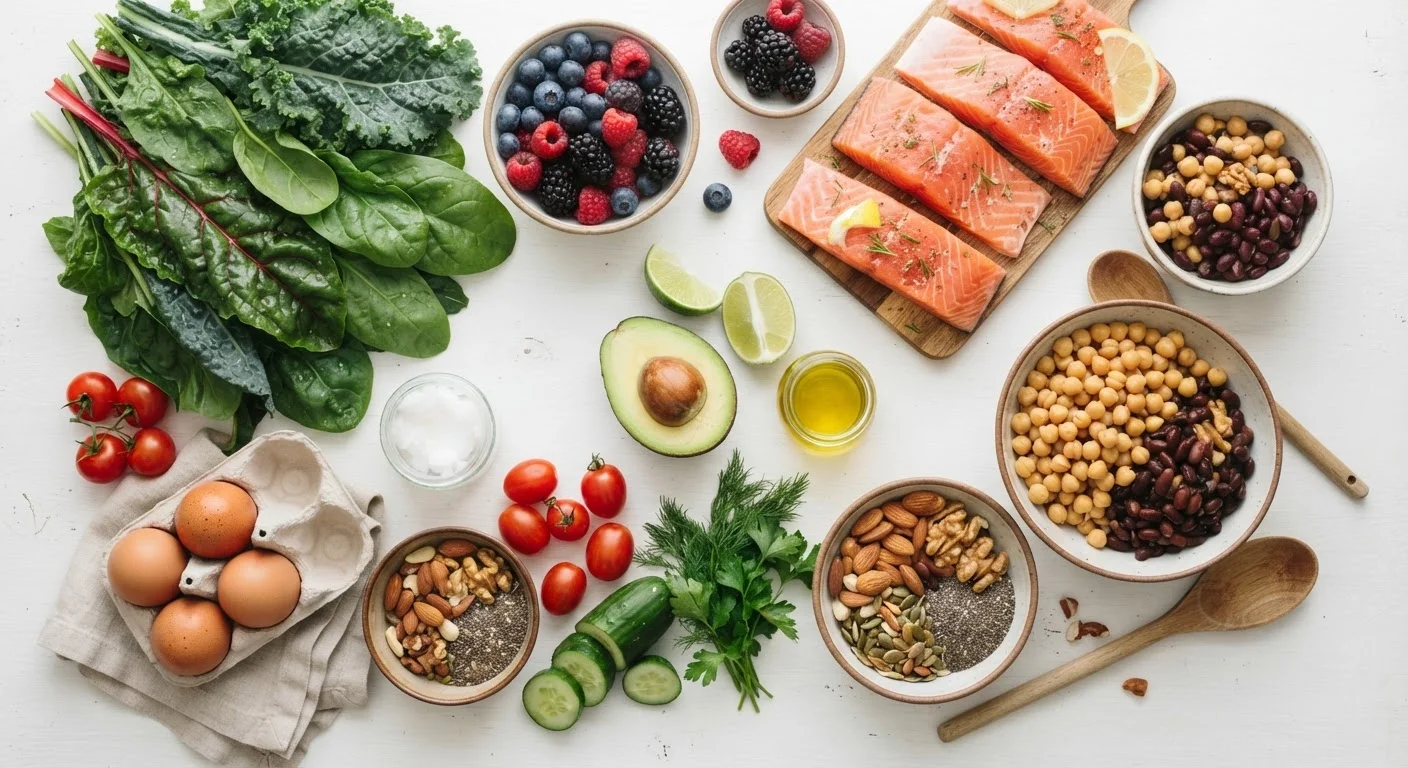
Nutrient-dense foods share a few common characteristics: they tend to be minimally processed, they contain meaningful amounts of at least several beneficial compounds, and they achieve this without an excessive calorie load. Dark leafy greens like spinach and kale, eggs, legumes, fatty fish, berries, and plain yogurt are frequently cited examples - not because they're superfoods in any magical sense, but because they pack a wide range of nutrients into a modest number of calories.
On the other end of the spectrum sit what nutrition researchers sometimes call "empty calorie" foods - items that provide substantial energy primarily through added sugars and refined starches, with minimal vitamins, minerals, or fiber. Sugary beverages, heavily processed snack foods, and many fast-food items fit this pattern. They're not inherently forbidden, but they offer little nutritional return per calorie compared to whole-food alternatives.
“The quality of calories matters enormously. Two diets with the same calorie count can have profoundly different effects on health depending on the nutrient composition of those calories.”
— Dariush Mozaffarian, Dean of the Friedman School of Nutrition Science and Policy, Tufts University
It's worth noting that nutrient density isn't binary. Many foods fall somewhere in the middle. Whole-grain bread, for instance, is more nutrient-dense than white bread but less so than most vegetables. The goal isn't to eliminate any category but to understand relative value.
Applying Nutrient Density to Everyday Eating
Thinking in terms of nutrient density doesn't require a scoring app or a nutrition degree. In practice, it looks like asking a simple question before meals or while grocery shopping: "Is this food doing meaningful work for my body, or mostly just adding calories?" That's it.
Some practical ways to apply the concept:
- Swap calorie-dense, low-nutrient items for whole-food alternatives. Replace a sweetened morning pastry with eggs and fruit. Swap white rice for a grain like farro or quinoa occasionally.
- Build meals around a nutrient-dense anchor. Starting a meal with a vegetable base, a lean protein, or legumes naturally crowds out lower-quality fillers.
- Be skeptical of fortified processed foods. Some packaged products are fortified with added vitamins to appear nutrient-dense, but the overall nutritional profile - including sodium, added sugars, and refined ingredients - may still be poor.
For those just getting started with nutrition fundamentals, this beginner's guide to nutrition provides a helpful broader foundation.
Nutrient density also interacts with other aspects of how we eat. Hydration, for example, plays a role in how efficiently the body absorbs and uses nutrients - explored further in how water fits into your daily diet.
This article is for general informational and educational purposes only and is not a substitute for professional medical or dietary advice. Consult a qualified healthcare provider or registered dietitian for guidance tailored to your individual health needs.
Frequently Asked Questions
Nutrient density refers to how much nourishment a food delivers for each calorie it contains. Foods that are high in vitamins, minerals, fiber, and other beneficial compounds relative to their calorie count are considered nutrient-dense. Think of it as getting the most nutritional return on your caloric investment.
No - they measure different things. Calorie counting tracks total energy intake, while nutrient density evaluates the quality of that energy. Two foods with identical calorie counts can have very different nutritional profiles. Using nutrient density alongside calorie awareness gives a fuller picture of what you're eating.
Dark leafy greens (like spinach and kale), organ meats, eggs, legumes, fatty fish, berries, and seeds consistently rank among the most nutrient-dense foods. They provide substantial amounts of vitamins, minerals, and other compounds per calorie compared to processed snacks or refined grains.
Yes, in some cases. Olive oil, for instance, provides beneficial fats but is calorie-dense with relatively few micronutrients. Dietary context matters - a food doesn't need top nutrient-density scores to have a place in a balanced eating pattern.
Start by identifying where your meals are calorie-heavy but nutrient-light - think sugary drinks, white bread, or packaged snacks - and look for whole-food alternatives. You don't need to overhaul everything at once; small swaps made consistently can meaningfully improve overall diet quality over time.
Yes. Whether someone follows a plant-based, omnivore, or any other dietary pattern, the principle of prioritizing nutrient-dense choices within that framework applies. Most well-researched eating patterns emphasize whole, minimally processed foods - a reliable proxy for higher nutrient density.
The content on this site is provided for informational purposes only and should not be considered a substitute for professional advice. While we strive to provide accurate and up-to-date information, we make no guarantees regarding its completeness or accuracy. Always consult a qualified professional for advice specific to your circumstances before making any decisions.