

Our Verdict
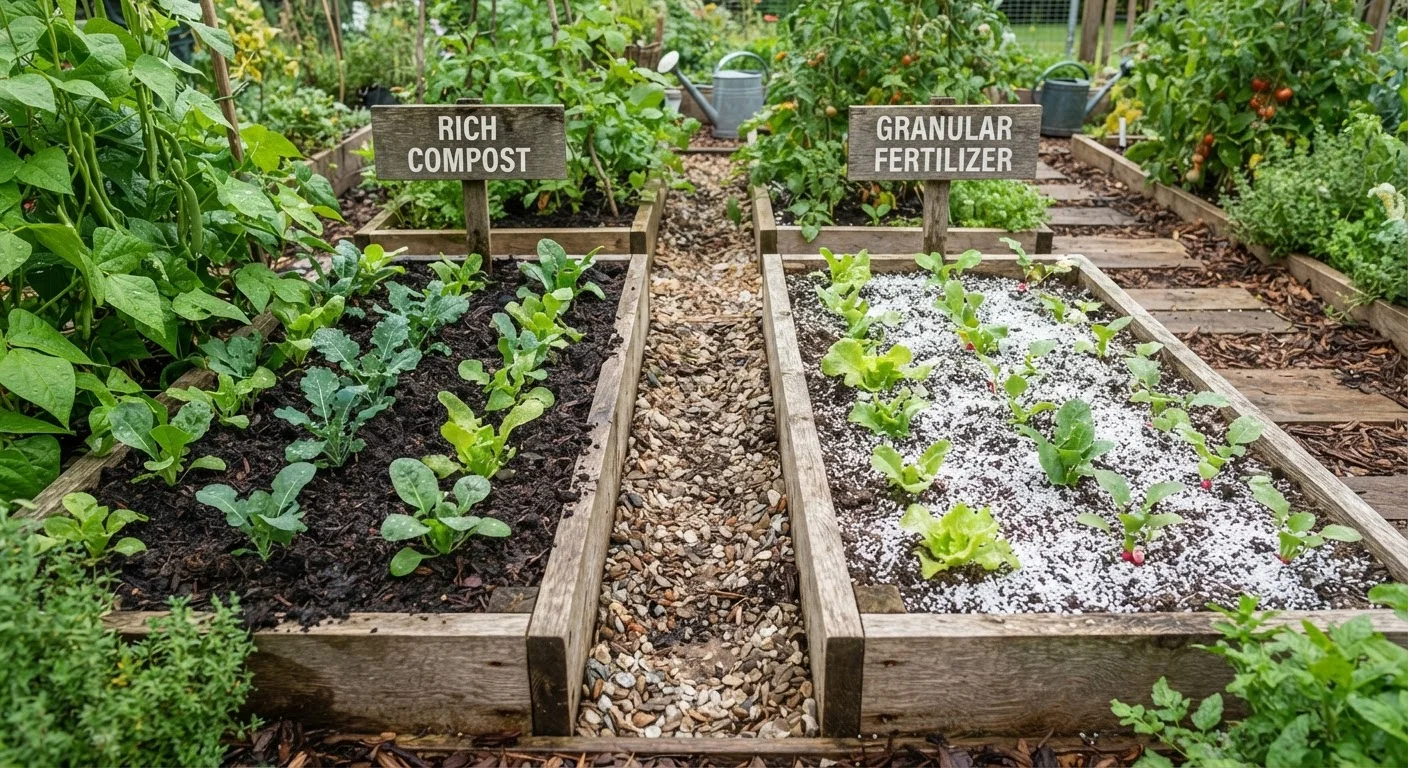
Organic fertilizers are the stronger long-term investment for soil health, while synthetic fertilizers offer precision and speed when plants need an immediate nutrient boost. Neither is inherently better - each serves a distinct purpose, and many gardeners find value in using both thoughtfully.
| Best for | Recommended |
|---|---|
| Gardeners focused on long-term soil health and sustainability | Organic fertilizer |
| Situations requiring fast, targeted nutrient correction | Synthetic fertilizer |
| Vegetable gardens where soil biology matters season after season | Organic fertilizer |
| New gardeners wanting predictable, measurable results quickly | Synthetic fertilizer |
How Each Type of Fertilizer Works in Soil
The most important difference between organic and synthetic fertilizers isn't the nutrients themselves - plants absorb nitrogen, phosphorus, and potassium the same way regardless of source. The difference lies in how and when those nutrients become available.
Organic fertilizers - derived from plant material, animal byproducts, or minerals - must be broken down by soil microorganisms before plants can use them. Compost, bone meal, fish emulsion, and worm castings all fall into this category. This microbial process takes time, which means nutrients release gradually over weeks or months. As a side effect, organic matter improves soil structure, water retention, and microbial diversity - benefits that compound over multiple growing seasons.
Synthetic fertilizers are manufactured to contain nutrients in forms plants can absorb almost immediately. A granular or liquid synthetic fertilizer skips the microbial middleman entirely. That speed is genuinely useful: if a plant shows signs of nitrogen deficiency mid-season, a synthetic fertilizer can address it quickly.
Understanding what your garden soil is already made of matters here. To learn more about how soil composition affects nutrient availability, see what garden soil is actually made of.
Comparing the Two Approaches Side by Side
Both fertilizer types have genuine strengths and real trade-offs. The table below outlines how they compare across the criteria most relevant to home gardeners.
| Organic Fertilizer | Synthetic Fertilizer | |
|---|---|---|
| Nutrient release speed | Slow; weeks to months | Fast; hours to days |
| Soil health impact | Improves structure and biology | Minimal long-term benefit |
| Nutrient precision | Variable, harder to control | Precise, consistent ratios |
| Risk of over-application | Lower; buffered by soil biology | Higher; can burn plants or leach |
| Cost per application | Often higher upfront | Generally lower upfront |
| Best use case | Long-term soil building | Fast nutrient correction |
One nuance worth noting: synthetic fertilizers can, over time, reduce soil microbial populations if organic matter isn't replenished alongside them. Conversely, organic fertilizers alone may not supply adequate nutrients fast enough for heavy-feeding crops during peak growth periods.
Start With a Soil Test Before Fertilizing
Before reaching for any fertilizer, consider having your soil tested. Many university cooperative extension programs offer low-cost testing that tells you your soil's existing nutrient levels and pH. This takes the guesswork out of choosing the right fertilizer type and application rate, and helps you avoid over-fertilizing - which can harm plants and pollute runoff water.
When to Use Each - and When to Combine Them
There's no rule that says you must pick one approach and stick to it. Many experienced gardeners use organic fertilizers as a foundation - building soil health over the long term - and reach for synthetics selectively when a specific deficiency needs fast correction.
Lean toward organic when:
- You're growing vegetables and want to build soil biology season over season
- You have sandy or depleted soil that needs structural improvement
- You're gardening with children or pets who spend time in planting areas
- Long-term sustainability is a priority for your yard
Lean toward synthetic when:
- A plant shows clear signs of nutrient deficiency mid-growing season
- You need precise control over nutrient ratios for specific crops
- You're working with a new planting bed and need quick establishment support
If you combine both, apply organic amendments in fall or early spring to build soil structure, and reserve synthetics for targeted, in-season corrections. Always follow label instructions - over-application of any fertilizer, synthetic or organic, can harm plants or leach into waterways.
~1%
Organic matter in average American topsoil
USDA soil health research indicates many cultivated soils have declined significantly in organic matter, underscoring the value of organic amendments for long-term fertility.
30-50%
Nitrogen potentially lost to leaching (synthetic)
Agricultural extension research has documented that a significant portion of synthetic nitrogen fertilizer can leach below the root zone before uptake, particularly in sandy soils or with excess irrigation.
Reading Fertilizer Labels Without the Confusion
All fertilizers - organic or synthetic - display an N-P-K ratio (nitrogen, phosphorus, potassium) on their packaging. A ratio of 10-10-10 means 10% of each nutrient by weight. Organic fertilizers typically show lower numbers (like 3-2-2) because much of their bulk is carbon-based organic matter rather than concentrated nutrients. That doesn't mean they're weaker over time - it reflects how nutrients are delivered.
When evaluating any fertilizer, consider:
- Nutrient content: Does the N-P-K ratio match what your soil or plant actually needs? A soil test gives you the clearest answer.
- Release rate: Does the label indicate slow-release, controlled-release, or quick-release? This determines how long one application lasts.
- Application method: Granular, liquid, and spike forms all have different coverage patterns and absorption speeds.
Getting a basic soil test through your local cooperative extension service before fertilizing is one of the most practical steps a home gardener can take - it removes guesswork and helps you avoid applying nutrients your soil already has in abundance.
The content on this site is provided for informational purposes only and should not be considered a substitute for professional advice. While we strive to provide accurate and up-to-date information, we make no guarantees regarding its completeness or accuracy. Always consult a qualified professional for advice specific to your circumstances before making any decisions.