

The Four Building Blocks of Soil
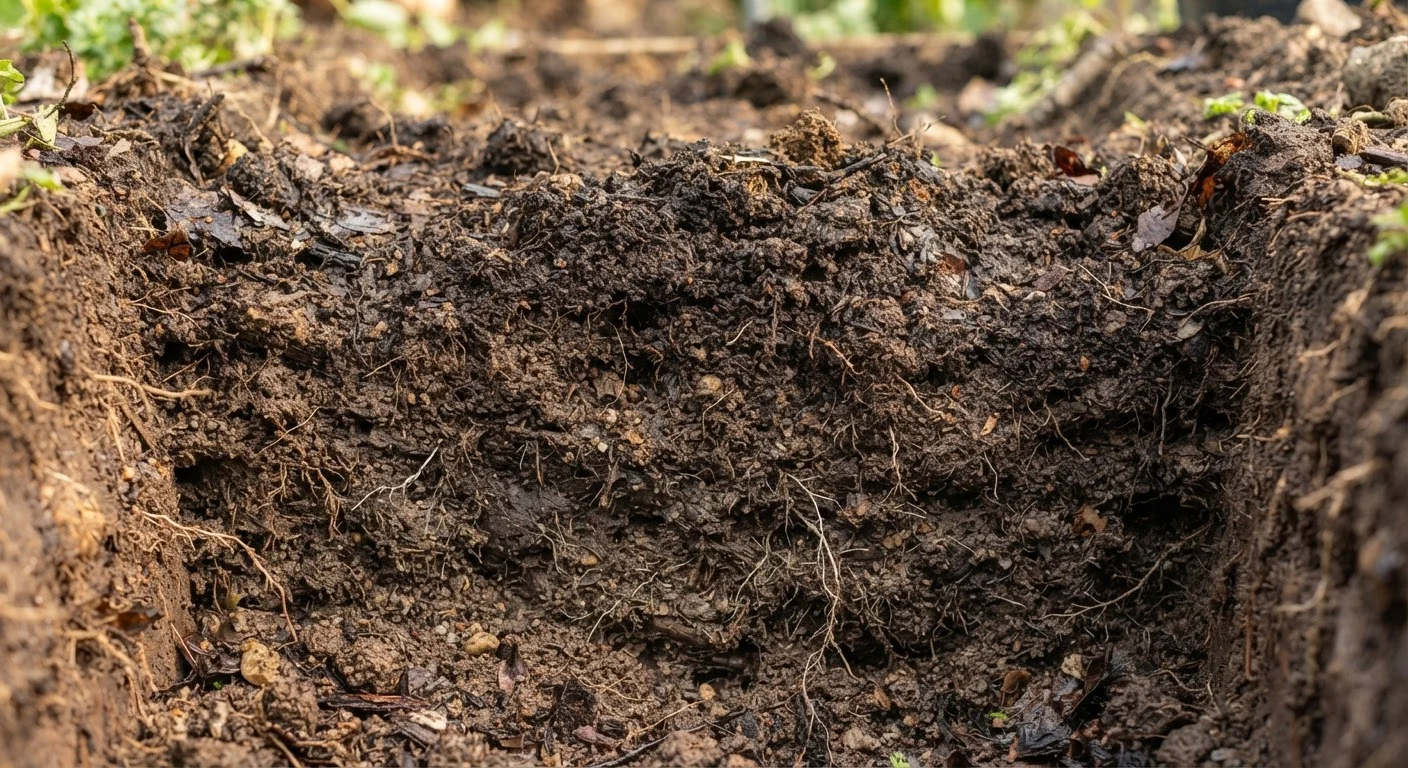
Dig into any productive garden bed and you're looking at four overlapping ingredients working together: mineral particles, organic matter, water, and air. Healthy soil is roughly 45% minerals, 5% organic matter, 25% water, and 25% air by volume - though these proportions shift constantly with weather, season, and management.
Mineral particles form the skeleton of soil. They come in three sizes: sand (the coarsest), silt (medium), and clay (the finest). Each behaves very differently, and their ratio largely determines how your soil acts. Sand drains quickly and doesn't compact easily, but it holds few nutrients and dries out fast. Silt has a silky texture when wet and offers better fertility than sand. Clay holds water and nutrients well but drains poorly and can become dense and sticky.
Organic matter - decomposed plant and animal material - ties everything together. Even in small quantities, it dramatically improves soil structure, supports microbial life, and acts as a slow-release nutrient reservoir. It also helps sandy soils retain moisture and helps clay soils drain more freely.
45%
Mineral content in healthy soil by volume
Soil scientists generally describe ideal garden soil as roughly 45% minerals, 25% water, 25% air, and 5% organic matter.
1 billion+
Bacteria per teaspoon of healthy soil
Research from USDA Agricultural Research Service estimates that a single teaspoon of healthy soil can contain over one billion bacterial cells.
6.0-7.0
Optimal pH range for most garden plants
Most vegetables and ornamentals perform best when soil pH falls within this slightly acidic to neutral range, according to cooperative extension guidelines.
Why Loam Is the Gold Standard
When gardeners talk about "good soil," they usually mean loam - a relatively even blend of sand, silt, and clay that balances drainage, moisture retention, and nutrient availability. Loam crumbles easily in your hand, doesn't stick together in a ball when wet, and bounces back after rain without crusting over.
Most native soils lean toward one extreme or another. Coastal or desert yards often have sandy soil; regions with heavy rainfall and older geology frequently have clay-heavy soils. Neither is a hopeless starting point - both can be improved steadily with organic amendments.
If you're starting your first garden and aren't sure what you're working with, the fundamentals every beginner should understand cover exactly how to evaluate your yard before planting. A quick jar test or a kit from your local cooperative extension service can reveal a lot about where you stand.
Test Before You Amend
Before adding lime, sulfur, or large quantities of compost, get a basic soil test. Most state cooperative extension services offer low-cost testing that measures pH, nitrogen, phosphorus, and potassium. Amending without testing is guesswork - and some changes, like raising or lowering pH, can take a full season to take effect.
Soil Structure, pH, and the Living Layer
Beyond texture, soil structure describes how individual particles clump together into aggregates. Good structure creates a network of pores that allow roots to penetrate, water to move, and air to circulate. Compaction - from heavy foot traffic, machinery, or repeated tilling - destroys this structure and makes growing far harder regardless of how rich the mineral content is.
Soil pH is another critical factor. It measures acidity or alkalinity on a 0-14 scale, with 7 being neutral. Most vegetables and flowers prefer a range of 6.0-7.0. Outside that range, essential nutrients like iron, phosphorus, and calcium can become chemically unavailable to plants even if they're physically present. A basic soil test - available through most county extension offices - measures both pH and key nutrient levels.
Then there's the living layer. Healthy soil hosts an enormous community of bacteria, fungi, earthworms, and other organisms that continuously break down organic matter and make nutrients accessible to roots. This biological activity is one reason that adding compost consistently outperforms simply dumping fertilizer on struggling plants. For a deeper look at how fertilizers interact with all of this, see how organic and synthetic fertilizers work differently in soil.
A homeowner in the Southeast finds their raised bed dries out within hours of watering, even in summer heat.
A gardener in the Midwest notices their vegetable bed floods after rain and the soil stays wet for days.
A suburban gardener's tomatoes show yellowing leaves despite regular fertilizing.
Improving What You Have
The encouraging truth is that soil composition isn't fixed. Consistent additions of compost, aged manure, or other organic matter improve almost every soil type over time. For compacted or clay-heavy soils, some gardeners find raised beds offer a practical workaround - you can read more about the real trade-offs between raised beds and in-ground plots before deciding which approach suits your yard.
Avoid common mistakes like over-tilling, which breaks down soil structure, or adding large amounts of raw wood chips directly to planting beds, which can temporarily tie up nitrogen as they decompose. For a reality check on popular gardening advice, common gardening myths that science doesn't support is worth a read before you start amending.
Understanding your soil's composition is the single most important step toward a productive garden. Once you know what you're working with, every other decision - what to plant, when to water, how to fertilize - becomes much easier to make well.
Frequently Asked Questions
Most vegetables thrive in loam soil - roughly 40% sand, 40% silt, and 20% clay - with 5-10% organic matter mixed in. This balance supports good drainage while retaining enough moisture and nutrients. If your native soil doesn't match this profile, amendments like compost can help bridge the gap.
A simple jar test works well: fill a clear jar with soil and water, shake it, and let it settle for 24-48 hours. Sand settles first, silt in the middle, and clay on top. You can also send a sample to your local cooperative extension service for a detailed lab analysis.
Yes - healthy garden soil teems with life. A single teaspoon can contain millions of bacteria, thousands of fungi, and dozens of nematodes. These organisms decompose organic matter, cycle nutrients, and support root health in ways that are essential to plant growth.
In most cases, yes. Adding compost, aged manure, or other organic matter over time significantly improves both sandy and clay soils. Repeated applications across multiple growing seasons yield the best results. Complete soil replacement is rarely necessary and is typically a last resort.
Soil pH measures how acidic or alkaline your soil is, which affects nutrient availability. Most garden plants prefer a slightly acidic to neutral pH of 6.0-7.0. Outside this range, nutrients can become chemically locked and unavailable even if they're present in the soil.
Surface crusting typically indicates high clay content or low organic matter. When clay-heavy soil dries, it shrinks and hardens. Adding organic matter like compost improves soil structure over time, reducing this tendency by increasing pore space and microbial activity.
The content on this site is provided for informational purposes only and should not be considered a substitute for professional advice. While we strive to provide accurate and up-to-date information, we make no guarantees regarding its completeness or accuracy. Always consult a qualified professional for advice specific to your circumstances before making any decisions.