

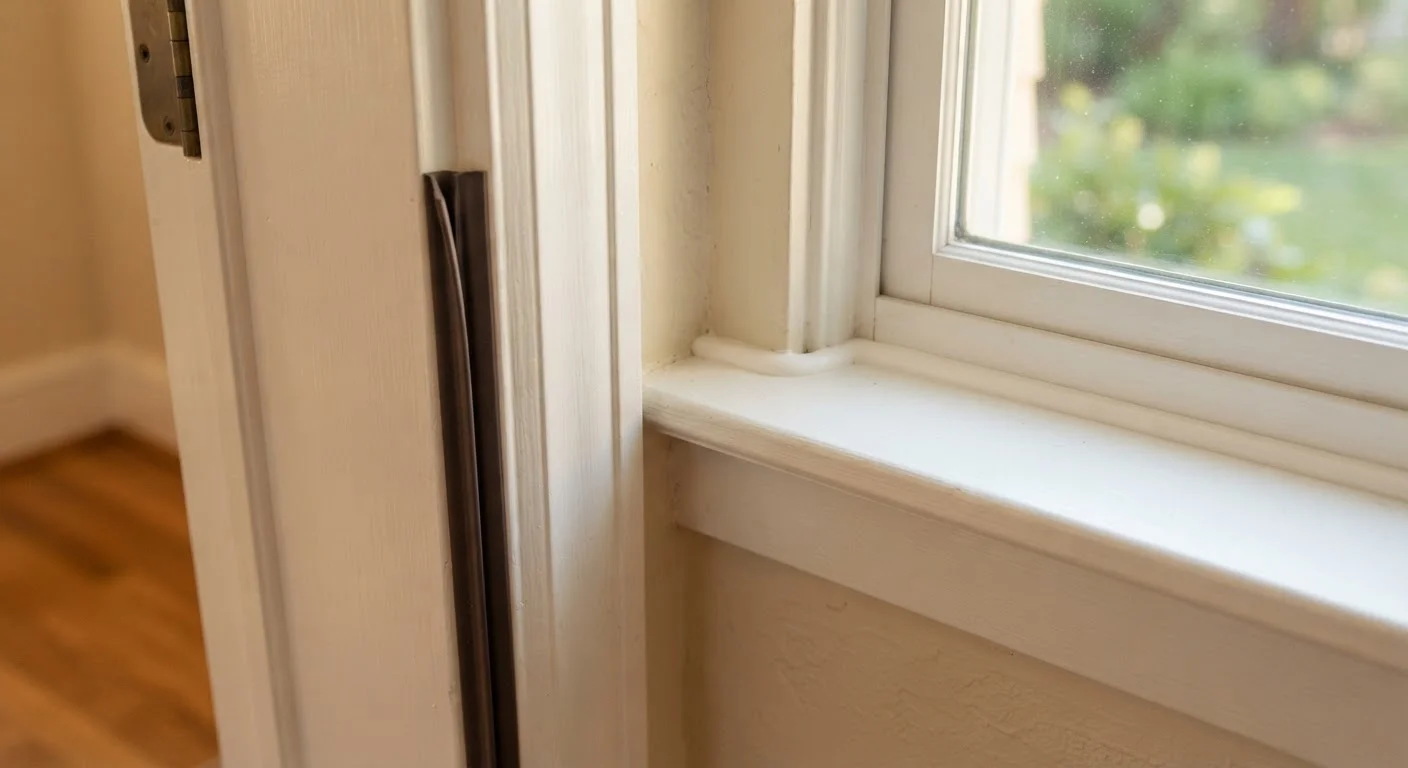
Option A
Caulk
The permanent, flexible sealant for stationary gaps.
Best for: Sealing fixed joints and cracks in surfaces that do not move, such as window frames, baseboards, and trim.
Option B
Weatherstripping
The compressible seal designed for moving parts.
Best for: Creating an air-tight seal around doors and operable windows that open, close, and flex with every use.
Why the Right Sealant Makes All the Difference
Air leaks and moisture intrusion are among the most common sources of energy waste and structural damage in American homes. Sealing those gaps is a smart, accessible DIY task - but only when you match the right material to the right location. Caulk and weatherstripping are both designed to block air and moisture, yet they work in fundamentally different ways. Using caulk where weatherstripping belongs, or vice versa, produces a seal that fails quickly and may be harder to remove and redo later.
The core distinction comes down to movement. Caulk is a pliable compound that bonds to two adjacent surfaces, cures in place, and creates a seal that is meant to stay put. Weatherstripping is a compressible material - foam, rubber, felt, or vinyl - that forms a seal through physical contact and pressure, accommodating repeated opening and closing. Think of caulk as a permanent adhesive gasket and weatherstripping as a reusable compression seal.
| Criterion | Caulk | Weatherstripping |
|---|---|---|
| Primary use | Stationary joints and cracks | Moving doors and windows |
| How it seals | Bonds and cures in place | Compresses under contact pressure |
| Typical lifespan | 5-10 years | 2-5 years (high-traffic) |
| Removal | Requires scraper and solvent | Usually peels or unscrews away |
| Best locations | Window frames, trim, penetrations | Door perimeters, thresholds, sashes |
| DIY difficulty | Low to moderate | Low |
| Paintable | Latex types yes; silicone no | Rarely; check product label |
Where Each Sealant Belongs
Use caulk wherever two fixed surfaces meet and you need a bonded, continuous seal:
- Window frames to exterior siding or interior drywall - these joints are stationary and exposed to rain and wind.
- Baseboards and door casing trim - small gaps where trim meets wall or floor allow drafts and look unfinished.
- Pipes, wires, and ducts penetrating walls or ceilings - fire-rated caulk is often required here; check local building codes.
- Bathtubs, showers, and sinks - a flexible, mildew-resistant caulk prevents water from sneaking behind tile and into the subfloor. For a deeper look at wet-area sealing, see our guide to grout, caulk, and tile.
Use weatherstripping wherever a moving part must close against a frame:
- Exterior door perimeters - foam tape, v-strip, or door-stop molding seal the top and sides.
- Door bottoms - door sweeps and threshold seals handle the gap at the floor.
- Operable windows - double-hung and casement windows benefit from compression seals along their sashes.
When Permits May Apply
Sealing around pipes or ducts that penetrate fire-rated walls and floors often requires fire-rated caulk and may be subject to local building codes or inspection requirements. If you are sealing penetrations as part of a larger renovation project, check with your local building department before proceeding to confirm what, if anything, needs to be permitted or inspected in your area.
Application Tips and Common Mistakes
Applying either product correctly starts with surface preparation. For caulk, clean the joint thoroughly - remove old caulk with a plastic scraper and solvent if needed, then let the surface dry completely. Apply caulk in a steady bead and smooth it with a dampened finger or caulking tool within a few minutes. Most latex-based caulks can be painted once cured; silicone caulks generally cannot.
For weatherstripping, measure the door or window perimeter before cutting strips to length. Self-adhesive foam compresses over time, so check annually and replace when it no longer springs back fully. V-strip (tension seal) weatherstripping is longer-lasting but requires careful installation in the door's stop channel. Never apply weatherstripping over old, flattened material - the door will not close properly and the seal will be uneven.
One of the most common mistakes homeowners make is caulking the hinge or latch side of an exterior door frame against the door itself. The door cannot open if those surfaces are bonded. Caulk belongs on the frame-to-wall joint only; the door-to-frame gap is always weatherstripping territory.
~30%
Home heating and cooling energy lost to air leaks
The U.S. Department of Energy estimates that air leakage accounts for roughly 30% of a home's heating and cooling energy use, making sealing a high-impact maintenance task.
$0.50-$25
Typical weatherstripping cost per door
Material cost varies widely by type - foam tape sits at the lower end while reinforced door sweeps and compression seals cost more, though all are generally within DIY budget range.
Seasonal Inspection and Maintenance
Both materials have a finite lifespan. Caulk typically lasts five to ten years depending on the formulation and exposure, while weatherstripping may need replacement every few years in high-traffic doorways. A quick seasonal inspection - ideally before winter and again in spring - can catch failures early.
To test your door seals, close the door on a sheet of paper. If you can pull it out without resistance, the weatherstripping has lost its compression. For windows, hold a lit incense stick near the frame on a windy day and watch for smoke disturbance - a simple indicator of air infiltration. If you find caulk that is cracked, shrinking, or pulling away from the surface, remove it completely before recaulking rather than layering new material over old.
Addressing both caulk and weatherstripping as part of routine maintenance keeps your home more comfortable year-round and reduces the workload your heating and cooling systems carry.
The content on this site is provided for informational purposes only and should not be considered a substitute for professional advice. While we strive to provide accurate and up-to-date information, we make no guarantees regarding its completeness or accuracy. Always consult a qualified professional for advice specific to your circumstances before making any decisions.