

Why the Crate Has a Bad Reputation
Many new dog owners feel immediate guilt at the idea of putting their dog in a crate. The image of confinement feels cruel - especially when a puppy cries the first night. But that guilt often leads to the very inconsistency that makes crate training harder and slower than it needs to be.
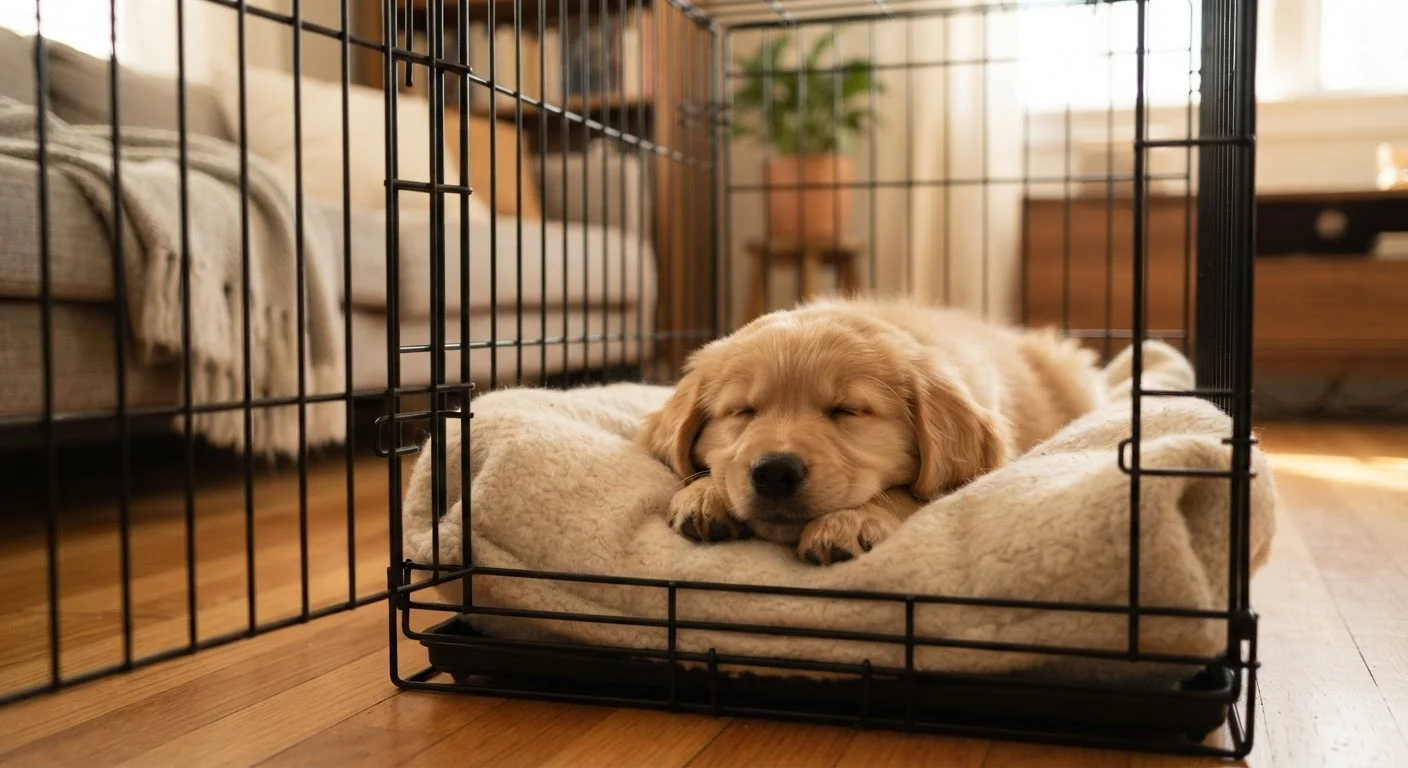
Dogs are den animals by nature. In the wild, canids rest in small, enclosed spaces that feel sheltered and secure. A properly introduced crate taps into that instinct rather than working against it. The problem isn't the crate itself - it's how quickly many owners rush the process, or how they use it after the fact.
If you're bringing a dog home for the first time, the first weeks of dog ownership involve more adjustment than most people anticipate. Crate training is one of the highest-leverage habits you can establish early - for housetraining, safety, and your dog's long-term sense of security.
The Crate Should Never Be a Punishment
One of the fastest ways to undermine crate training is sending your dog in when you're frustrated with them. The crate must remain a neutral-to-positive space at all times. If your dog associates it with being scolded, they will resist entering - and that resistance becomes very difficult to reverse.
What You'll Need Before You Start
Setting yourself up for success means having the right setup in place before your dog ever steps near the crate.
What you will need
Wire or plastic dog crate
Provides the safe, enclosed space central to crate training - wire offers better visibility and airflow, while plastic feels more den-like.
Soft crate liner or mat
Makes the crate comfortable and encourages the dog to associate it with rest and relaxation.
High-value training treats
Used to reward calm, voluntary engagement with the crate at every stage of introduction.
Food-stuffed chew toy or puzzle feeder
Gives the dog something rewarding to do inside the crate, building a positive association with time spent inside.
Crate divider panel
Reduces interior space for growing puppies so the crate doesn't feel too large during early housetraining.
Step-by-Step: Introducing the Crate Without Stress
The following steps work for puppies and adult dogs alike. Move at your dog's pace - if they show signs of stress at any stage, slow down rather than push through.
Place the crate and let curiosity do the work
Set the crate in a well-used room with the door open and leave it alone. Place a few treats just inside the entrance without any pressure on the dog to enter. Allow the dog to investigate at their own pace over several hours or even a full day. Do not push, coax, or lure the dog fully inside yet - the goal at this stage is simple: the crate becomes a normal, unfrightening object in the environment.
Reward any voluntary engagement
Once the dog is approaching the crate comfortably, begin marking and rewarding each closer interaction - sniffing the door, stepping one paw in, putting their head inside. Use a consistent marker (a clicker or a verbal "yes") the moment the behavior happens, then deliver the treat. Keep sessions short - two to three minutes - and end on a positive note before the dog loses interest.
Encourage full entry - still with the door open
Toss a treat to the back of the crate so the dog has to step fully inside to retrieve it. The moment all four paws are in, mark and praise. Let them exit freely. Repeat this multiple times across several short sessions. The door should remain open throughout this entire phase - the dog must always feel they can leave.
Close the door briefly - then immediately reopen it
Once your dog is stepping in voluntarily and appearing relaxed, gently close the door for two to three seconds while they eat a treat, then open it again before they show any concern. Gradually increase the closed duration over multiple sessions - aiming for 30 seconds, then a minute, then several minutes. Always open the door while the dog is calm, not in response to whining or pawing, which would reinforce those behaviors.
Build duration and begin short absences
Once the dog is settling calmly for several minutes with you present, practice stepping briefly out of the room while they rest in the closed crate. Return before any distress begins. Over days and weeks, gradually extend both the time and your physical distance. The goal is a dog that settles into a natural resting posture - lying down, sighing, or sleeping - rather than vigilantly watching the door.
Maintain the routine consistently
Once crate training is established, consistency keeps it intact. Use the crate regularly even when you don't strictly need to - for naps, downtime, or feeding puzzle toys. A crate that appears only when you're leaving soon becomes a predictor of isolation rather than a neutral resting place. Dogs thrive on predictable routines, and the crate should be part of a broader daily structure. See how to structure your puppy's early experiences for more on building healthy daily habits.
Know the Limits of Crate Confinement
A crate is a training tool, not a long-term housing solution. Dogs should not be crated for extended periods that exceed their physical or emotional capacity. Puppies under six months generally shouldn't be crated more than three to four hours at a stretch during the day. Adult dogs left crated for eight or more hours routinely is generally considered beyond humane limits by most veterinary and training organizations. If your schedule demands long absences, explore alternatives such as a dog walker, doggy daycare, or a safely gated room.
The Mistakes That Make Dogs Hate Their Crate
Even well-intentioned owners can accidentally poison the crate experience. The most common error is using the crate as a consequence - sending the dog in after a scolding or as a time-out. Dogs don't connect past behavior to current consequences the way humans do, and what gets conditioned instead is that the crate predicts something unpleasant.
Leaving a dog crated for too long is another frequent problem. A general guideline used by many trainers is that young puppies can hold their bladder roughly one hour per month of age, up to a maximum of around four to five hours during the day. Exceeding that creates a negative association with confinement that's difficult to reverse.
If your dog shows intense distress beyond normal adjustment whining - such as relentless panting, self-injury, or inability to settle even after gradual conditioning - that may point to something deeper. The signs of separation anxiety overlap with crate resistance, and distinguishing between the two matters for choosing the right approach.
Reward-based training underlies every step of crate work, but it's easy to apply it inconsistently. See where positive reinforcement commonly goes wrong to avoid timing and treat-dependency pitfalls that can slow your progress.
This article provides general educational information about dog training practices. It is not a substitute for guidance from a certified professional dog trainer or veterinary behaviorist, particularly for dogs showing signs of fear, aggression, or anxiety.
The content on this site is provided for informational purposes only and should not be considered a substitute for professional advice. While we strive to provide accurate and up-to-date information, we make no guarantees regarding its completeness or accuracy. Always consult a qualified professional for advice specific to your circumstances before making any decisions.