

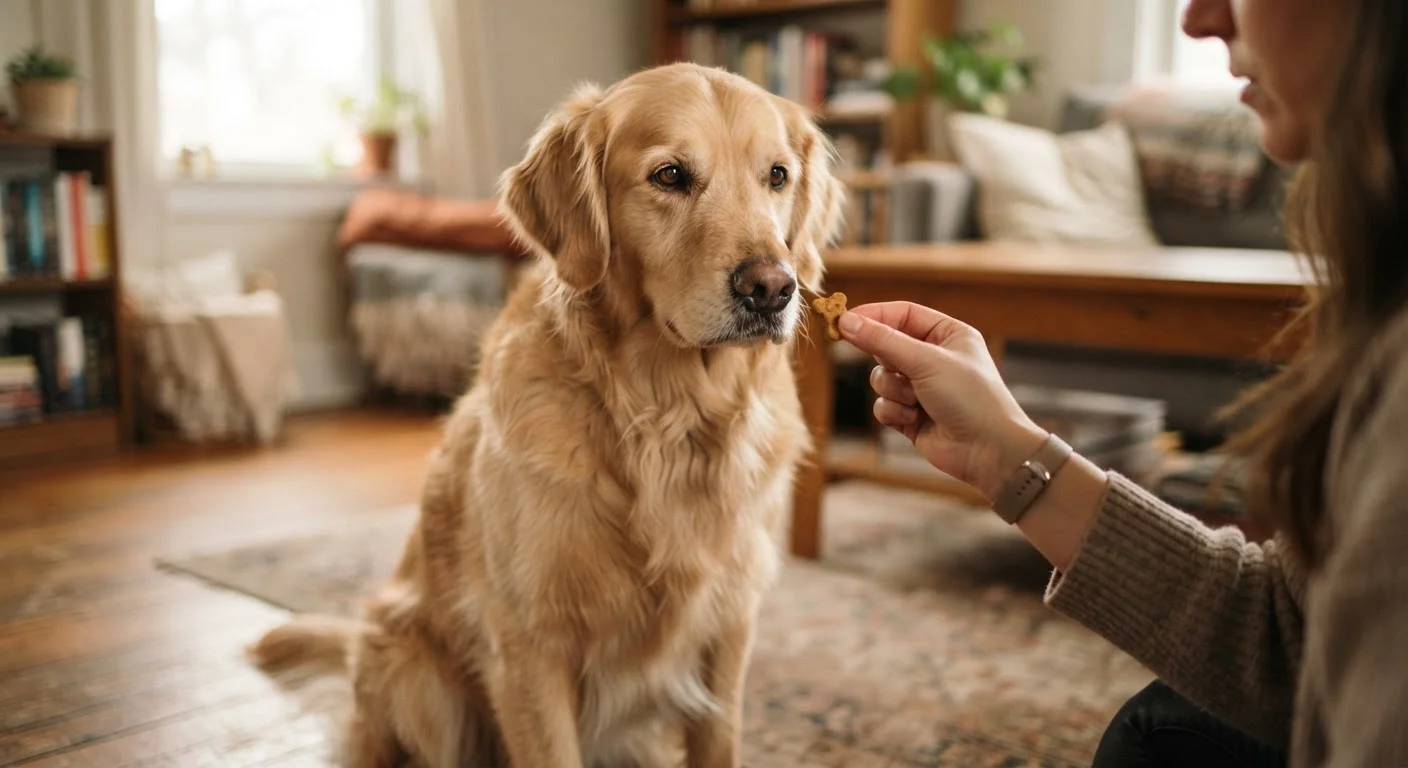
Why Positive Reinforcement Can Still Go Off Course
Reward-based training has strong scientific backing - it builds trust, encourages learning, and avoids the side effects associated with punishment-based methods. But the method being sound doesn't mean every application of it is. Many dog owners who commit fully to positive reinforcement still find their dogs ignoring cues, performing only when treats are visible, or regressing on skills they seemed to have mastered.
These outcomes aren't usually signs that the approach doesn't work. They're signs that one or more key elements - timing, consistency, reward scheduling, or environment - have slipped. Understanding where the breakdown happens is the first step to correcting it. For owners navigating the early stages of training, pairing these principles with solid foundational work like early socialization can make a meaningful difference in how quickly dogs generalize their skills.
Reward Timing Is Everything
Dogs associate rewards with whatever they are doing at the moment of delivery - not what they did three seconds earlier. A treat given even a few seconds late can accidentally reinforce an unrelated behavior, such as jumping up after a sit. If you struggle with timing, a clicker or verbal marker like 'yes' can bridge the gap precisely.
The Most Common Mistakes - and How to Fix Them
The errors below account for the majority of reward-training frustrations. Most are easy to correct once identified.
Delivering the treat too late after the behavior occurs.
Why it happens: Owners often fumble with treat pouches or pause to praise verbally first, adding a delay that breaks the association between behavior and reward.
Rewarding every repetition of a learned behavior indefinitely.
Why it happens: Owners worry that reducing treats will cause the dog to stop performing, so they maintain constant food delivery even for well-established commands.
Different household members applying different rules or cues for the same behavior.
Why it happens: Training is often left to one person, and expectations aren't clearly communicated to everyone who interacts with the dog.
Asking for a behavior the dog hasn't yet reliably learned in a distracting environment.
Why it happens: Owners assume a dog that sits reliably at home will do so in a busy park, not realizing that dogs learn in context and must be gradually proofed across locations.
Using food rewards to soothe a fearful dog during exposure to something frightening.
Why it happens: Owners instinctively offer treats when a dog seems anxious, intending to comfort them, but this can inadvertently reinforce the anxious response.
Don't Skip the Fade-Out Phase
Continuing to reward every single repetition of a learned behavior indefinitely can create a dog that only performs when food is visible. Most trainers recommend transitioning to a variable reinforcement schedule once a behavior is reliably established - this mirrors how lasting habits form and keeps motivation high. Skipping this phase is one of the most common reasons dogs ignore commands outside of training sessions.
Training challenges rarely mean starting over. In most cases, tightening just one or two of these variables produces noticeable improvement within days. If you're working through crate introduction alongside obedience training, crate training done right follows many of the same principles around gradual criteria-raising and consistent reinforcement.
Building Training That Holds Up Outside the Kitchen
The ultimate goal of reward-based training isn't a dog that performs for treats in the living room - it's a dog that responds reliably across real-life situations. That requires deliberately practicing in varied environments, with different people, and on a reinforcement schedule that doesn't keep the dog dependent on a visible food source.
~70%
Dog owners who report inconsistent rule enforcement
Survey data from applied animal behavior research consistently shows household inconsistency as among the most frequently reported training challenges.
1-2 sec
Optimal reward delivery window after behavior
Behavioral science research on operant conditioning indicates the association between action and consequence weakens rapidly beyond a one-to-two second window.
Think of treats as a teaching tool rather than a permanent payment system. As behaviors solidify, real-world rewards - a game of fetch, a chance to sniff, access to a favorite spot - can carry as much motivational weight as food. Dogs that learn to work for life rewards tend to be more resilient and responsive in unpredictable situations, which is the practical measure of a well-trained dog.
The content on this site is provided for informational purposes only and should not be considered a substitute for professional advice. While we strive to provide accurate and up-to-date information, we make no guarantees regarding its completeness or accuracy. Always consult a qualified professional for advice specific to your circumstances before making any decisions.