

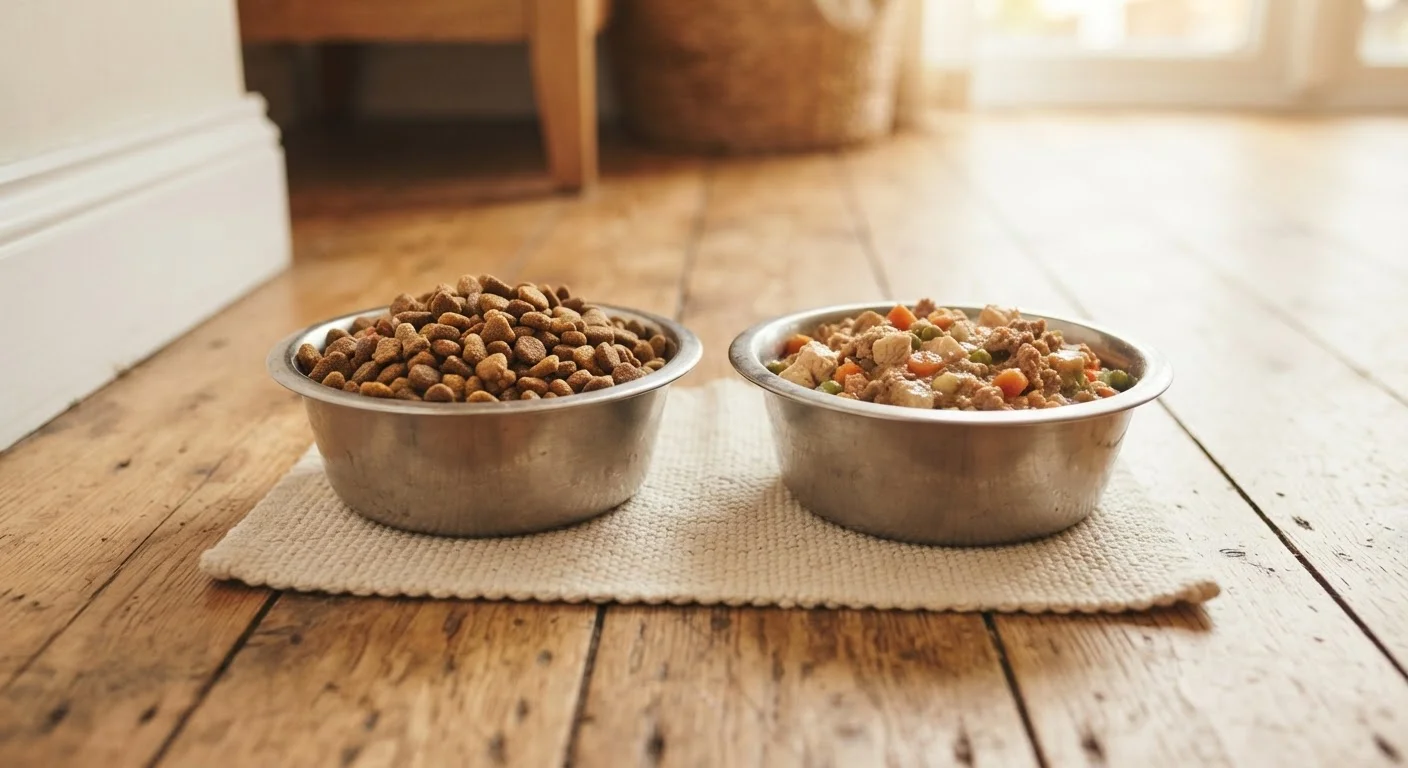
Option A
Dry Food (Kibble)
The convenient, budget-friendly staple of most dog diets.
Best for: Dogs whose owners prioritize dental support, long shelf life, and lower daily feeding costs.
Option B
Wet Food (Canned or Pouched)
The moisture-rich, palatable option for picky or health-challenged dogs.
Best for: Dogs needing extra hydration, senior dogs with dental issues, or picky eaters who won't touch kibble.
The Core Difference Between Kibble and Wet Food
At its most basic, the distinction between dry and wet dog food comes down to moisture content and manufacturing process. Kibble is typically cooked at high temperatures, shaped into pellets, and dried to a moisture level of around 10%. Wet food - whether canned or pouched - is processed at lower temperatures and retains 70-80% moisture. Both formats can be nutritionally complete, but the difference in water content has meaningful downstream effects on digestion, hydration, and palatability.
It's worth noting that "complete and balanced" labeling - regulated in the US by the Association of American Feed Control Officials (AAFCO) - applies to both formats. That means the format alone doesn't determine quality; the ingredient composition and manufacturing standards of the specific product matter just as much. For a broader look at how food costs fit into overall ownership expenses, see the hidden costs of dog ownership.
| Criterion | Dry Food (Kibble) | Wet Food |
|---|---|---|
| Moisture content | ~10% | ~70-80% |
| Cost per calorie | Lower | Higher (2-4x more) |
| Shelf life (opened) | Weeks in sealed container | 2-3 days refrigerated |
| Dental benefit | Modest plaque reduction | Minimal |
| Palatability for picky dogs | Moderate | Higher (stronger aroma) |
| Ease of portion control | Simple by weight/cup | Simple by can/portion size |
| Suitable for dogs with dental pain | Less ideal | Well suited |
| Supports urinary health | Only if dog drinks adequately | Yes, via higher moisture intake |
Nutrition, Hydration, and Dental Health: The Real Trade-offs
Hydration: Dogs on a dry-food-only diet consume considerably less water through meals than dogs eating wet food. While a healthy dog can compensate by drinking more, some don't - particularly dogs that are sedentary, older, or already prone to lower water intake. Chronic mild dehydration has been linked in veterinary literature to increased risk of urinary crystals and kidney stress, making wet food a practical tool for at-risk dogs.
Dental health: Kibble is often cited as better for teeth, and there's a kernel of truth here - the chewing action does scrape against enamel and can reduce plaque buildup. However, veterinary dental associations consistently note that dry food alone is not sufficient to maintain oral health. Regular tooth brushing remains the gold standard. If your dog's dental health is a concern, especially as they age, our guide on aging dogs and shifting health needs covers what to watch for after age seven.
Caloric density and weight management: Kibble is more calorie-dense by volume than wet food, which means portion control is easier to miscalculate. Wet food's high water content means dogs eat a larger apparent volume for fewer calories - useful for dogs prone to weight gain or those who act perpetually hungry.
70-80%
Moisture content in wet dog food
Compared to roughly 10% in dry kibble, this difference meaningfully affects daily fluid intake for dogs.
2-4x
Higher cost per calorie for wet food
Veterinary nutrition sources broadly confirm wet food is significantly more expensive per calorie than equivalent dry food.
~80%
Of dogs show signs of periodontal disease by age 3
According to the American Veterinary Dental College, periodontal disease is the most common clinical condition in adult dogs, underscoring that food format alone cannot address dental health.
Practical Considerations: Cost, Convenience, and Feeding Strategy
Wet food typically costs two to four times more per calorie than comparable-quality kibble. For a 70-pound dog, feeding wet food exclusively can add significantly to monthly expenses. Many owners opt for a mixed approach - kibble as the daily base with wet food added as a topper - to balance cost with the palatability and hydration benefits of wet food.
Storage is another practical factor. An open can of wet food must be refrigerated and used within two to three days, while kibble can sit in a sealed container for weeks. If you travel frequently with your dog or feed on an unpredictable schedule, kibble's shelf stability is a genuine advantage.
Dogs with specific health conditions - kidney disease, obesity, diabetes, or severe dental disease - may have medically informed reasons to lean one direction or the other. In those cases, a veterinarian's input should guide the decision, not general guidelines. The nutritional needs of dogs also shift meaningfully across life stages, which is worth considering alongside activity levels; our piece on exercise needs across dog breeds and life stages offers useful context on how physical demands change with age and breed.
This article is for general informational purposes only and does not constitute veterinary advice. Always consult a licensed veterinarian before making significant changes to your dog's diet or if your dog has any existing health conditions.
The content on this site is provided for informational purposes only and should not be considered a substitute for professional advice. While we strive to provide accurate and up-to-date information, we make no guarantees regarding its completeness or accuracy. Always consult a qualified professional for advice specific to your circumstances before making any decisions.