

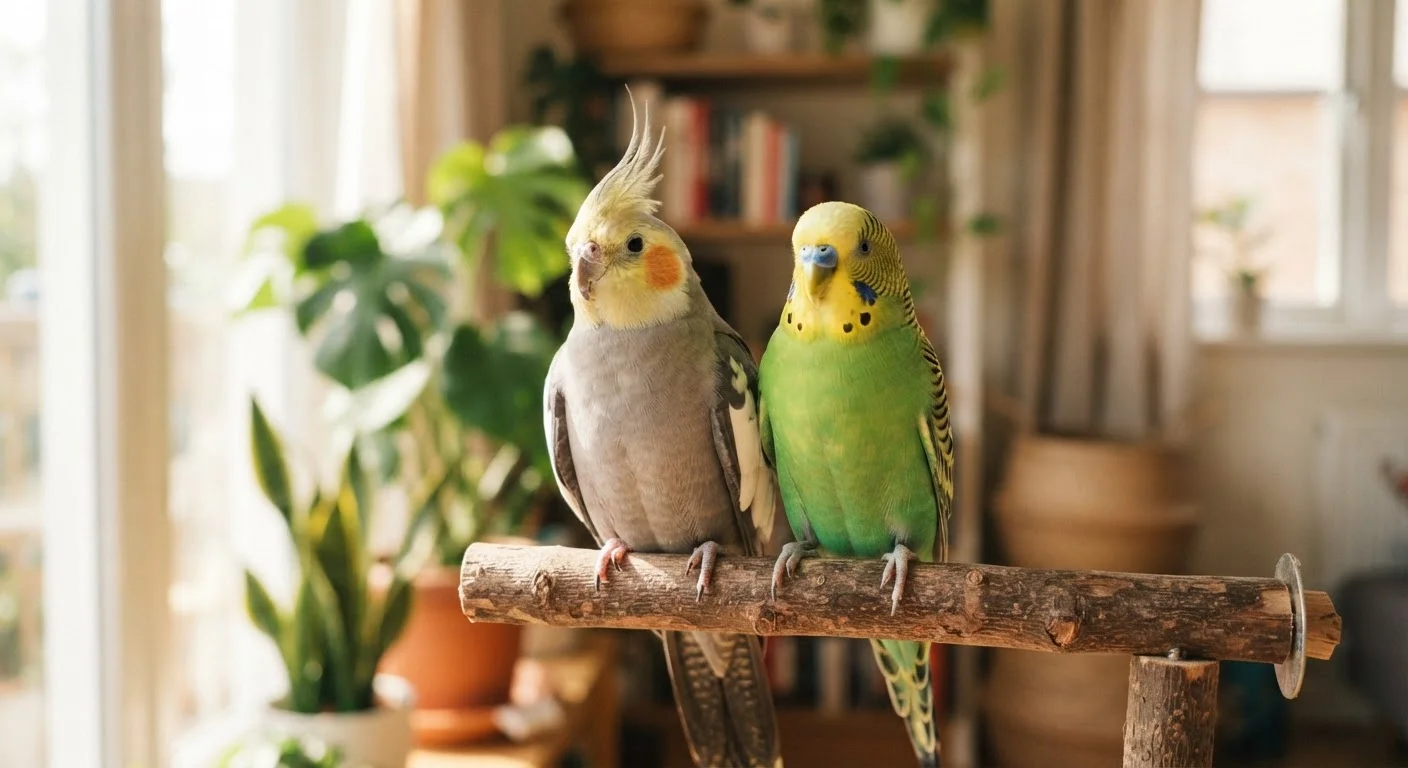
Option A
Parakeet (Budgerigar)
The compact, lively, and budget-friendly starter bird.
Best for: First-time bird owners or families in smaller spaces who want an active, social companion without overwhelming noise or care demands.
Option B
Cockatiel
The affectionate, interactive bird for hands-on bonding.
Best for: Owners who have time for daily one-on-one interaction and want a bird that can learn songs and form a close individual bond.
Size, Noise, and Day-to-Day Living
Parakeets - commonly called budgies, short for budgerigars - are small birds, typically weighing less than 1.5 ounces and measuring around 7 inches from beak to tail. Cockatiels are noticeably larger, averaging 3-4 ounces and 12-13 inches long. That size difference matters for cage requirements: cockatiels need substantially more horizontal flying space, which translates to a larger (and more expensive) enclosure.
In terms of noise, both species are vocal, but in different ways. Parakeets produce a near-constant stream of cheerful chattering that blends easily into background noise. Cockatiels can whistle loudly and persistently, especially at dawn and dusk - a behavior called contact calling - and males in particular are enthusiastic singers. Neither bird is silent, but apartment dwellers with thin walls may find cockatiel vocalizations more noticeable to neighbors.
Daily care routines are similar: fresh water, quality pellets supplemented with leafy greens, and cage cleaning are non-negotiable for both. Cockatiels produce significantly more feather dust (a fine powder from their down feathers), which can settle on surfaces and trigger sensitivities in some people. If anyone in your household has respiratory concerns, discuss this with a healthcare provider before adopting either species.
| Criterion | Parakeet | Cockatiel |
|---|---|---|
| Average adult size | ~7 inches, under 1.5 oz | ~12 inches, 3-4 oz |
| Typical lifespan | 7-12 years | 15-20 years |
| Noise level | Moderate chatter | Louder whistling/singing |
| Feather dust production | Low to moderate | High |
| Social preference | Flock-oriented; pairs well | Deep one-on-one bonds |
| Ease of taming | Moderate | Generally easier |
| Cage space needed | Smaller footprint | Larger enclosure required |
| Handling tolerance | Can be skittish early on | Typically enjoys close contact |
Social Needs, Bonding, and Handling
One of the most meaningful differences between these two birds is how they prefer to socialize. Parakeets are flock animals by nature. A single parakeet without consistent human interaction can become lonely and withdrawn, but they adapt well to a companion bird of the same species. Two parakeets housed together will entertain each other, which is ideal for owners who work long hours.
Cockatiels also need social connection, but they tend to focus their attachment more intensely on a specific person. A hand-raised cockatiel will often seek out its favorite human for head scratches, shoulder rides, and close proximity. This depth of bonding is rewarding but comes with a responsibility: a cockatiel left alone without sufficient daily interaction can develop stress behaviors such as feather plucking.
Learning to read your bird's signals matters enormously for both species. Understanding your bird's body language - from pinned pupils to raised crests on a cockatiel or puffed feathers on a parakeet - helps you gauge mood, catch early signs of illness, and build trust during handling sessions.
Cockatiels generally tame more readily and tolerate handling with patience-based training. Parakeets can absolutely be trained to step up and interact calmly, but they tend to be quicker and more skittish early in the taming process.
Lifespan, Health, and Long-Term Commitment
Lifespan is a dimension that many first-time bird owners underestimate. Parakeets in good health typically live 7-12 years, while cockatiels commonly reach 15-20 years with proper care - and some live even longer. Choosing a cockatiel is a commitment comparable in length to adopting a dog.
15-20 years
Cockatiel average captive lifespan
Avian veterinary references consistently cite this range for well-cared-for cockatiels, making them one of the longer-lived small pet birds.
7-12 years
Parakeet average captive lifespan
With proper diet and veterinary care, many parakeets reach the higher end of this range, though genetics and husbandry play significant roles.
~600
Parakeet vocalizations per day (estimated)
Behavioral studies on budgerigars suggest they are among the most vocally active small birds, producing a near-continuous stream of chirps and chatter.
Both species are susceptible to certain illnesses. Parakeets can develop tumors (particularly of the kidney and gonad) at higher rates than many other small birds. Cockatiels are prone to respiratory infections and nutritional deficiencies if fed a seed-only diet. A pelleted diet supplemented with fresh vegetables is now widely recommended by avian veterinarians for both species - seeds alone are considered nutritionally incomplete.
Annual wellness exams with an avian-certified veterinarian are advisable for both birds. Avian vets are not universally available in all areas, so it's worth researching local options before you bring a bird home. Emergency avian care can be costly, so factoring potential veterinary expenses into your budget is a realistic part of responsible ownership.
Finding an Avian Veterinarian
Not every general practice veterinarian has specialized training in bird care. The Association of Avian Veterinarians (AAV) maintains a directory to help owners locate qualified practitioners in their area. Establishing care with an avian vet before a health issue arises - rather than scrambling in an emergency - is strongly recommended for both parakeet and cockatiel owners.
The content on this site is provided for informational purposes only and should not be considered a substitute for professional advice. While we strive to provide accurate and up-to-date information, we make no guarantees regarding its completeness or accuracy. Always consult a qualified professional for advice specific to your circumstances before making any decisions.