

Our Verdict
No single housing style is universally right for every rabbit or every home. A well-sized pen offers the best balance of safety and space for most owners, while free-roam living suits confident, litter-trained rabbits in thoroughly rabbit-proofed homes. Traditional cages work only as a supplement - not a permanent, all-day solution.
| Best for | Recommended |
|---|---|
| New rabbit owners still learning their pet's behavior | Exercise pen |
| Experienced owners with rabbit-proofed, open living spaces | Free-roam |
| Temporary containment during travel or veterinary recovery | Cage (as supplement only) |
| Owners of multiple rabbits needing manageable boundaries | Exercise pen |
Why Housing Choice Matters More Than You Might Think
Rabbits are active, intelligent animals that need room to run, binky (leap and twist mid-air), dig, and stretch fully in multiple directions. In the wild, a rabbit may cover a territory of several acres. While domestic rabbits obviously require far less space than that, their core behavioral needs don't disappear just because they live indoors.
Confining a rabbit to an undersized enclosure for most of the day is a well-documented source of stress and can contribute to obesity, stereotypic (repetitive, purposeless) behaviors, and musculoskeletal problems. The house rabbit community, along with many rabbit-savvy veterinarians, generally recommends a minimum of 12 square feet of living space - with attached daily exercise space bringing the total to at least 32 square feet. Many rabbits benefit from even more.
For the full picture of day-to-day rabbit care, see our complete rabbit care guide. Below, we break down the three most common housing approaches and what each realistically involves.
Traditional Cage: Familiar but Frequently Limiting
The classic wire or plastic cage - the type sold at most pet stores - is often the first thing new rabbit owners picture. Unfortunately, the majority of commercially available rabbit cages fall well below the space recommendations issued by rabbit welfare organizations. A cage marketed for a medium-sized rabbit may measure only 4 to 6 square feet of floor space, which is insufficient for anything beyond brief, temporary use.
When a cage can make sense:
- As a safe base or "home base" within a larger pen or free-roam setup
- During post-surgical recovery when restricted movement is prescribed by a vet
- For short-term containment during transport or home hazards (e.g., active construction)
Key drawbacks:
- Most commercial sizes are too small for full-time housing
- Wire flooring can cause sore hocks (pressure sores on the feet) without solid resting areas
- Rabbits left in cages for extended periods frequently develop behavioral problems
Don't Rely on Cage Size Claims on Packaging
Pet store packaging frequently overstates which rabbit size a cage suits. A cage labeled for a "large rabbit" may still fall short of minimum welfare space standards. Always measure the actual floor dimensions and compare against the 12 square foot baseline before purchasing. When in doubt, err toward more space.
If a cage is part of your setup, it should function as a retreat or sleeping area - not the primary living space. Rabbits require daily out-of-cage exercise time regardless of enclosure size.
Exercise Pen: Flexible, Scalable, and Owner-Friendly
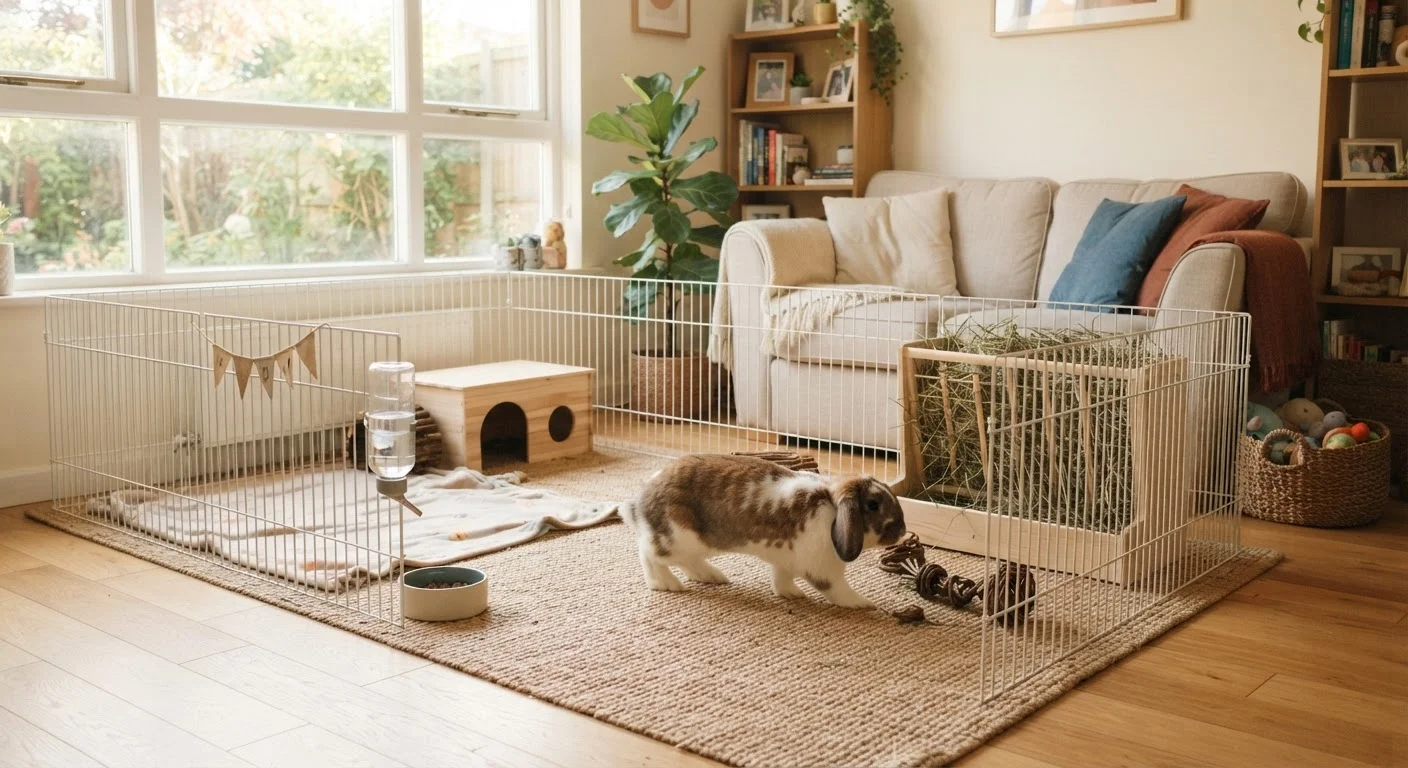
A modular exercise pen (also called an x-pen) has become the preferred baseline setup for many rabbit owners. These wire panels - typically 24 to 36 inches tall - can be configured in different shapes and expanded over time as your rabbit's needs or your available space changes.
A standard 8-panel x-pen configured as an octagon offers roughly 16 to 24 square feet of floor space depending on panel length, and panels can be linked together for larger areas. Enclosures can be left open-topped for rabbits that don't jump excessively, or covered with a mesh lid for escape artists.
Advantages of the pen approach:
- Easily expandable and reconfigurable without major home renovation
- Can be moved or disassembled for cleaning
- Gives owners control over which areas the rabbit accesses
- A good intermediate step before committing to full free-roam
Things to plan for:
- Tall or determined rabbits may climb or jump pen walls
- Flooring protection (rugs, mats, or foam tiles) is usually necessary on hard floors
- The pen area still needs rabbit-proofing within its perimeter
Starting with a Pen Before Going Free-Roam
Many owners find it helpful to begin with a well-sized exercise pen and gradually expand the rabbit's territory as trust and litter habits are established. This lets you identify how your rabbit behaves in different areas before committing to fully open access. Rabbits often settle into free-roam more smoothly when the transition is gradual rather than immediate.
If you have other pets at home, a pen also provides a clear physical boundary that helps manage initial introductions. See our guide on introducing small pets to homes with cats or dogs for structured steps on managing multi-species households.
Free-Roam Living: Maximum Freedom, Maximum Responsibility
Free-roam, also called free-range, means the rabbit has access to one or more rooms - or even the entire home - much like a cat or dog. This approach most closely matches what rabbit welfare advocates describe as ideal, and free-roam rabbits often display a broader behavioral repertoire and stronger bonds with their owners.
However, free-roam requires serious, room-by-room rabbit-proofing before it's safe. Rabbits chew constantly and indiscriminately. Electrical cords are a life-threatening hazard. Toxic houseplants, small gaps behind appliances, open staircases, and accessible household chemicals all become risks when a rabbit has unsupervised run of a space.
Free-roam works best when:
- The rabbit is reliably litter trained (most spayed/neutered rabbits achieve this)
- All accessible rooms have been thoroughly audited and hazards removed or blocked
- The household routine accommodates a rabbit moving freely underfoot
- Other pets in the home have been carefully introduced and managed
For owners weighing whether their home and lifestyle suit a single free-roam rabbit, our article on single-rabbit ownership addresses the social and welfare dimensions of that decision in more depth.
Side-by-Side Comparison
Use the table below to quickly compare how each housing approach stacks up across the criteria that matter most in daily life.
| Traditional Cage | Exercise Pen | Free-Roam | |
|---|---|---|---|
| Typical space provided | 4-8 sq ft (usually insufficient) | 16-32+ sq ft (scalable) | One or more full rooms |
| Setup cost | Low to moderate | Low to moderate | Low (plus proofing costs) |
| Rabbit-proofing required | Minimal within cage | Moderate within pen area | Extensive throughout home |
| Litter training dependency | Low | Moderate | High - essential |
| Enrichment & exercise support | Poor without supplements | Good | Excellent |
| Owner supervision needed | Low when enclosed | Moderate | Higher, especially early on |
| Ideal rabbit profile | Supplemental use only | Most rabbits; great starting point | Confident, trained adult rabbits |
The content on this site is provided for informational purposes only and should not be considered a substitute for professional advice. While we strive to provide accurate and up-to-date information, we make no guarantees regarding its completeness or accuracy. Always consult a qualified professional for advice specific to your circumstances before making any decisions.