

The Distraction Problem Is Bigger Than Most Drivers Think
Most drivers, if asked whether they drive distracted, picture someone texting at a red light. That framing is understandable - phone use behind the wheel is a well-documented and serious hazard. But it's also incomplete. Distraction is formally categorized across three dimensions: manual (hands off the wheel), visual (eyes off the road), and cognitive (mind off the task of driving). A smartphone hits all three simultaneously, which is why it receives so much attention. But dozens of everyday behaviors each qualify as at least one type of distraction - and drivers engage in them constantly without recognizing the risk.
Understanding the full picture matters because the mindset of defensive driving depends on continuous situational awareness. You cannot maintain that awareness if part of your attention - your hands, eyes, or mind - is somewhere other than the road. The list below covers the most common non-phone distractions that drivers tend to dismiss or simply never think about.
Eating and drinking
Grabbing a coffee or unwrapping a sandwich during a commute is so routine it barely registers as risky. But eating involves manual distraction (one hand off the wheel), visual distraction (glancing down at food or a spill), and - depending on the meal - can create sudden crises when something drops or spills hot liquid. The unpredictability of the distraction is part of what makes it dangerous: a driver can't anticipate exactly when their attention will be pulled away.
A spilled drink can pull a driver's eyes and hands away at exactly the wrong moment.
Adjusting in-vehicle controls
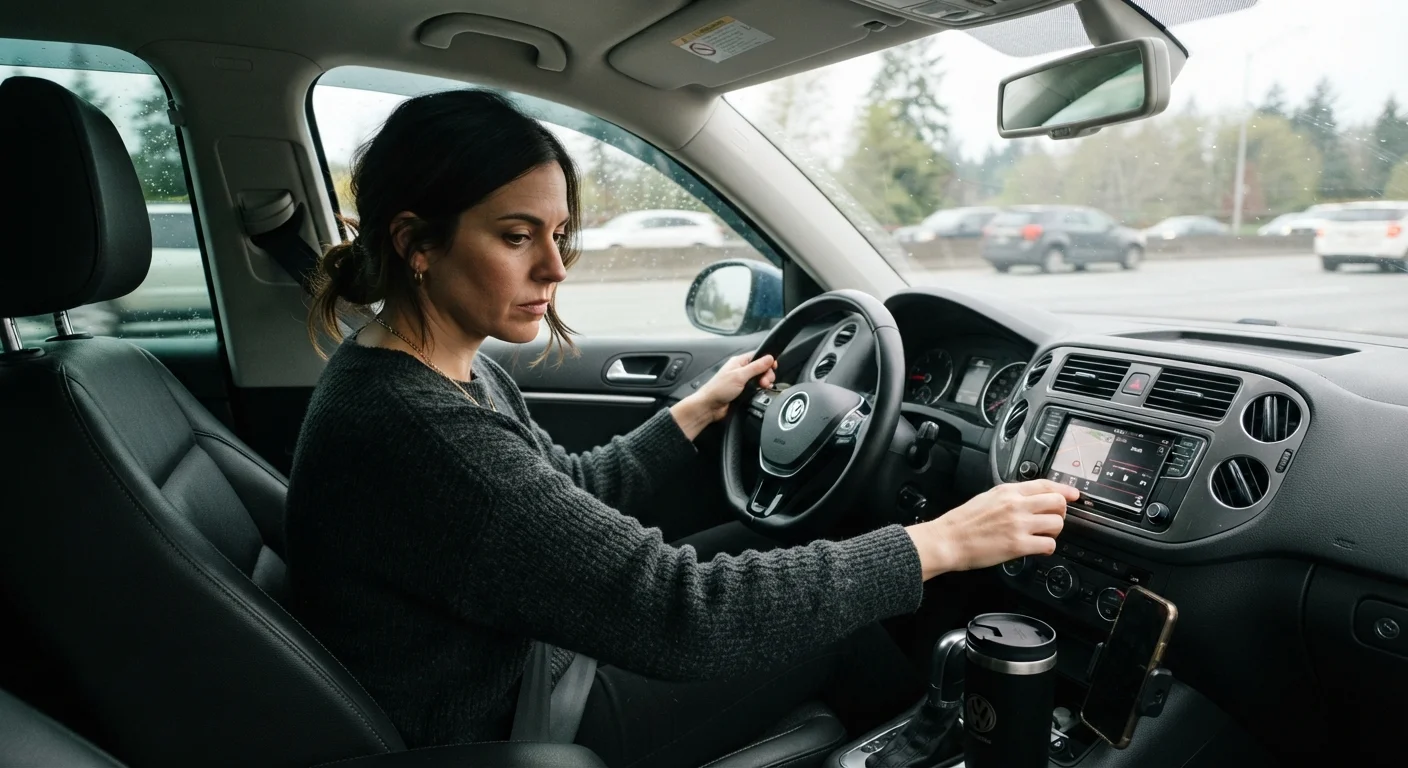
Climate controls, the radio, navigation systems, and even seat adjustments all compete for a driver's attention. Infotainment screens - now standard on most new vehicles - can require multiple visual and manual inputs to complete a simple task like changing a playlist. Even brief glances away from the road at highway speed cover substantial distance before attention returns. Familiarizing yourself with controls before you start driving reduces the need to hunt for buttons while moving.
At 60 mph, a two-second glance at the infotainment screen covers nearly 180 feet of road.
Grooming behind the wheel
Applying makeup, checking a mirror for appearance reasons, combing hair, or adjusting sunglasses all pull visual and manual attention from the driving task. These behaviors tend to occur when drivers feel they have spare capacity - light traffic, a straight road - but road conditions can change faster than a driver can react when their attention is already committed elsewhere.
Grooming feels harmless in light traffic, but road conditions can change in an instant.
Passenger interactions
Conversations with passengers create cognitive distraction; managing children in the back seat adds manual and visual distraction on top of that. Research has consistently found that rear-seat child distractions rank among the most time-consuming for drivers. Adult conversations, while generally less demanding, can still absorb enough cognitive bandwidth to reduce hazard detection - particularly during emotionally charged exchanges. Unlike a phone call, in-person passengers can at least respond to cues that the driver needs to focus.
Managing children in the back seat is consistently among the most time-consuming driver distractions.
Cognitive distraction and mind-wandering
Also called inattention blindness, cognitive distraction occurs when a driver's eyes are on the road but their mind is processing something else entirely - a work problem, an argument, an upcoming appointment. Studies using eye-tracking technology have found that cognitively distracted drivers look at the road but fail to process what they're seeing at the same rate as fully attentive drivers. This is among the most underappreciated forms of distraction because it leaves no visible trace and drivers often don't self-identify it as a problem.
Inattention blindness means your eyes can be forward while your mind is effectively elsewhere.
Rubbernecking and external events
Slowing to look at a crash, a roadside animal, a striking billboard, or emergency vehicles is so universal it has its own name. Rubbernecking causes visual and cognitive distraction simultaneously, and it's a common trigger for secondary collisions. Highways and busy roads can also present unexpected road hazards that demand immediate response - attention pulled toward a distraction at that moment leaves no margin for reaction.
Rubbernecking is a primary trigger for secondary crashes at existing accident scenes.
Driving With Full Attention Is a Skill Worth Practicing
The thread connecting every item on this list is the same: driving well requires sustained, deliberate attention, and that attention is finite. Experienced drivers develop systematic scanning habits precisely because they understand how quickly the road can change. Any behavior that interrupts that scan - however briefly - introduces risk.
Cognitive distraction deserves special mention here. Unlike eating or adjusting the radio, mind-wandering leaves no obvious outward sign. A driver can have both hands on the wheel, eyes nominally forward, and still be processing almost nothing about the environment ahead. This makes it one of the harder distractions to self-police. If you notice your recall of the last few miles is fuzzy, that's a signal your attention drifted - and it's worth acknowledging rather than brushing off. For context on how fatigue compounds this problem, see our look at drowsy driving myths that drivers commonly accept as harmless.
Build a Pre-Drive Habit
Before pulling out of a parking spot or driveway, take 60 seconds to handle common distractions proactively: adjust mirrors, set your navigation destination, connect Bluetooth, and secure any food or drinks. This small routine reduces the likelihood of needing to handle those tasks while moving. It's a low-effort habit with a meaningful payoff in sustained on-road attention.
The content on this site is provided for informational purposes only and should not be considered a substitute for professional advice. While we strive to provide accurate and up-to-date information, we make no guarantees regarding its completeness or accuracy. Always consult a qualified professional for advice specific to your circumstances before making any decisions.