

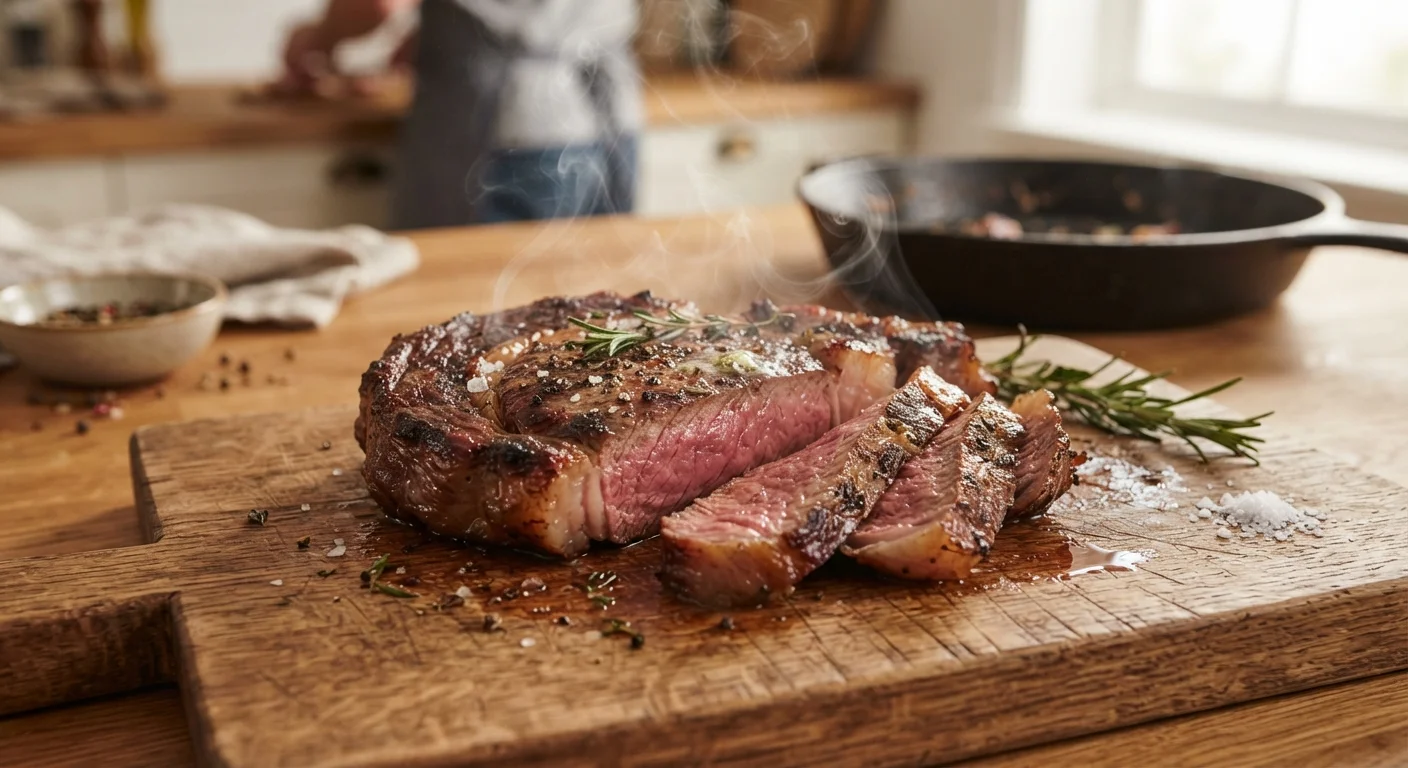
What Actually Happens Inside Meat When It Cooks
When meat hits a hot pan or grill, the muscle fibers contract sharply due to the heat. This contraction forces moisture - the liquid that carries flavor - toward the cooler center of the cut. The result is a dense, pressurized core of juice surrounded by drier outer layers.
If you cut into that steak immediately, you're releasing all that built-up pressure at once. The juice floods your cutting board rather than staying in the meat. This isn't a cooking myth - it's basic food science rooted in how protein structures respond to temperature change.
Resting gives those contracted muscle fibers time to relax. As the temperature across the cut begins to equalize, the fibers gradually loosen and reabsorb much of the expelled moisture. The result is a more evenly juicy piece of meat from edge to center.
~30%
Juice loss from cutting too soon
Food science research has demonstrated that meat cut immediately after cooking can lose roughly 30% more juice than meat allowed to rest adequately.
5-15°F
Carryover temperature rise after heat removal
Depending on the size of the cut and the cooking temperature, internal temperature continues rising by 5-15°F after meat is pulled from the heat source.
Common Myths About Resting - Corrected
A number of persistent misconceptions lead home cooks to either skip resting entirely or approach it the wrong way. Understanding what's true and what isn't will help you make better decisions at the stove.
Myth
Resting meat is only necessary for steaks and big roasts - smaller cuts don't need it.
Fact
All cooked muscle protein benefits from resting, though the required time scales down with the cut's size.
Even a pan-seared chicken breast or a pork chop will retain more moisture with just 3-5 minutes of rest. The same physics apply regardless of size - muscle fibers have contracted and need time to relax. Skipping rest on smaller cuts is one reason quick weeknight proteins often feel drier than expected.
Myth
Resting meat causes it to go cold and ruins the eating experience.
Fact
Properly rested meat stays warm enough to serve comfortably, especially when loosely tented with foil.
A well-seared steak carries significant residual heat. Resting for 5-10 minutes will drop the surface temperature only modestly - and the interior will actually rise slightly due to carryover cooking. Serving on a warm plate further reduces perceived heat loss. Cold rested meat is almost always the result of resting too long or in a cold, drafty environment.
Myth
The juices that run out when you cut meat are just blood, so losing them doesn't matter much.
Fact
Those juices are primarily water combined with dissolved proteins and myoglobin - they carry significant flavor and moisture.
Commercially sold meat is almost always fully bled. The reddish liquid seen in packaging or on the cutting board is myoglobin, a protein that stores oxygen in muscle tissue - not blood. More importantly, those juices contain dissolved flavor compounds and represent moisture that would otherwise stay in the meat. Losing them means a noticeably less succulent result.
Myth
Covering meat tightly with foil while resting keeps it juicier.
Fact
Tight foil trapping creates steam, which can soften exterior crusts and alter texture negatively.
The goal of tenting is to slow heat loss, not to seal in steam. A loose foil tent allows some airflow, preserving the texture of a seared crust while still moderating temperature drop. If you've worked to develop a crispy skin on poultry or a caramelized crust on a roast, wrapping it tightly undermines that effort in just a few minutes.
How Long Should You Actually Rest Meat?
Rest time isn't one-size-fits-all - it scales with the size and density of the cut. Here's a practical breakdown:
- Thin cuts (chicken breast, pork chop, fish fillet): 3-5 minutes is sufficient. These cuts equalize temperature quickly.
- Steaks (1-2 inches thick): 5-10 minutes gives fibers enough time to relax without the meat going cold.
- Whole roasts, leg of lamb, or large pork shoulder: 20-30 minutes. The dense interior takes much longer to stabilize.
- Whole roasted poultry: 15-20 minutes. Carving too soon leads to dry breast meat.
A common technique is to tent the meat loosely with aluminum foil during resting. This slows heat loss without trapping steam - which can soften a crust you worked hard to develop. The key word is loosely: a tight seal turns rest time into steaming time.
Always Use a Meat Thermometer
Visual cues alone - color, firmness, or juice clarity - are unreliable indicators of safe internal temperature. The USDA recommends specific minimum internal temperatures for different meats (e.g., 145°F for whole cuts of beef, pork, and lamb; 165°F for poultry). Use an instant-read thermometer and account for carryover cooking when deciding when to pull the meat from heat.
Pairing good resting habits with other fundamentals - like knowing how to salt at the right moment - compounds your results significantly. Moisture management starts before the meat ever hits the heat.
Carryover Cooking and Why It Changes When You Pull the Meat
Resting also intersects with a principle called carryover cooking - the continued rise in internal temperature after the meat is removed from the heat source. For a thick steak, that rise can be 5-10°F. For a large roast, it may reach 15°F or more.
This means pulling meat from the oven or grill slightly before it hits your target internal temperature isn't a mistake - it's the correct approach. If you're aiming for a medium steak at 145°F, pulling at 135-138°F and resting it will carry it exactly where you want it.
Ignoring carryover cooking leads to consistently overcooked results, even when you're checking temperatures carefully. Building resting into your cooking plan - not treating it as an afterthought - is what separates a reliably good cook from one who occasionally gets lucky.
If you're working through a larger cooking session, resting meat fits naturally into batch-style workflows. Our guide to batch cooking explains how to sequence tasks so that resting periods do double duty - keeping food timing tight while nothing goes to waste.
The content on this site is provided for informational purposes only and should not be considered a substitute for professional advice. While we strive to provide accurate and up-to-date information, we make no guarantees regarding its completeness or accuracy. Always consult a qualified professional for advice specific to your circumstances before making any decisions.