

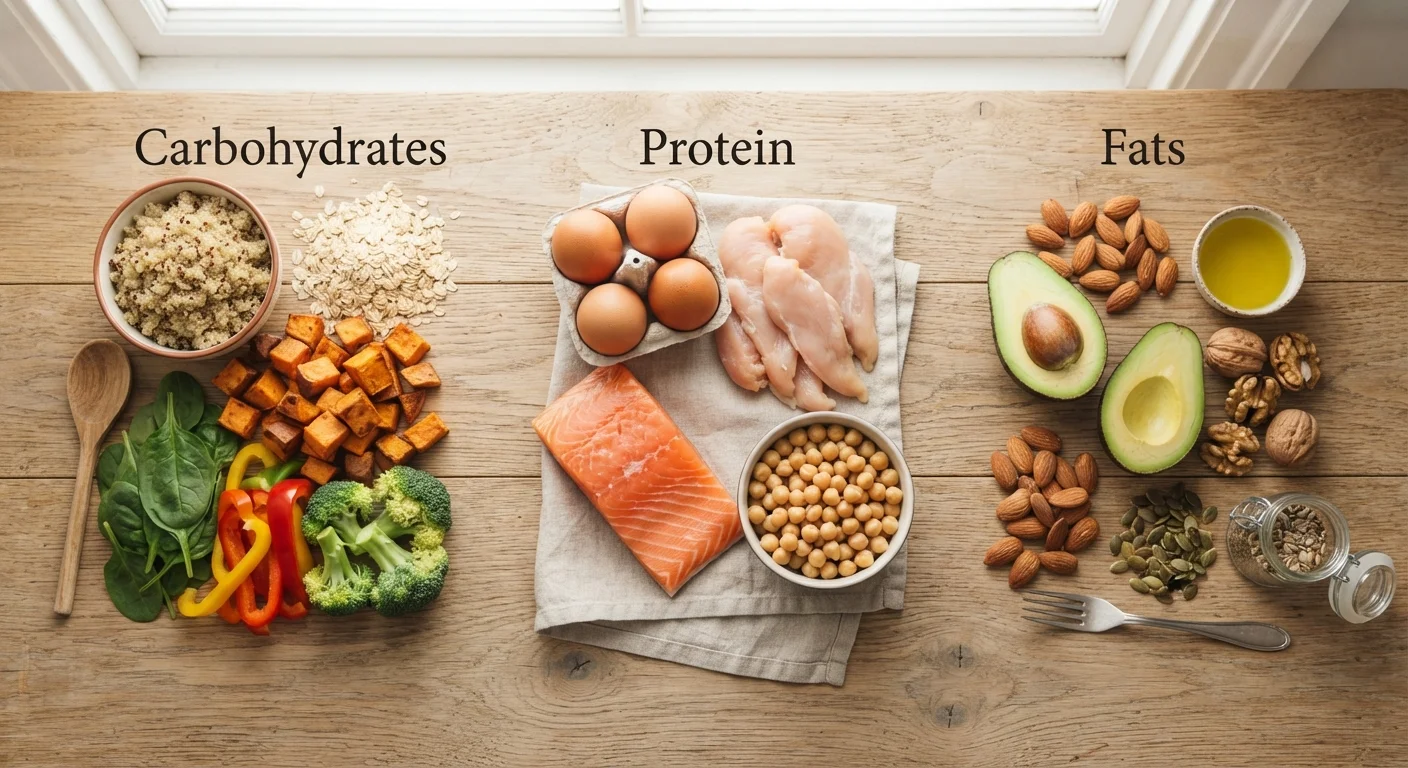
What Macronutrients Actually Are
Every food you eat is made up of chemical building blocks, and macronutrients are the big three: carbohydrates, protein, and fat. The prefix "macro" simply means they're needed in large quantities - grams, not micrograms - because they supply the raw energy and structural material your body runs on.
It's easy to assume macronutrients are interchangeable because all three provide calories. They're not. Each one is processed differently, stored differently, and used for different jobs. Understanding that distinction is what separates a practical approach to eating from the oversimplified rules that fuel most diet trends. For a look at how diet myths have distorted public understanding of these nutrients, see our breakdown of common nutrition myths.
45-65%
Recommended daily calories from carbohydrates
According to the Dietary Guidelines for Americans, carbohydrates should account for roughly half of total daily calorie intake for most adults.
10-35%
Recommended daily calories from protein
The Acceptable Macronutrient Distribution Range (AMDR) set by the National Academies of Medicine covers a wide range to accommodate varying activity levels and life stages.
20-35%
Recommended daily calories from fat
The same AMDR framework recommends fat make up between one-fifth and one-third of daily calorie intake, with an emphasis on unsaturated sources.
Carbohydrates: Your Body's Default Fuel
Carbohydrates are the body's preferred and most readily available energy source. When you eat carbs - whether from bread, fruit, beans, or oats - your digestive system breaks them down into glucose, which circulates in the bloodstream and fuels your cells. Your brain, in particular, runs almost exclusively on glucose under normal conditions.
Not all carbohydrates behave alike. Simple carbohydrates (sugars) digest quickly and cause faster rises in blood glucose. Complex carbohydrates - starches and dietary fiber - break down more slowly, providing steadier energy and supporting gut health. Fiber, technically a carbohydrate, isn't absorbed for energy at all; instead, it feeds beneficial gut bacteria and helps regulate digestion.
Excess glucose is stored as glycogen in the liver and muscles for short-term use, or converted to fat for longer-term storage. This storage capacity is why total calorie intake still matters alongside macronutrient composition - a topic explored in depth in our article on why the calorie equation is incomplete.
Protein: Builder, Repairer, Regulator
Protein is the macronutrient most associated with muscle, and for good reason - but its role extends well beyond the gym. Every protein you eat is broken down into amino acids, which your body uses to build and repair tissues, produce enzymes, create antibodies, and synthesize hormones. Without adequate protein, the body can't maintain muscle mass, mount immune responses, or carry out basic metabolic processes.
There are 20 amino acids total; nine are considered essential, meaning the body can't synthesize them and must obtain them through food. Animal proteins (meat, poultry, fish, eggs, dairy) contain all nine essential amino acids. Many plant proteins are lower in one or more essential amino acids, though eating a varied diet with legumes, whole grains, nuts, and seeds covers this gap effectively.
Build Meals Around All Three Macronutrients
A simple way to structure balanced meals is to include a source of complex carbohydrate, a lean or plant-based protein, and a small amount of healthy fat at each sitting. This combination slows digestion, helps stabilize energy between meals, and ensures you're getting functional fuel from all three categories. You don't need to count grams - starting with this basic framework moves you in the right direction.
Because protein digests more slowly than simple carbohydrates and triggers satiety hormones, meals with adequate protein tend to keep you fuller longer - a practical advantage when managing appetite. For a head-to-head look at how protein and carbohydrates compare, see our guide to protein vs. carbohydrates.
Fat: Essential, Not Optional
Dietary fat has spent decades as a nutritional villain, but the science has always been more nuanced. Fat is essential for absorbing the fat-soluble vitamins A, D, E, and K - none of which can enter your cells without fat present. It also forms the structural layer of every cell membrane in your body, supports brain development, and is the raw material for steroid hormones including estrogen, testosterone, and cortisol.
Fat also slows digestion, which helps moderate blood sugar responses when eaten alongside carbohydrates. And it makes food taste satisfying - a function that's easy to underestimate until you've eaten a fat-free meal that left you hungry an hour later.
The type of fat matters significantly. Unsaturated fats - found in olive oil, avocados, nuts, and fatty fish - are broadly associated with cardiovascular benefit. Saturated and trans fats have more complex and, in the case of trans fats, largely negative health profiles. For a full breakdown, see our explainer on fat types.
Why Cutting One Macronutrient Out Backfires
Low-fat, low-carb, and near-zero-carb diets have each had their moment in the spotlight. And while reducing certain foods can be appropriate for some people in some circumstances, eliminating an entire macronutrient category typically creates problems rather than solving them.
Cut fat too aggressively and you impair vitamin absorption and hormone production - plus fat is often replaced by added sugars in processed low-fat products. Eliminate carbohydrates almost entirely and you remove the primary fuel source for the brain and high-intensity exercise, along with most of the dietary fiber that supports a healthy gut. Over-rely on protein as a primary energy source and you stress the kidneys over time and crowd out the fats and carbohydrates needed for other functions.
A more durable framework focuses on food quality within each macronutrient: choosing whole grains over refined ones, lean or plant-based proteins, and unsaturated fats - rather than treating an entire macronutrient as the enemy. To understand how macronutrients compare to the vitamins and minerals your body also requires, see our overview of micronutrients.
This article is for general educational purposes only and is not a substitute for personalized dietary or medical advice. Consult a registered dietitian or qualified healthcare professional for guidance tailored to your individual health needs.
A runner fueling up with oatmeal and banana before a morning jog.
Someone recovering from surgery eating eggs, Greek yogurt, and lentils throughout the day.
A person adding olive oil and avocado to a salad containing spinach and carrots.
Someone switching to a strict fat-free diet and finding they feel hungry within an hour of eating.
Frequently Asked Questions
Yes, your body relies on carbohydrates, protein, and fat daily for energy, tissue repair, and hormone regulation. While the exact proportions can vary based on individual needs, none of the three are truly optional over the long term. Cutting one out entirely usually means compensating with more of another, which can create its own imbalances.
No single macronutrient controls body weight in isolation. Total calorie balance, food quality, and lifestyle factors all play roles. Protein tends to promote satiety and preserve muscle during weight loss, but demonizing carbs or fat oversimplifies how metabolism works. <a href="/health-wellness/nutrition-basics/calories-in-calories-out-and-why-that-formula-is-incomplete">The calorie equation is more complex</a> than most diet plans suggest.
No. Carbohydrates range from simple sugars (like those in candy or soda) to complex starches and fiber (found in whole grains, legumes, and vegetables). Complex carbohydrates digest more slowly, support stable energy levels, and often carry fiber and micronutrients. Simple sugars digest quickly and provide little nutritional depth.
Not as a category. Fat is essential for absorbing fat-soluble vitamins (A, D, E, and K), supporting brain health, and producing hormones. The type of fat matters - unsaturated fats found in olive oil, nuts, and fish are generally considered beneficial, while heavily processed trans fats are widely associated with health risks. For a deeper look, see our article on <a href="/health-wellness/nutrition-basics/saturated-fat-unsaturated-fat-and-trans-fat-what-each-one-does-in-the-body">the different types of dietary fat</a>.
General guidance from health organizations suggests roughly 0.8 grams of protein per kilogram of body weight per day for sedentary adults, with higher needs for active individuals, older adults, and those recovering from illness. Individual needs vary, and a registered dietitian can give personalized recommendations. This article provides general educational information, not medical or dietary prescriptions.
The body adapts by producing glucose from protein and fat through a process called gluconeogenesis. On very low-carb diets, the liver also produces ketone bodies as an alternative fuel. While some people tolerate low-carb eating well, others experience fatigue, difficulty concentrating, or digestive issues from reduced fiber intake. Long-term effects depend heavily on overall diet quality and individual physiology.
The content on this site is provided for informational purposes only and should not be considered a substitute for professional advice. While we strive to provide accurate and up-to-date information, we make no guarantees regarding its completeness or accuracy. Always consult a qualified professional for advice specific to your circumstances before making any decisions.