

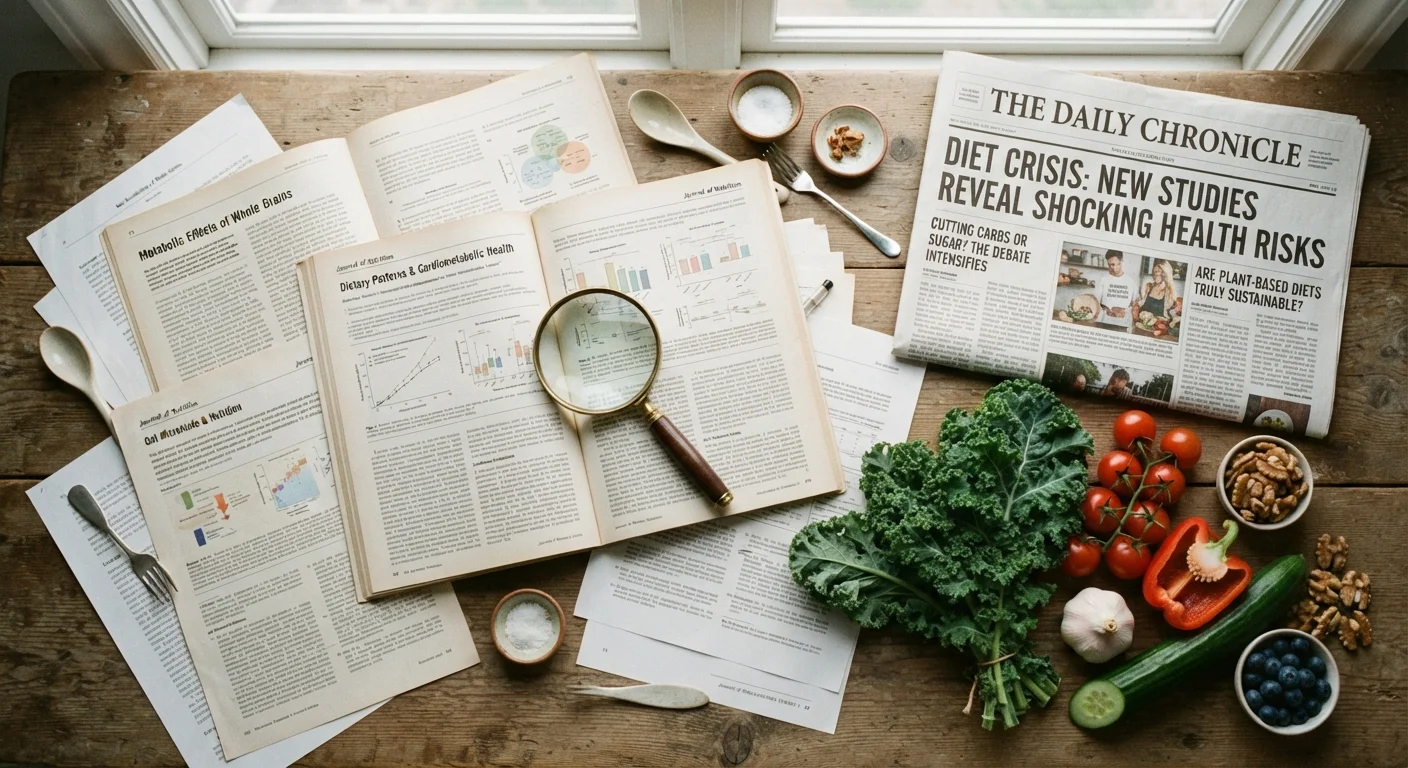
Why Nutrition Research Feels So Contradictory
One week coffee is linked to longer life. The next, a study warns of cardiovascular risk. If you've ever felt whiplash from the news cycle around food, you're not imagining it - the field of nutrition science has genuine structural challenges that make clean, definitive answers rare. Understanding those challenges is the first step toward filtering signal from noise.
Nutrition is an extraordinarily difficult science. Human diets are complex, highly variable, and change over decades. People can't be locked in a lab and fed a controlled diet for years the way lab animals can. Researchers rely heavily on self-reported food diaries, which are notoriously imprecise. And the outcomes that matter most - heart disease, cancer, cognitive decline - unfold over a lifetime. These obstacles mean even well-designed studies carry meaningful uncertainty. That uncertainty is normal and honest; the problem is that media coverage rarely conveys it. If you find yourself feeling overwhelmed, our guide Nutrition for Beginners is a grounding starting point.
The Hierarchy of Evidence: Not All Studies Are Equal
Nutrition studies come in several designs, and they carry very different levels of reliability.
- Case reports and animal studies generate hypotheses. A result in mice is intriguing but rarely translates directly to humans.
- Observational studies (cohort, cross-sectional, case-control) track what large groups of people eat and what health outcomes they experience. They can identify associations, but correlation is not causation. People who eat more leafy greens may also exercise more, sleep better, and have higher incomes - all factors that independently affect health.
- Randomized controlled trials (RCTs) randomly assign people to dietary interventions and are better at establishing causation. But long-term dietary RCTs are logistically grueling and expensive, so they're rare in nutrition.
- Systematic reviews and meta-analyses pool results from multiple studies, giving a broader, more reliable picture - but only as reliable as the underlying studies they include.
~88%
Industry-funded studies favoring sponsor
A review published in PLOS Medicine found that industry-funded nutrition and beverage studies were roughly four to eight times more likely to show favorable results for the funder than independently funded studies.
1 in 3
Adults who change diet based on a news story
Surveys on health media consumption suggest a substantial share of adults report modifying eating habits in response to a single news report, illustrating the real-world impact of headline distortion.
~50%
Observational findings that replicate in RCTs
Researchers have estimated that fewer than half of positive associations found in observational nutrition studies hold up when tested in randomized controlled trials.
When a news story cites a single observational study with a modest sample size run over a short period, be appropriately skeptical. Contrast that with guidance based on decades of converging evidence from multiple study types - that's a far sturdier foundation.
How Funding and Publication Bias Shape What You Read
Who pays for a study matters - not because funded researchers are necessarily dishonest, but because funding shapes which questions get asked, which results get published, and how findings are framed. Research consistently shows that industry-funded nutrition studies are more likely to report favorable outcomes for the sponsor's product than independently funded studies of the same topics.
Publication bias compounds the problem. Journals are more likely to publish studies showing a dramatic positive or negative effect than studies showing no effect at all. This skews the published literature toward exciting but potentially unreliable findings. A treatment or food that looks promising across five published trials might have had fifteen unpublished neutral results sitting in a file drawer. Always ask: has this finding been replicated by independent research groups? If the answer is no - or not yet - maintain healthy skepticism while the evidence accumulates.
When evaluating a nutrition study, go straight to the 'limitations' section of the paper - researchers themselves flag the study's weakest points, which rarely make it into the headline.
Authors are required to acknowledge methodological constraints, and reading this section gives you the most honest assessment of how much weight the finding deserves.
Treat any nutrition claim that uses the word 'superfood' as a signal to slow down. The term has no regulatory or scientific definition and is almost always marketing language, not research language.
No single food has been shown to prevent or cure disease in isolation. Claims built around superfoods typically rely on extrapolating from isolated-nutrient or animal research.
Common Ways Headlines Distort Findings
Even solid research can be misrepresented on the way from journal to reader. Here are the most frequent distortions to watch for:
- Relative vs. absolute risk
- A headline reading "Food X increases cancer risk by 50%" sounds alarming. But if the baseline risk is 1 in 10,000, a 50% increase brings it to 1.5 in 10,000 - a very different picture than the headline implies.
- Conflating correlation with causation
- Observational associations get reported as if a food directly causes an outcome. Language like "linked to" or "associated with" signals correlation, not proven cause-and-effect.
- Extrapolating from extreme exposures
- Many food-and-cancer studies expose cells or animals to doses far beyond what a human would consume in a lifetime. Results at extreme doses don't automatically apply to normal dietary amounts.
- Short-duration studies
- A four-week trial measuring a biomarker (like LDL cholesterol) cannot tell you whether a food pattern affects heart disease risk over twenty years.
For a deeper look at how specific myths survive despite the evidence, see Nutrition Myths That Refuse to Die.
A Practical Framework for Reading Nutrition News
The goal isn't to dismiss every new study - it's to put it in context. Use these questions as a quick filter:
- What type of study was it? Observational, RCT, meta-analysis? That tells you how much causal weight it can carry.
- How many people were studied, and for how long? Small, short studies generate hypotheses; larger, longer studies are more reliable.
- Who funded it? Check the disclosures section - most journals require authors to disclose conflicts of interest.
- Has it been replicated? One study is rarely enough to change established guidance.
- Does the headline match the actual finding? Read beyond the headline to the study abstract if you can. Many university press offices and science journalists provide summaries.
Pairing this skepticism with solid label-reading skills helps on a practical level - see Reading a Nutrition Facts Label Without the Guesswork for a hands-on walkthrough.
When to Update Your Eating Habits Based on New Research
The honest answer: rarely on the basis of a single study. Nutrition science moves through a process of accumulation - many imperfect studies, from multiple teams, using different methods, gradually converging on more reliable conclusions. Major dietary guidelines reflect that accumulated weight of evidence, not individual papers.
A reasonable threshold for adjusting your own eating patterns is when a finding has been replicated in multiple study types, including at least some human trials, by independent research groups, and is consistent with the broader body of knowledge. That standard filters out most of the noise. It also means the fundamentals of good eating - plenty of vegetables, minimally processed foods, adequate protein, balanced variety - remain remarkably stable even as individual headline stories come and go. If you're curious how different evidence-supported eating patterns compare, Eating Patterns Backed by Nutrition Research offers a comparative look.
This article is for general informational and educational purposes only. It is not medical or dietary advice. For personal nutrition guidance, consult a registered dietitian or qualified healthcare professional.
The content on this site is provided for informational purposes only and should not be considered a substitute for professional advice. While we strive to provide accurate and up-to-date information, we make no guarantees regarding its completeness or accuracy. Always consult a qualified professional for advice specific to your circumstances before making any decisions.