

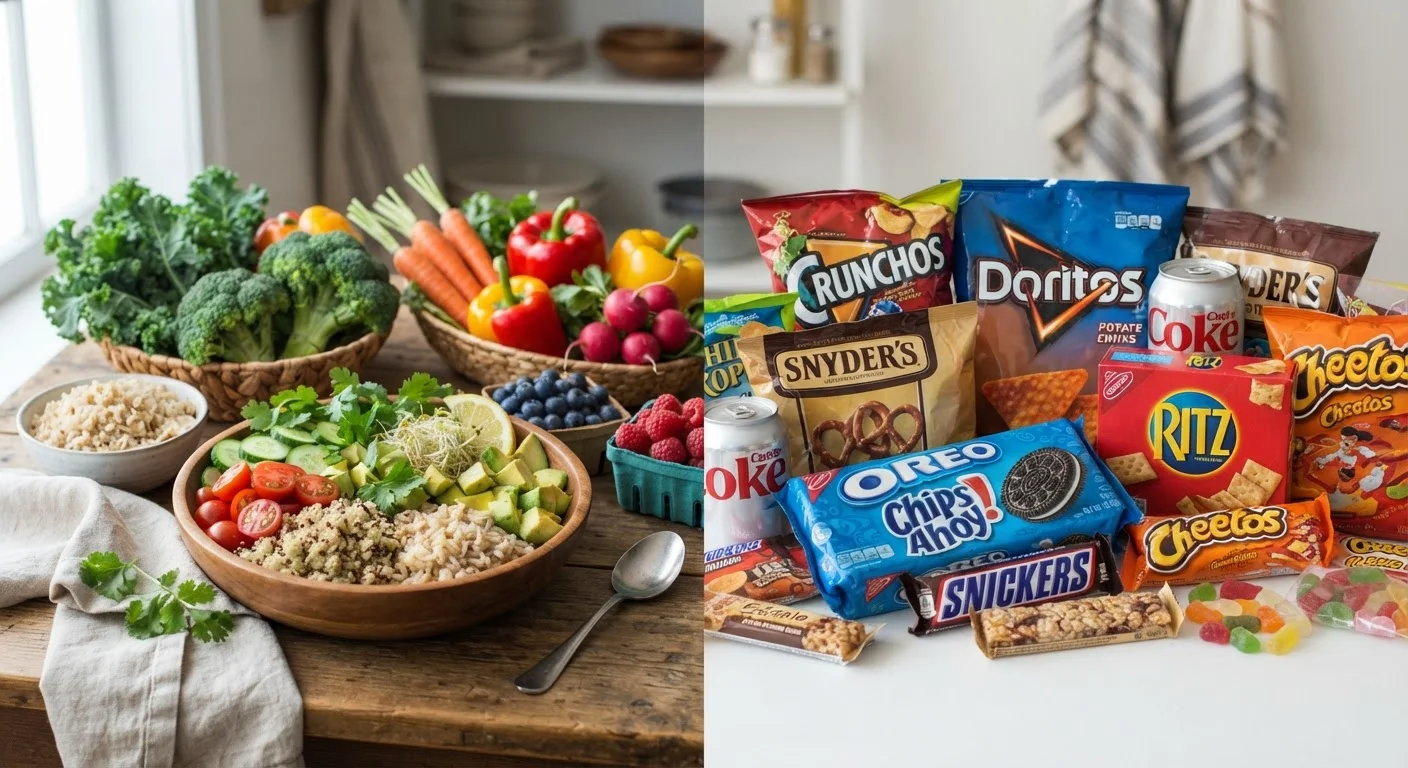
Option A
Whole Foods
The minimally altered, nutrient-dense baseline.
Best for: Anyone looking to maximize nutrient density and eat foods closest to their natural state.
Option B
Ultra-Processed Foods
Industrial formulations engineered for palatability and shelf life.
Best for: Understanding what to limit and why - not all processing is equal, but this category warrants the most scrutiny.
How Scientists Classify Foods: Meet the NOVA System
Most people think of food processing as a simple on/off switch - either a food is processed or it isn't. In reality, processing exists on a spectrum, and where a food sits on that spectrum matters far more than whether it was touched by industry at all.
The most widely used research framework is the NOVA classification system, developed by nutrition researchers at the University of São Paulo. NOVA groups foods into four categories:
- Group 1 - Unprocessed or minimally processed foods: Fresh fruits, vegetables, plain meat, eggs, milk, and legumes. These are either used as-is or have been cleaned, cut, dried, or frozen without adding substances.
- Group 2 - Processed culinary ingredients: Oils, butter, flour, salt, and sugar - extracted from nature and used in home cooking, not typically eaten alone.
- Group 3 - Processed foods: Products made by combining Group 1 and Group 2 items, such as canned vegetables, cheese, cured meats, and freshly baked bread. The goal is preservation or flavor enhancement.
- Group 4 - Ultra-processed foods: Industrial formulations that contain little or no whole food. They include ingredients rarely found in a home kitchen - emulsifiers, flavor enhancers, hydrogenated oils, artificial colorants, and modified starches.
The NOVA framework isn't without critics; some researchers argue it doesn't account sufficiently for nutrient content within each group. Still, it gives consumers and scientists a shared language for a genuinely complex topic. For a closer look at how the full spectrum works in practice, see the whole-to-processed spectrum explained.
What Sets Ultra-Processed Foods Apart
The defining feature of ultra-processed foods isn't simply that they contain salt or sugar. It's the combination of industrial additives, refined ingredients, and manufacturing techniques designed specifically to maximize palatability, shelf life, and convenience - often at the expense of nutritional integrity.
Common markers of ultra-processed foods include:
- Long ingredient lists featuring substances like carrageenan, polysorbate 80, or sodium stearoyl lactylate
- Multiple sources of refined sugar under different names (e.g., dextrose, maltose, high-fructose corn syrup)
- Artificial or "nature-identical" flavors listed without specificity
- Protein isolates or modified starches used as bulking agents
These products are engineered to be eaten quickly and in large quantities. Research published in peer-reviewed journals, including studies from The BMJ and JAMA Internal Medicine, has found associations between higher ultra-processed food consumption and increased risk of obesity, type 2 diabetes, cardiovascular disease, and certain cancers. These are observational findings - they establish correlation, not direct causation - but the consistency across multiple large cohort studies is notable.
| Criterion | Whole Foods | Ultra-Processed Foods |
|---|---|---|
| Ingredient complexity | One or few recognizable ingredients | Long lists including industrial additives |
| Fiber content | Naturally present, intact | Often stripped out or absent |
| Nutrient density | Generally high relative to calories | Often low; calories from refined fats and sugars |
| Satiety signals | Supports normal hunger regulation | May override satiety via hyper-palatability |
| Shelf life | Short to moderate | Extended through preservatives and low water activity |
| Cost and convenience | Varies; staples like oats and beans are affordable | Often convenient and inexpensive per serving |
| Research association | Linked to reduced chronic disease risk | Linked to higher chronic disease risk in cohort studies |
Understanding what's actually in a packaged food requires more than a glance at the Nutrition Facts panel. The ingredient list tells you the processing story. For guidance on decoding both, see reading a Nutrition Facts label without the guesswork.
The Case for Whole Foods - and the Nuance Around 'Processed'
Whole foods - vegetables, fruits, whole grains, legumes, nuts, seeds, plain dairy, and unprocessed meats - provide nutrients in a matrix that matters. Fiber slows digestion and feeds beneficial gut bacteria. Antioxidants in whole fruits behave differently inside the body than the same compounds in a supplement. This concept, sometimes called food synergy, suggests that nutrients work together in ways that isolated extracts don't replicate.
That said, dismissing all processing as harmful is its own oversimplification. Fermentation produces probiotic-rich yogurt and kimchi. Freezing preserves vitamins in vegetables picked at peak ripeness. Canned tomatoes deliver more bioavailable lycopene than raw ones. The goal isn't to avoid all intervention - it's to distinguish between processing that serves nutrition and processing that primarily serves profit margins.
~57%
Share of U.S. calories from ultra-processed foods
A nationally representative study published in BMJ Open estimated that ultra-processed foods account for roughly 57% of total energy intake among American adults.
10%
Rise in cardiovascular risk per serving increase
A large French cohort study (NutriNet-Santé) found a roughly 10% higher risk of cardiovascular disease associated with each 10-percentage-point increase in ultra-processed food consumption.
4 groups
NOVA food classification categories
The NOVA system, developed at the University of São Paulo, organizes all foods into four groups based on the extent and purpose of processing - not nutrient content alone.
When planning a diet that leans toward whole foods, protein choices are part of the picture too. Protein sources across different diets outlines how animal and plant options compare nutritionally, which complements any whole-food eating approach. Additionally, understanding how added sugars differ from naturally occurring ones adds another layer of clarity - see how your body responds differently to added vs. natural sugar.
This article is for general informational and educational purposes only and is not a substitute for professional medical or dietary advice. Consult a qualified healthcare provider or registered dietitian for personalized guidance about your diet and health.
The content on this site is provided for informational purposes only and should not be considered a substitute for professional advice. While we strive to provide accurate and up-to-date information, we make no guarantees regarding its completeness or accuracy. Always consult a qualified professional for advice specific to your circumstances before making any decisions.