

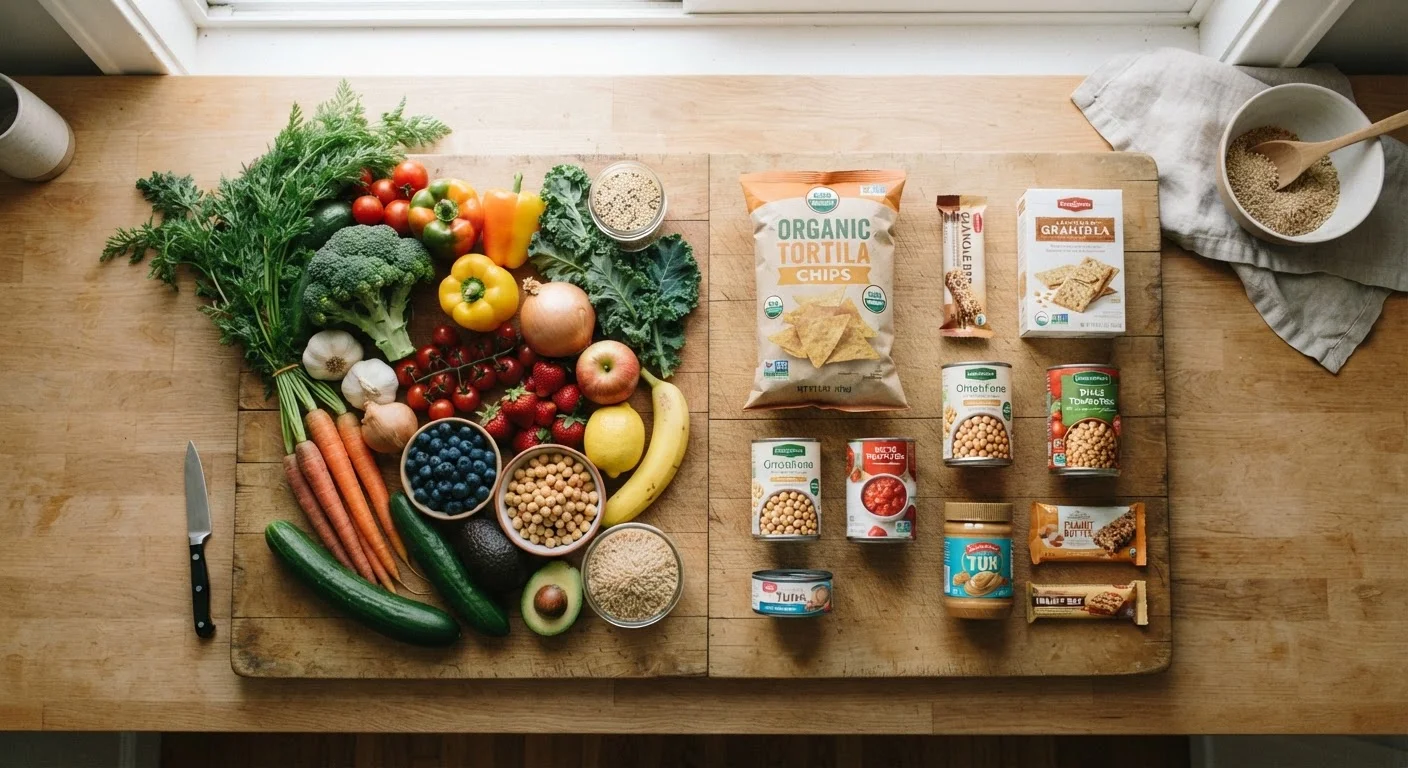
Option A
Whole Foods
Foods in their natural, unaltered state.
Best for: People seeking maximum nutrient density with minimal additives in their daily diet.
Option B
Processed Foods
Foods altered from their original form - across a broad spectrum.
Best for: Anyone navigating real-world convenience, cost, and shelf-life constraints in everyday eating.
What Does 'Processed' Actually Mean?
The word processed gets used as a blanket negative, but it describes a far wider range of foods than most people realize. At its most basic, processing simply means any deliberate change made to a food between harvest and consumption - which includes washing, cooking, fermenting, freezing, and packaging. By that definition, almost everything we eat has been processed in some way.
A more useful framework comes from nutrition researchers, who classify foods along a spectrum based on how extensively they've been altered and for what purpose. The NOVA classification system, developed by researchers at the University of São Paulo, groups foods into four broad categories: unprocessed or minimally processed foods, processed culinary ingredients, processed foods, and ultra-processed foods. Understanding where a food sits on this spectrum - rather than applying a simple whole/processed binary - gives you a far more practical tool for everyday decision-making.
For a deeper look at how ultra-processed foods specifically are defined and studied, see the science behind ultra-processed food classification.
Whole Foods: Nutrients as Nature Packaged Them
Whole foods are foods that remain close to their natural state - vegetables, fruits, legumes, whole grains, nuts, seeds, eggs, and unprocessed meat or fish. What distinguishes them nutritionally isn't just what they contain, but what hasn't been removed or diluted.
Fiber is a key example. In a whole apple, the fiber in the cell walls slows glucose absorption, supports gut bacteria, and contributes to satiety. When that apple is processed into juice, most of the fiber is stripped away, and the sugar it contains behaves very differently in the body - a principle explored further in how food structure affects sugar metabolism.
Whole foods also tend to deliver a broader range of micronutrients and phytonutrients - plant compounds with potential health-supporting roles - that are difficult to replicate through fortification alone. That said, whole foods aren't a cure or guarantee of any health outcome; they're one meaningful part of an overall dietary pattern.
| Criterion | Whole Foods | Processed Foods |
|---|---|---|
| Fiber content | High; naturally intact | Often reduced or removed |
| Micronutrient density | Broad, naturally occurring | Variable; may be fortified |
| Added sugars / sodium | Minimal to none | Widely variable; check labels |
| Shelf life | Short; requires fresh use | Extended; more convenient |
| Cost and accessibility | Can be higher; seasonal variation | Often lower; widely available |
| Preparation time | Usually requires cooking | Often ready to eat or quick |
| Ingredient simplicity | One ingredient: the food itself | Ranges from simple to complex |
The Processing Spectrum: Not All Trade-Offs Are Equal
Lumping frozen spinach together with a fluorescent-orange cheese puff as equally "processed" misses the point entirely. Here's how the middle of the spectrum generally breaks down:
- Minimally processed: Frozen vegetables, plain canned beans, pasteurized milk, bagged salads. Convenience-focused changes that preserve most of the original nutritional profile. These are generally sound choices.
- Processed culinary ingredients: Olive oil, flour, salt, sugar. Used in cooking to build meals from scratch; not typically eaten on their own.
- Processed foods: Canned fish in oil, cheese, cured meats, bread. Made by adding salt, sugar, oil, or preservation techniques to whole foods. Nutritional quality varies widely - reading labels matters here.
- Ultra-processed: Mass-produced items formulated from industrial ingredients - emulsifiers, artificial flavors, modified starches - engineered for extended shelf life and high palatability. Research has more consistently associated heavy consumption of this category with adverse health outcomes.
Learning to read a Nutrition Facts label accurately is one of the most practical skills for navigating the middle of this spectrum confidently.
NOVA Is a Research Tool, Not a Shopping Rule
The NOVA classification system is widely used in nutritional epidemiology to study population-level dietary patterns, but it wasn't designed as a rigid consumer label. A food can be classified as "processed" under NOVA and still be a nutritious, reasonable everyday choice. Use it as a thinking framework - a prompt to consider how much a food has been altered and why - rather than an absolute guide to what you should or shouldn't eat.
Putting It Into Practice
A useful rule of thumb: aim to build most meals around whole or minimally processed foods, use processed culinary ingredients to cook with, and treat heavily engineered ultra-processed products as occasional rather than everyday choices. No single food makes or breaks a diet - it's the overall pattern that matters most.
If you're looking for a broader framework, exploring dietary patterns supported by nutrition research can help put food-level choices into context. Protein quality also shifts depending on how food is processed; protein sources across different eating styles breaks this down clearly.
The goal isn't dietary perfection. It's building a sustainable pattern that leans toward nutrient density, minimizes ultra-processed staples, and fits your actual life - budget, time, and preferences included.
This article provides general nutrition education and is not a substitute for personalized advice from a qualified healthcare professional or registered dietitian.
57%
Share of U.S. calories from ultra-processed foods
Research published in BMJ Open estimated that ultra-processed foods account for roughly 57% of total energy intake in the average American diet.
4 Groups
NOVA food classification categories
The NOVA system, developed by researchers at the University of São Paulo, groups all foods into four processing-level categories to support nutrition research.
The content on this site is provided for informational purposes only and should not be considered a substitute for professional advice. While we strive to provide accurate and up-to-date information, we make no guarantees regarding its completeness or accuracy. Always consult a qualified professional for advice specific to your circumstances before making any decisions.