

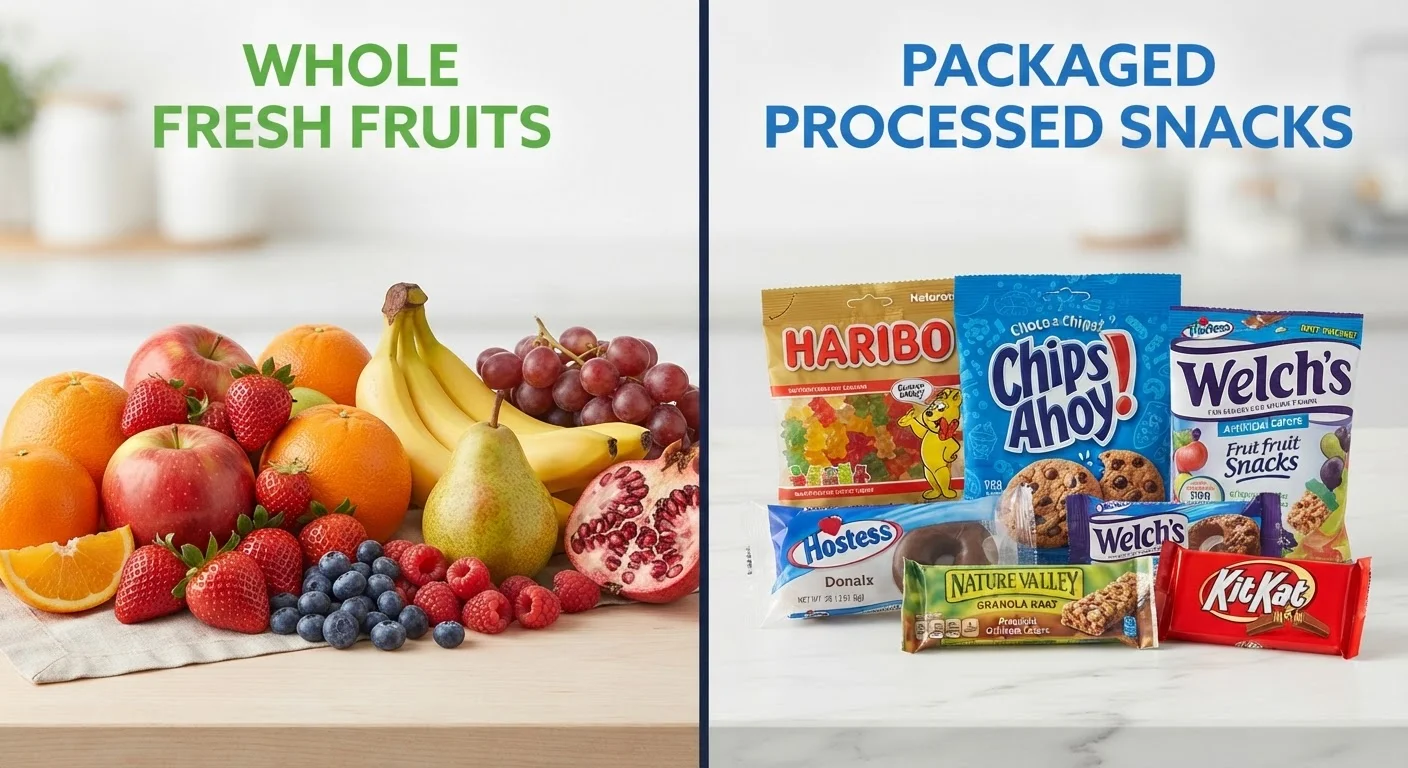
Option A
Natural Sugar
Sugar as nature packages it - surrounded by fiber, water, and nutrients.
Best for: People seeking to understand why sugar in whole foods like fruit and dairy is nutritionally different from refined sweeteners.
Option B
Added Sugar
Sugar introduced during processing - without the nutritional context of whole foods.
Best for: Anyone trying to identify hidden sweeteners in packaged foods and manage overall sugar intake more effectively.
What Makes a Sugar 'Natural' or 'Added'?
At the molecular level, the glucose and fructose in a ripe peach are chemically identical to those in a spoonful of table sugar. What differs is everything surrounding them. Natural sugars are those inherently present in whole, unprocessed foods - the lactose in milk, the fructose in an apple, the glucose in a beet. Added sugars, by contrast, are any sugars or caloric sweeteners incorporated into foods during processing, preparation, or manufacturing. This category includes white sugar, high-fructose corn syrup, honey added to a granola bar, and maple syrup stirred into a salad dressing.
The distinction matters because the U.S. Food and Drug Administration now requires food manufacturers to list added sugars separately on the Nutrition Facts panel, directly beneath total sugars. If you want to put this knowledge to immediate use, see our guide to reading a Nutrition Facts label for a full breakdown of every line on the panel.
| Criterion | Natural Sugar | Added Sugar |
|---|---|---|
| Source | Inherent in whole foods | Added during processing or cooking |
| Common examples | Fructose in fruit, lactose in milk | Table sugar, high-fructose corn syrup, honey in packaged goods |
| Accompanying nutrients | Fiber, vitamins, minerals, water | Typically none; calories only |
| Effect on blood glucose | Generally slower absorption due to fiber | Often faster spike without buffering fiber |
| Listed separately on label? | No separate line | Yes - under "Added Sugars" per FDA rules |
| Health guidance target? | Not a primary restriction target | Yes - limit to <10% of daily calories |
How the Food Matrix Changes Everything
The most important concept separating natural from added sugar is what nutrition scientists call the food matrix - the physical structure and surrounding nutrients a food delivers alongside its sugars. When you eat a whole orange, its fructose arrives packaged with dietary fiber, vitamin C, potassium, and a significant amount of water. That fiber slows digestion, moderating how quickly glucose enters the bloodstream. The volume and chewing required also support satiety signals.
Stripped of this context, added sugars behave very differently. A sweetened beverage delivers a concentrated sugar load with minimal fiber or protein to slow absorption. The result is a faster rise in blood glucose, followed by a sharper decline - a pattern that can drive hunger and encourage overconsumption over time. Understanding how fiber types support this buffering effect is worth exploring further in our article on soluble vs. insoluble fiber.
17 tsp
Average daily added sugar intake for U.S. adults
According to CDC data, American adults consume roughly 17 teaspoons of added sugar per day - more than triple what many health organizations recommend as a ceiling.
~40%
Share of added sugar from beverages
The CDC estimates that sugar-sweetened drinks account for roughly 40% of added sugar consumption among U.S. adults, making them a key category to monitor.
10%
Recommended added sugar cap (% of daily calories)
The Dietary Guidelines for Americans advise limiting added sugars to less than 10 percent of total daily caloric intake for adults and children over two.
Practical Guidance for Everyday Eating
Health organizations including the American Heart Association and the Dietary Guidelines for Americans recommend limiting added sugars to no more than 10 percent of total daily calories - roughly 50 grams on a 2,000-calorie diet. These guidelines do not target natural sugars in whole fruits, vegetables, or unsweetened dairy, reflecting the recognition that nutritional context matters as much as raw sugar content.
In practice, the most effective moves are straightforward: prioritize whole fruits over juices, check labels on condiments and sauces (where added sugars often hide), and be aware that "natural" or "organic" labeling on a product doesn't mean it's free of added sweeteners. Just as dietary fat requires nuance - distinguishing saturated from unsaturated sources, for example - so does sugar. Our overview of dietary fats illustrates how a similar nutrient-type distinction plays out in another key macronutrient category.
For a deeper look at how food structure specifically affects blood glucose response, see our companion piece on why your body responds differently to each sugar type.
This article is for general informational and educational purposes only and does not constitute medical or dietary advice. Consult a qualified healthcare provider for guidance tailored to your individual health needs, especially if you are managing a condition such as diabetes.
The content on this site is provided for informational purposes only and should not be considered a substitute for professional advice. While we strive to provide accurate and up-to-date information, we make no guarantees regarding its completeness or accuracy. Always consult a qualified professional for advice specific to your circumstances before making any decisions.