

Our Verdict
Open shelving delivers a genuinely lighter, more personal kitchen aesthetic and can improve how quickly you access everyday items. However, it demands an ongoing commitment to organization and cleaning that not every household will find sustainable. It's a design choice that rewards intentional, curated kitchens far more than busy, high-volume cooking spaces.
Best for homeowners who already keep a tidy kitchen, have a curated set of attractive everyday dishes, and want to make a smaller kitchen feel more open without a full renovation.
Why Open Shelving Has Stayed Popular
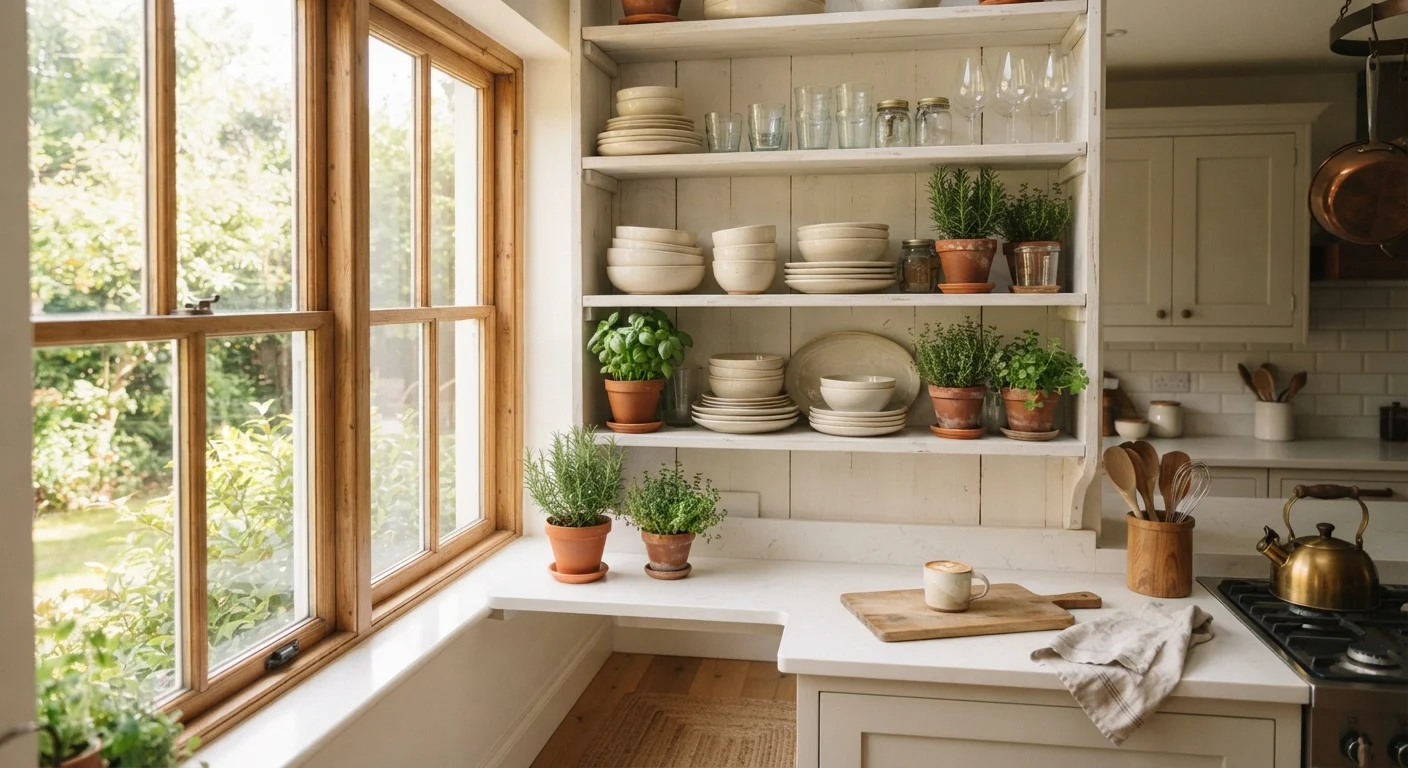
Open shelving replaced upper cabinets in countless kitchen renovations over the past decade, and its appeal is easy to understand. Removing closed cabinetry visually opens a room, lets natural light travel further across the space, and creates an opportunity to display dishware, glassware, and kitchen objects as part of the decor rather than hiding them behind doors.
For smaller kitchens in particular, the effect can be striking - sightlines extend further, and the room reads as larger than its square footage suggests. There's also a practical argument: items you reach for every single day are immediately visible and accessible. No opening, no searching. That convenience is real, especially in a well-organized kitchen.
It's also worth noting that shelving itself is among the more approachable kitchen upgrades a homeowner can take on. Floating shelves supported by proper wall anchors secured into studs can be installed without professional help in many cases, making open shelving a relatively low-cost way to update the look of a space. If you're already thinking about adjacent upgrades, pairing shelves with a new tile surface is a natural combination - adding a backsplash at the same time creates a cohesive finished look.
Makes kitchens feel more open and spacious
Removing the visual bulk of upper cabinets lets the eye travel further across the room. This effect is especially pronounced in smaller kitchens where ceiling-height cabinets can feel imposing.
Everyday items are immediately visible and accessible
Frequently used dishes and glasses are grabbed without opening doors or searching. For households with consistent routines, this streamlines the cooking and table-setting process.
Turns functional objects into part of the decor
Attractive dishware, glassware, and ceramics become display elements. This can personalize a kitchen in a way that closed cabinetry never allows.
Often a DIY-friendly, lower-cost upgrade
Floating shelf installation is within reach for many homeowners comfortable with basic tools, making it one of the more affordable ways to visually transform a kitchen.
Works well in hybrid configurations
Replacing only select cabinet runs with shelves lets homeowners capture visual lightness while retaining closed storage where it matters most - a flexible solution for varied needs.
The Everyday Realities Most People Don't Anticipate
Living with open shelving is meaningfully different from admiring it in a design photo. The most consistent feedback from homeowners who've made the switch is that the kitchen must be styled and tidied almost continuously - clutter that would be hidden behind a cabinet door is now fully on display.
Grease and cooking vapors are the other surprise. In an active cooking kitchen, a fine film of oil and airborne particles settles on everything within a few feet of the stove. Dishes, glasses, and decorative objects on open shelves need wiping down regularly, more often than most people initially expect. Items used infrequently can accumulate noticeable dust and grease between uses.
Requires relentless tidiness and styling
Every item on open shelves is visible at all times. Clutter, mismatched items, or casual stacking that would be hidden inside cabinets becomes a constant visual presence.
Grease and dust accumulate on exposed items
Cooking vapors settle on everything within range of the stove, including dishes and glassware that may appear clean but carry a fine residue. Regular wiping-down becomes a necessary routine.
Reduced total storage capacity
Shelves are generally shallower and offer less vertical stacking than enclosed cabinets. Households with substantial kitchenware, bakeware, or pantry items often feel the loss quickly.
Less protection for rarely used items
Seasonal or infrequently used pieces - holiday dishware, specialty tools - accumulate significant dust when stored on open shelves rather than behind cabinet doors.
May not suit all household styles or family sizes
Larger households or those with young children often find the aesthetic discipline required by open shelving difficult to maintain consistently alongside busy daily life.
Storage capacity is also genuinely reduced. Upper cabinets typically offer significantly more total cubic footage than the same linear feet of shelving, partly because shelves are shallower and partly because vertical stacking is limited. Households with a large collection of bakeware, small appliances, or pantry overflow often find themselves without good solutions for items that don't photograph well. A well-stocked pantry becomes even more valuable when upper cabinet space shrinks.
Making the Decision: Questions Worth Asking First
Before committing to open shelving - or ruling it out entirely - a few honest questions can clarify whether it fits your household's actual habits rather than its aspirational ones.
Safety Note: Proper Wall Anchoring Matters
Floating shelves must be anchored securely into wall studs or with appropriate wall anchors rated for the intended load. Shelves bearing the weight of stacked dishes and glassware can cause serious damage or injury if they fail. If you're uncertain about your wall structure or the correct hardware, consulting a professional before installation is strongly recommended.
- How often do you cook? High-frequency, high-heat cooking produces more grease vapor. A household that cooks elaborate meals most nights will deal with more residue on exposed shelves than one that cooks lightly.
- Is your current dishware display-worthy? Mismatched or worn items look fine inside cabinets. On open shelves, what's there becomes part of the room's visual identity.
- How much storage do you actually need? Audit your upper cabinets before removing them. If they're packed with rarely-used items, you'll need an alternative storage plan first.
- Would a hybrid approach work better? Many homeowners remove only one or two upper cabinet runs and replace them with shelves, keeping closed storage where it's most needed. This middle path captures most of the visual benefit with fewer trade-offs.
Thinking through kitchen organization more broadly - including what you reach for most and how you plan around staple items - connects directly to how functional open shelving will feel day-to-day. If you're rethinking your kitchen systems more holistically, stocking a functional pantry is a useful parallel project.
~30%
Upper cabinet storage lost when fully replaced with shelves
Design and remodeling professionals commonly estimate that open shelves hold roughly 30% less total volume than enclosed upper cabinets of equivalent width due to shallower depth and limited stacking.
1 of the top 5
Most requested kitchen design features in recent years
Open shelving has consistently appeared among the most requested kitchen design elements cited in annual home remodeling trend surveys from organizations such as the National Kitchen and Bath Association.
The content on this site is provided for informational purposes only and should not be considered a substitute for professional advice. While we strive to provide accurate and up-to-date information, we make no guarantees regarding its completeness or accuracy. Always consult a qualified professional for advice specific to your circumstances before making any decisions.