

Why Enrichment Matters More Than Most Owners Realize
A cat that sleeps 16 hours a day and ignores its toys isn't necessarily content - it may simply be under-stimulated. Domestic cats retain the full behavioral repertoire of their wild relatives: stalking, pouncing, climbing, sniffing, and problem-solving. When those drives have no outlet, boredom can quietly escalate into destructive scratching, overgrooming, or aggression.
The good news is that meaningful enrichment doesn't require expensive gear or hours of your time. It requires variety, consistency, and a working understanding of what actually engages a cat's senses. If you're also thinking about how your cat's environment supports their overall wellbeing, the room-by-room home setup checklist is a useful companion resource. The ideas below go well beyond the standard toy mouse and cover the sensory, social, and cognitive dimensions of feline enrichment.
Puzzle Feeders and Foraging Opportunities
In the wild, cats spend a significant portion of their day hunting - not eating from a bowl in 90 seconds. Puzzle feeders replicate that foraging effort by requiring cats to bat, paw, or manipulate a container to release kibble or treats. This slows eating, reduces boredom, and channels predatory energy productively.
You don't need to buy a commercial puzzle feeder to start. A muffin tin covered with tennis balls, a paper bag with holes cut in it, or kibble scattered across a textured mat all create low-effort foraging opportunities. As your cat masters simpler formats, introduce more complex feeders to maintain the challenge.
Foraging for food - even indoors - satisfies the hunt-catch-eat cycle cats are wired for.
Window Perches and Bird Feeders Outside
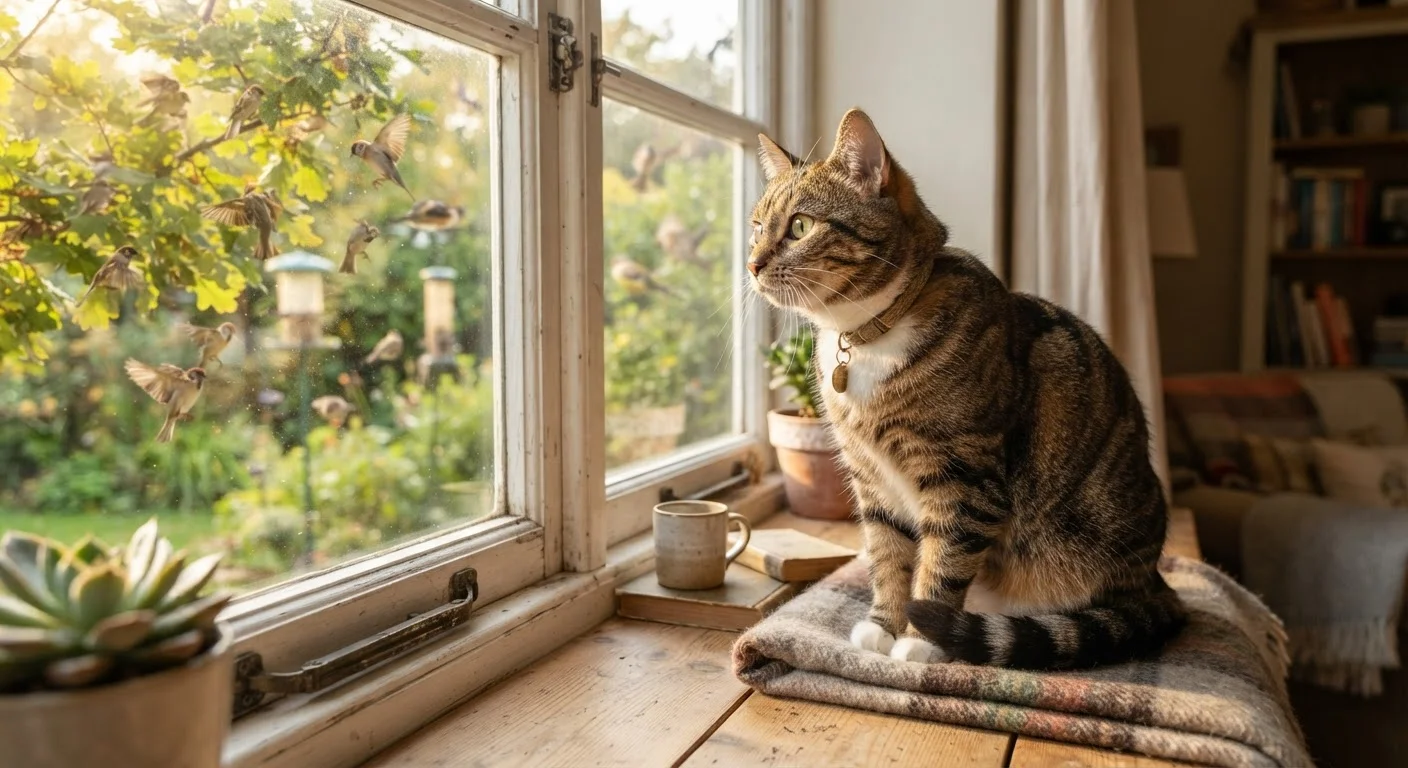
Visual stimulation is often overlooked in cat enrichment. A window perch positioned near a bird feeder or squirrel-frequented tree gives your cat hours of unpredictable, live entertainment - often called "cat TV" by owners who've discovered how transfixing it can be.
The perch itself matters: it should be sturdy, wide enough for your cat to sprawl comfortably, and positioned at a height that lets them feel elevated and secure. Adding a suction-cup bird feeder to the outside of the window creates movement and wildlife activity just inches from your cat's nose. This combination addresses visual, auditory, and even olfactory curiosity simultaneously.
A bird feeder positioned outside a window can provide hours of daily visual stimulation.
Scent Enrichment and Herb Gardens
Cats have roughly 200 million scent receptors - about 40 times more than humans. Scent enrichment uses that sensitivity as a powerful engagement tool. Catnip is the classic example, but silver vine, valerian root, and Tatarian honeysuckle wood are alternatives that produce similar or even stronger responses in cats who don't react to catnip.
Potted cat grass or a small herb garden with cat-safe herbs like valerian lets cats sniff, rub, and chew in a controlled way. Introducing a new scent on a cloth - a piece of bark from outside, a dried herb bundle - gives your cat novel sensory information to process without any safety risk. Rotate scents every few days to prevent habituation.
Cats experience the world primarily through smell - scent enrichment taps directly into that strength.
Vertical Space and Climbing Structures
Height is security in cat psychology. Cats that can survey a room from above feel safer and exhibit fewer stress behaviors than those confined to floor level. Tall cat trees, wall-mounted shelves, or even a cleared bookshelf top all provide valuable vertical territory.
If floor space is limited, wall-mounted "catwalks" - a series of shelves at staggered heights - let cats travel an entire room without touching the ground. Adding different textures (carpet, sisal, bare wood) across the structure gives paws varied sensory input and satisfies the urge to scratch in appropriate locations. For a fuller picture of how physical setup affects your cat's comfort, keeping an indoor cat mentally stimulated covers related strategies in depth.
Cats feel more secure when they can observe their environment from an elevated vantage point.
Interactive Play That Mimics the Hunt
A wand toy waved erratically across the floor is infinitely more engaging than a static toy left out indefinitely. The key is mimicking real prey behavior: start slow, pause, dart suddenly, hide under fabric, and always let your cat make the final "kill" before ending the session. Abruptly pulling the toy away every time can leave cats frustrated and less willing to engage next time.
Two 10-to-15 minute play sessions per day - ideally one in the morning and one before the cat's evening meal - are generally more effective than one long session. Ending play near mealtime aligns with the natural hunt-catch-eat-groom-sleep cycle, which can also improve nighttime behavior and reduce early-morning activity.
Always let your cat make the final catch - an unresolved hunt cycle can cause lasting frustration.
Cardboard Boxes, Paper Bags, and DIY Hideouts
The internet's long-running observation that cats prefer boxes to expensive toys is backed by behavioral research. Enclosed spaces give cats a sense of control over their environment - they can observe without being seen, retreat when overstimulated, and feel thermally insulated. A simple cardboard box with a hole cut in the side outperforms many commercial cat condos for this purpose.
Crinkle paper bags (with handles removed for safety), paper grocery bags laid flat, and tunnels made from rolled cardboard all create exploration opportunities at zero cost. Cats are drawn to novelty, so rotating these items in and out - rather than leaving them permanently - sustains interest far longer.
Enclosed hideouts give cats a sense of control, reducing stress and supporting confident behavior.
Building Enrichment Into Daily Life
The most effective enrichment isn't a single activity - it's a rotating mix woven naturally into your cat's day. Swap puzzle feeders every week or two so your cat doesn't lose interest. Rotate scent sources, rearrange climbing structures occasionally, and vary when and how you run interactive play sessions. Cats are creatures of habit in some ways, but they're also wired to notice change in their environment.
Rotate Enrichment to Prevent Boredom
Cats habituate quickly to static items in their environment. Swap puzzle feeders, scent sources, and toys on a weekly or biweekly schedule to preserve novelty. Keeping a small "library" of enrichment items and cycling them in and out is more effective - and cheaper - than continually buying new products.
If you notice a sudden drop in interest across all enrichment activities, it's worth a vet visit. Reduced engagement can sometimes signal an underlying health issue rather than simple boredom. For cats who seem unmotivated around food-based enrichment specifically, reviewing their overall diet is a smart step - our guide on how cat nutrition actually works can help you assess whether their feeding routine is meeting their needs. Enrichment and nutrition work together: a well-fed, physically healthy cat is far more likely to engage enthusiastically with their environment.
The content on this site is provided for informational purposes only and should not be considered a substitute for professional advice. While we strive to provide accurate and up-to-date information, we make no guarantees regarding its completeness or accuracy. Always consult a qualified professional for advice specific to your circumstances before making any decisions.