

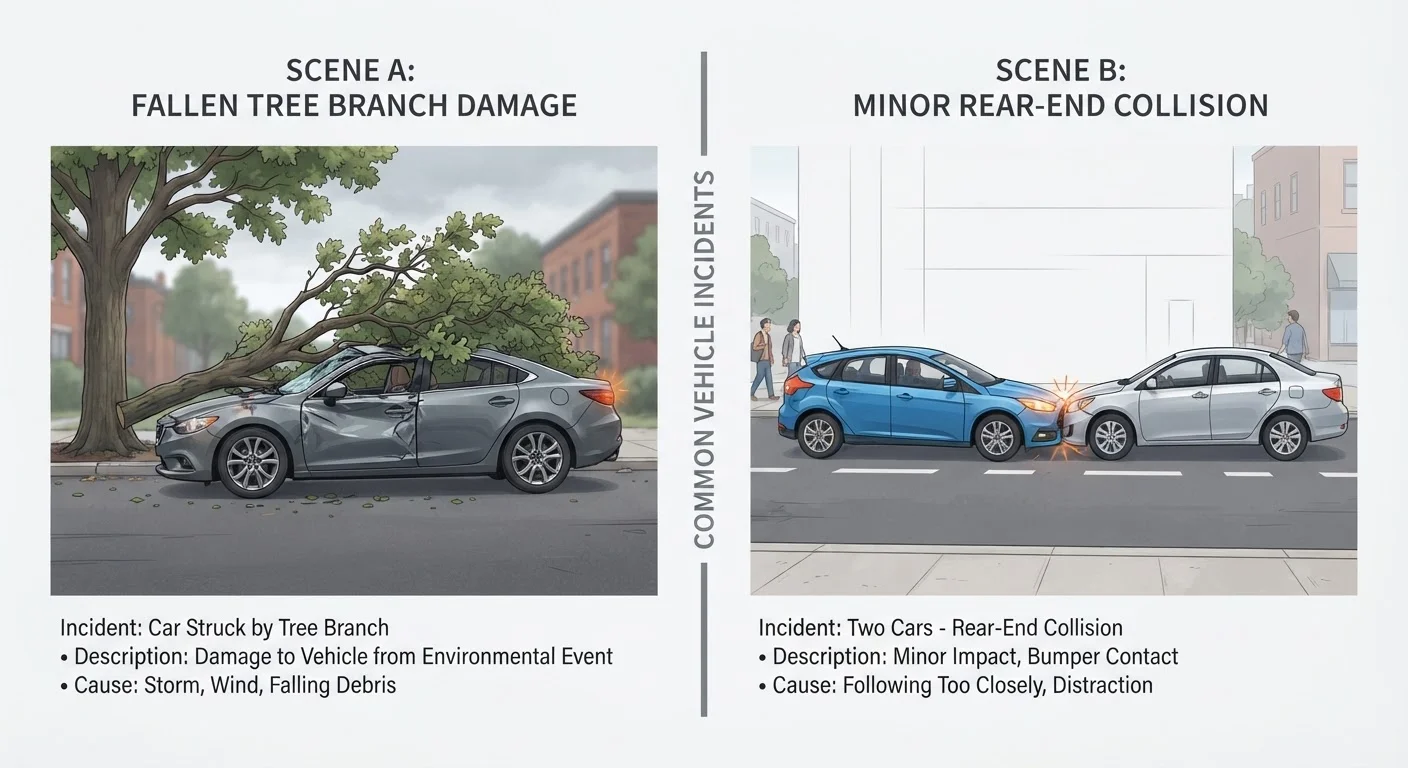
Option A
Comprehensive Coverage
Protection from the world acting on your vehicle.
Best for: Owners who want coverage against theft, weather, and non-collision damage outside their control.
Option B
Collision Coverage
Protection from accidents involving your vehicle's movement.
Best for: Drivers who want their vehicle repaired regardless of fault when they're involved in a crash.
The Core Distinction: What Triggers Each Coverage
The simplest way to separate these two coverages is by asking: what caused the damage? Comprehensive coverage applies when something outside of a driving collision damages your vehicle. Collision coverage applies when your vehicle strikes - or is struck by - another vehicle or object while in motion.
Comprehensive (sometimes called "other than collision") covers events like theft, vandalism, fire, hail, flooding, falling objects, and animal strikes. If a deer runs into your car or a tree limb falls on the hood, that's a comprehensive claim. Collision coverage, by contrast, responds when you rear-end another car, back into a pole, or roll your vehicle - regardless of who's legally at fault.
Neither coverage pays for injuries to you or others (that falls under liability or medical payments coverage), and neither covers mechanical breakdowns unrelated to a covered event. For a deeper look at what each line item on your policy actually means, see how to read your declarations page.
How Deductibles and Payouts Work
Both comprehensive and collision are subject to a deductible - the amount you pay out of pocket before your insurer covers the rest. Common deductible amounts range from $250 to $1,500. Higher deductibles generally mean lower premiums, but more exposure per claim.
Crucially, both coverages pay out based on your vehicle's actual cash value (ACV) at the time of the loss, not its original purchase price or what it would cost to replace with a new equivalent. ACV accounts for depreciation, meaning an older vehicle may receive a payout well below what you'd expect. If the cost to repair the vehicle exceeds its ACV, the insurer will typically declare it a total loss and pay the ACV minus your deductible.
| Criterion | Comprehensive Coverage | Collision Coverage |
|---|---|---|
| What triggers a claim | Non-collision events (theft, weather, animals, fire) | Vehicle striking or being struck by an object or car |
| Fault relevance | Not applicable - no crash involved | Pays regardless of fault |
| Deductible applies | Yes | Yes |
| Payout basis | Actual cash value of vehicle | Actual cash value of vehicle |
| Required by lenders/lessors | Almost always | Almost always |
| Covers theft | Yes | No |
| Covers at-fault accident damage | No | Yes |
Understanding how premiums are set - including how your deductible choice factors in - is covered in detail in our guide on how car insurance premiums are calculated.
When Carrying Both Makes Sense - and When It Might Not
For vehicles with active financing or a lease, the question is largely settled: lenders almost universally require both comprehensive and collision coverage. Dropping either without satisfying the loan puts you in breach of contract and could trigger force-placed insurance, which is typically more expensive and less protective.
For owners of older, fully paid-off vehicles, the calculation is worth running. A general rule of thumb: if your annual premium for a given coverage exceeds 10% of the vehicle's ACV, the coverage may not be cost-effective on pure financial terms alone. That said, personal risk tolerance and financial cushion matter too - someone without savings to absorb a $4,000 repair bill may reasonably choose to keep collision coverage even when the math is close.
The 10% Rule Is a Guideline, Not a Formula
The common advice to drop physical damage coverage when premiums exceed 10% of vehicle value is a useful starting point, not a firm financial rule. Your emergency fund, local risk factors (hail-prone regions, high theft ZIP codes), and driving frequency all reasonably affect the decision. Use the guideline to prompt the conversation, not to end it.
Skipping coverage on a lower-value vehicle can be reasonable, but it's a decision worth making deliberately rather than by default. Our article on common costly ownership decisions explores how well-intentioned choices like this can sometimes backfire.
Edge Cases Worth Knowing
A few scenarios trip up even experienced drivers when filing claims:
- A hit-and-run while parked: This is typically a collision claim, not comprehensive - even though your car was stationary. Your insurer's position depends on policy language, so verify with your carrier.
- Flood damage from a car wash or driving through high water: Comprehensive covers this. If you drive intentionally into a flooded road and sustain damage, coverage may still apply, but circumstances matter.
- Hitting an animal: Deer, dogs, and other animals are comprehensive events. Swerving to avoid an animal and hitting a guardrail, however, is a collision claim.
- A cracked windshield: Usually comprehensive - but some policies include separate glass coverage with no deductible. Check your declarations page.
Reducing your exposure to at-fault collisions through better driving habits can also reduce how frequently you need to lean on collision coverage. Defensive driving techniques are one practical way to lower your overall risk profile on the road.
~$192
Average annual comprehensive premium (U.S.)
According to the National Association of Insurance Commissioners, the average U.S. expenditure for comprehensive coverage has historically been well under $200 annually, though individual rates vary widely.
~$381
Average annual collision premium (U.S.)
Collision coverage consistently costs roughly twice as much as comprehensive on average, reflecting its higher claim frequency, per NAIC data.
The content on this site is provided for informational purposes only and should not be considered a substitute for professional advice. While we strive to provide accurate and up-to-date information, we make no guarantees regarding its completeness or accuracy. Always consult a qualified professional for advice specific to your circumstances before making any decisions.