

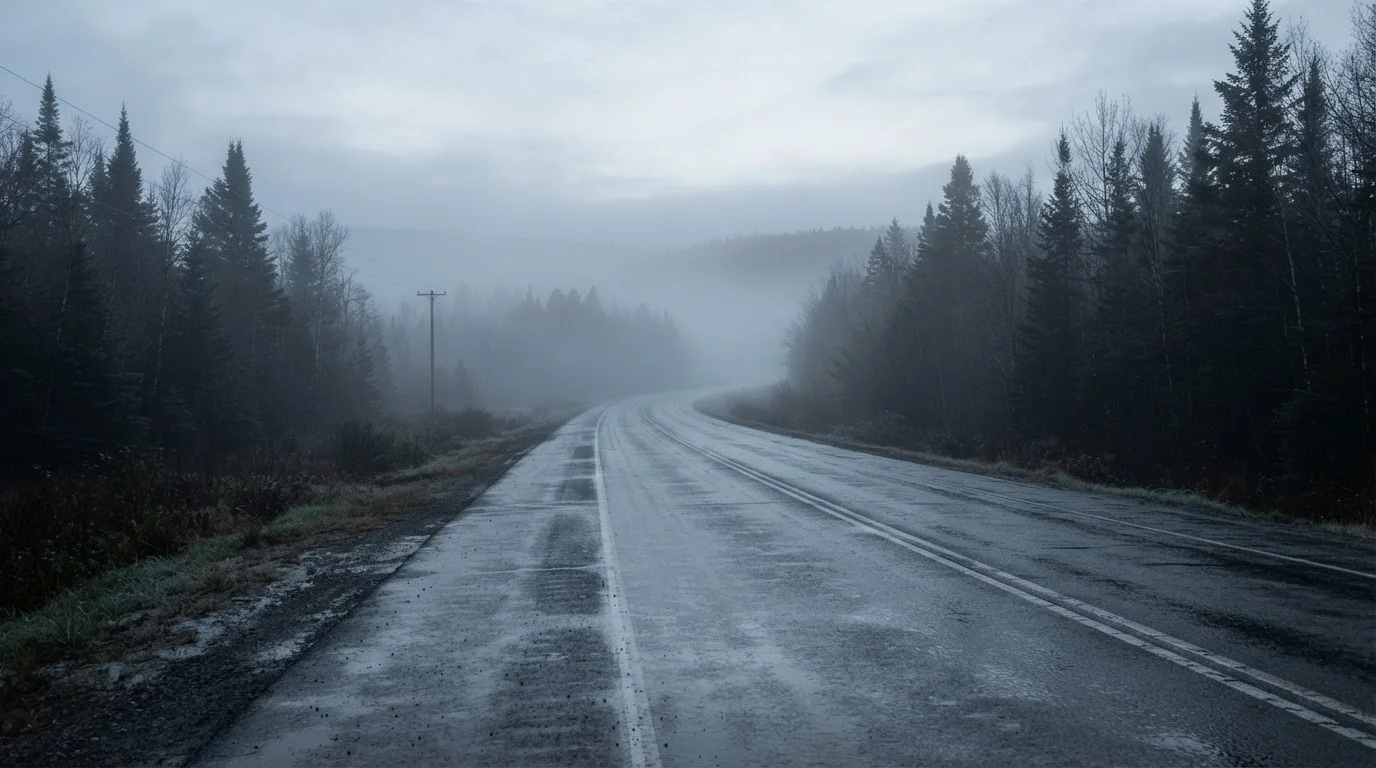
The Hazards You Don't See Coming
Most drivers mentally prepare for obvious dangers - heavy rain, construction zones, dense fog. What catches people off guard are the hazards that look completely ordinary until something goes wrong. These are the conditions that don't announce themselves with warning signs or dramatic weather, yet they account for a significant share of loss-of-control crashes on American roads.
Recognizing these invisible hazards requires understanding not just what they look like, but how they behave - and why human perception consistently fails to register them as threats in time. The list below covers the road conditions that experienced safety professionals consider the most consistently underestimated.
Before heading out, a pre-trip walkaround can catch some vehicle-side issues that make these hazards more dangerous - low tire pressure in particular significantly worsens your ability to handle any of the conditions described here.
Black Ice
Black ice is a thin, nearly transparent layer of glaze ice that forms on pavement - most commonly on bridges, overpasses, shaded road sections, and low-lying areas where cold air pools. It earns its name because it blends so completely with the dark asphalt beneath it that drivers see nothing unusual until the vehicle loses traction.
What makes black ice particularly deceptive is when it forms. It can appear at air temperatures several degrees above the 32°F freezing point on surfaces that have already chilled from previous overnight lows. Bridges are especially prone because cold air circulates underneath them, chilling the surface faster than road sections built on ground. If the pavement looks slightly glossy or wet but surrounding surfaces seem dry, treat it as potential ice and reduce speed before entering.
Black ice can form on bridges even when air temperatures are technically above freezing.
Sun Glare
Low-angle sunlight during the first and last hour of daylight can produce near-total visual whiteout for drivers heading directly into it. Unlike fog or rain, sun glare strikes without warning and can last for several seconds at a stretch - long enough to miss a red light, a pedestrian, or a car that has stopped ahead.
The hazard is compounded by a dirty windshield. Road film, interior haze, and small chips all scatter incoming light, turning a manageable brightness into a blinding wash. Clean windshields - inside and out - reduce the severity significantly. Polarized sunglasses help cut reflected glare from wet surfaces, though they don't fully neutralize direct sun angle. Reducing speed and increasing following distance during glare-heavy conditions is essential, as even brief visual impairment functions like distraction in terms of reaction time.
A dirty windshield can turn manageable sunlight into a complete visual whiteout for drivers.
Standing Water and Hydroplaning Risk
Drivers approaching standing water on a roadway routinely underestimate two things: depth and speed threshold. What appears to be a shallow puddle can conceal a pothole, a depression, or runoff that is several inches deep. More critically, hydroplaning - where a tire rides up on a film of water and loses contact with the pavement - can begin at speeds as low as 35 mph on worn tires in as little as one-tenth of an inch of water.
When a vehicle hydroplanes, steering input and braking become largely ineffective until tires regain contact with the road. The correct response is to ease off the accelerator smoothly, hold the steering wheel steady, and avoid sudden braking. Tire tread depth is directly related to hydroplaning resistance: deeper tread channels water away from the contact patch more effectively, which is one reason tire condition is a critical part of any routine pre-drive inspection.
Hydroplaning can begin at speeds as low as 35 mph on worn tires in minimal standing water.
Road Crown and Adverse Camber
Road crown refers to the slight arch built into the center of a roadway to encourage water drainage toward the edges. On well-maintained urban roads, this is subtle and rarely noticeable. On older rural highways and certain curve sections, the crown or camber can be pronounced enough to pull a vehicle toward the shoulder - a phenomenon that catches drivers off guard, particularly in curves where the bank tilts in the wrong direction (adverse camber).
Adverse camber on a curve means the road tilts away from the direction of the turn rather than into it, reducing the natural centripetal force that helps vehicles navigate bends. Drivers entering such curves at highway speeds may find themselves applying unexpected steering correction. Slowing before the curve - not during it - is the standard safe-driving principle here, and it applies with greater urgency on roads where camber cannot be confirmed in advance.
Adverse camber tilts the road away from a curve, reducing the natural force that keeps vehicles on track.
Loose Surface Material
Gravel, sand, and dirt deposited across otherwise paved roads are easy to underestimate because the pavement itself looks intact. Construction runoff, agricultural traffic, and road shoulder erosion regularly deposit loose material at intersections, curves, and rural road junctions. On a dry day with clear visibility, this looks like ordinary road surface - until braking or turning reveals dramatically reduced friction.
Loose material sitting on top of pavement effectively acts as ball bearings under tires, reducing grip in ways that can cause a vehicle to slide through a turn or extend braking distance by a significant margin. This risk is heightened immediately after rain, when wet grit provides even less traction. Scanning the road surface for color and texture variations - light patches on dark asphalt, for example - can provide early identification. Adapting speed and braking technique for gravel or degraded surfaces can make a meaningful difference in maintaining control.
Loose gravel on pavement acts like ball bearings under tires, sharply reducing braking and cornering grip.
Frost Heave and Pavement Buckling
In regions that experience freeze-thaw cycles, pavement can heave, buckle, or develop sudden sharp ridges as water beneath the road surface freezes and expands. These deformations can appear quickly - sometimes overnight - and are frequently unmarked, particularly on secondary and rural roads.
Unlike potholes, which are generally visible depressions, frost heave can create upward ridges in the pavement that are difficult to judge at speed. Striking one at highway velocity can cause sudden loss of vehicle control, tire damage, or wheel misalignment. After periods of alternating freezing and thawing temperatures in late winter and early spring, treat rural routes with additional caution and reduce speed enough to allow reaction time if pavement quality deteriorates unexpectedly.
Frost heave can create sharp pavement ridges overnight, with little visual warning for drivers approaching at speed.
Staying Ahead of What You Can't Always See
The common thread running through every hazard on this list is that perception alone isn't enough to protect you. By the time your eyes confirm the danger, your vehicle may already be responding to it. The defense is anticipation - using context clues like temperature, geography, time of day, and road age to predict where dangerous conditions are likely to exist before you enter them.
Use Temperature and Geography as Early Warnings
When outside temperatures are between 25°F and 38°F, assume ice is possible on any bridge, overpass, or shaded stretch - even if the road ahead looks clear. Similarly, approaching low-lying dips in rural roads after rain should automatically trigger a speed reduction, since water collects there and depth is impossible to judge from a distance. These contextual cues work as a hazard early-warning system even when your eyes give no obvious signal.
Developing strong scanning habits also plays a major role. Experienced drivers scan the road differently, processing pavement texture, color variations, and surface sheen in ways that give them earlier warning. And once you're on a compromised surface, knowing how to adjust - speed, braking distance, steering input - is as important as recognition. Adjusting your driving for changing surfaces is a skill that applies directly to nearly every condition described above.
Visibility hazards like sun glare also interact with other risks. Combine glare with the reduced visibility of nighttime driving during transitional light hours - dawn and dusk - and the margin for error shrinks considerably. Treat those windows as elevated-risk periods and adjust speed and following distance accordingly.
The content on this site is provided for informational purposes only and should not be considered a substitute for professional advice. While we strive to provide accurate and up-to-date information, we make no guarantees regarding its completeness or accuracy. Always consult a qualified professional for advice specific to your circumstances before making any decisions.