

Start here
What Makes a Roundabout Different from a Regular Intersection
Core rule
The Core Rule: Yield to Traffic Already Inside
Lane strategy
How to Choose the Right Lane
In practice
Entering, Circulating, and Exiting Without Hesitation
Refine your skills
Common Mistakes-and How to Avoid Them
What Makes a Roundabout Different from a Regular Intersection
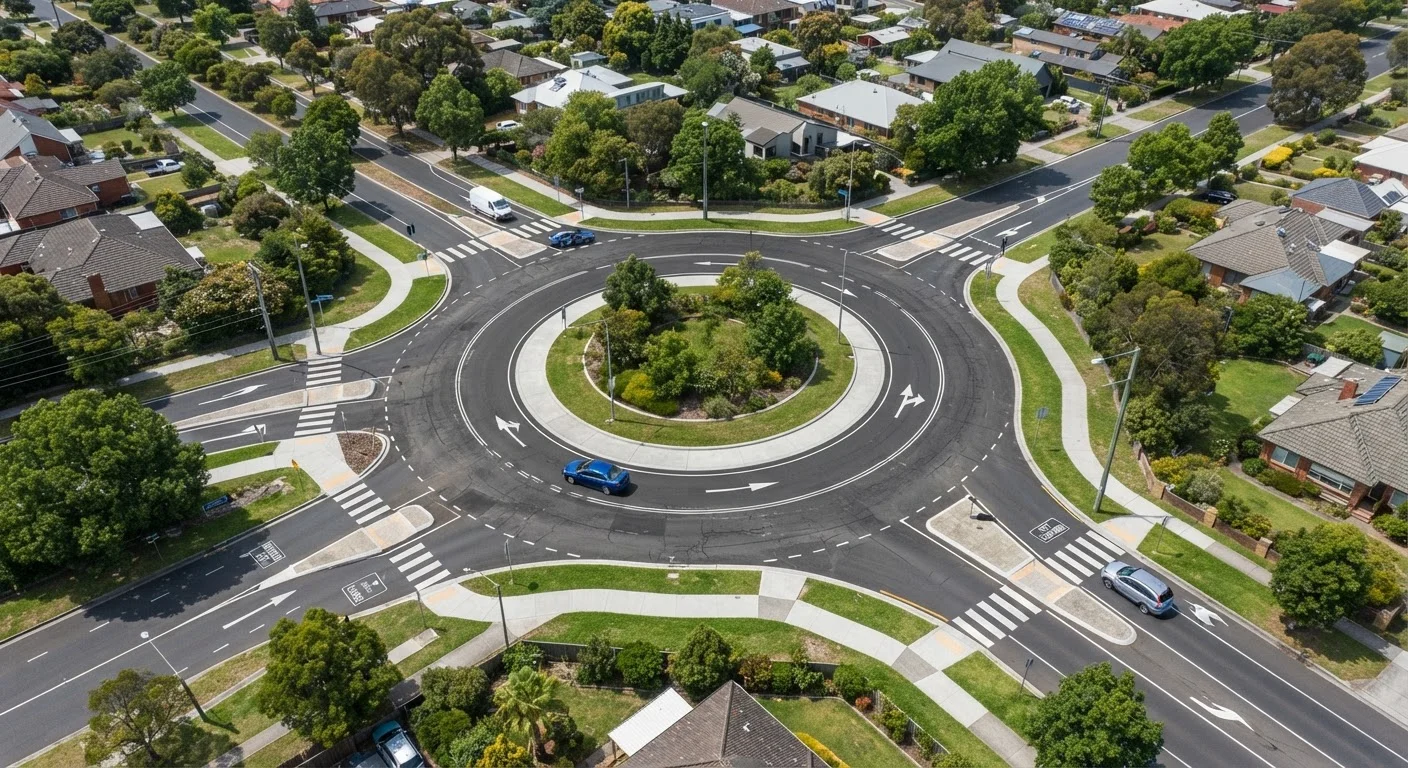
A roundabout is a circular junction where all traffic travels counterclockwise around a central island. Unlike a traditional intersection controlled by traffic signals or stop signs, a roundabout uses continuous, yield-based flow - vehicles enter when there's a safe gap and exit at the appropriate point around the circle.
That single design change eliminates the most dangerous conflict types found at standard intersections: head-on and right-angle (T-bone) collisions. Instead, any contact that does occur tends to happen at low, glancing angles. Traffic engineers have built thousands of roundabouts across the U.S. over the past two decades precisely because the safety data supports them.
Roundabout
A circular intersection where all vehicles travel in one direction (counterclockwise in the U.S.) around a central island, entering and exiting at designated points.
Yield
A traffic instruction to slow down and give the right of way to vehicles or pedestrians already in the intersection, without necessarily coming to a full stop.
Circulating lane
The travel lane inside the roundabout where vehicles move around the central island. Entering traffic must yield to vehicles already in this lane.
Splitter island
A raised or painted island that separates incoming from outgoing traffic at a roundabout's approach, helping guide drivers to the correct entry lane.
Right-of-way
The legal entitlement to proceed through a space first. In a roundabout, vehicles inside the circle always have right-of-way over those waiting to enter.
Understanding a roundabout starts with seeing it as a one-way loop with multiple entry and exit points, rather than a four-way crossing. Once that mental model clicks, the rules follow naturally. For a broader look at how road markings and signs guide you into and through intersections, see what road sign colors and markings mean.
The Core Rule: Yield to Traffic Already Inside
Every roundabout in the United States operates on one foundational rule: traffic inside the circle has the right of way. Drivers entering from any approach must yield - meaning slow down, assess the gap, and only proceed when the circulating lane is clear.
A yield sign (not a stop sign) marks every roundabout entry for a reason. You are not required to come to a complete stop unless a safe gap doesn't exist. Rolling slowly while scanning for that gap is correct behavior. Coming to a full stop when the circle is empty wastes time and confuses drivers behind you.
Finding a Gap Is a Skill, Not a Gamble
A usable gap is one where you can enter and reach highway speed without forcing circulating traffic to brake. If you're unsure, wait for the next gap - a few extra seconds of patience is always safer than a rushed entry. With experience, reading gaps becomes fast and intuitive.
Pedestrian crosswalks are located just outside the yield line at each approach. These crosswalks are separate from the circulating roadway - yield to pedestrians crossing your approach lane before you enter, then yield again to pedestrians at your exit lane as you leave. Bicyclists may use the roundabout as a vehicle or walk their bike through the crosswalk; both are legal.
How to Choose the Right Lane
Single-lane roundabouts are straightforward: there's only one choice. Multi-lane roundabouts require you to select a lane before you reach the yield line, and pavement markings or overhead signs will indicate which exits each lane serves.
- Right (outer) lane: Use for the first exit or a right-turn equivalent - typically exits at roughly the 12 o'clock position or earlier.
- Left (inner) lane: Use for exits that require passing the halfway point of the circle, such as going straight through or making the equivalent of a left turn.
Stay in your chosen lane throughout the circle. Lane changes inside a roundabout are prohibited and dangerous. If you're unsure which lane to use, the posted signs approaching the roundabout will show exit destinations with arrows indicating the appropriate lane. Treat those signs the way you would approach a highway split - read them early and position yourself before the yield line.
Multi-lane driving confidence ties directly to understanding different driving environments, where lane discipline is a skill that transfers.
Entering, Circulating, and Exiting Without Hesitation
The sequence for navigating a roundabout breaks into three clean steps:
- Approach: Slow down, read the signs, position yourself in the correct lane, and look left for circulating traffic. Yield to any pedestrians crossing your approach lane.
- Enter: When there's a clear gap in circulating traffic, merge smoothly into the circle. Match the speed of traffic inside - typically 15-25 mph in most U.S. roundabouts. Don't stop in the middle of your entry.
- Exit: Signal right before your intended exit - not before entering. Look for pedestrians in the crosswalk at your exit, yield to them, and complete your turn out of the roundabout.
If you miss your exit, don't panic. Continue around the circle and take your exit on the next pass. Reversing or cutting across lanes is far more dangerous than making one extra loop.
The signaling logic here is similar to the discipline required when merging onto a highway - you act at the moment that communicates your intent to others, not prematurely.
Common Mistakes-and How to Avoid Them
Most roundabout confusion comes down to a handful of repeated errors:
- Stopping inside the circle: This is the most disruptive thing a driver can do. Unless an emergency or collision forces it, keep moving once you're in the roundabout.
- Entering without yielding: Pulling directly into circulating traffic without checking for a gap causes the majority of roundabout collisions.
- Signaling on entry: There's nothing to signal when you enter - all traffic in a roundabout goes the same direction. Signal only when exiting.
- Changing lanes inside: Pick your lane before the yield line and hold it. Mid-circle lane changes are a leading cause of sideswipe incidents.
- Tailgating: Roundabouts require quick reactions as drivers enter and exit. Maintain a comfortable following distance inside the circle.
Large Vehicles Need Extra Space
Trucks, buses, and vehicles towing trailers may need to use both lanes or straddle lane lines to navigate tight roundabouts. If you see a large vehicle entering or circulating, give it extra clearance. Don't position yourself alongside a truck inside a roundabout - it may need the space your lane occupies.
Becoming a confident roundabout driver is part of the broader skill set that city driving demands. With practice, what once felt uncertain becomes one of the most efficient intersections you'll encounter.
Frequently Asked Questions
Vehicles already circulating inside the roundabout always have the right of way. Drivers approaching an entry point must yield and wait for a safe gap before entering. You do not stop once inside unless traffic ahead forces it.
You don't signal when entering. Instead, signal right as you approach your intended exit to let other drivers and pedestrians know you're leaving the roundabout. Begin the signal before you reach the exit.
For a left turn (or any exit past the halfway point of the roundabout), use the left or inner lane if one is available. Follow posted lane markings, which indicate which exits each lane serves.
You should only stop inside a roundabout if an emergency vehicle is approaching or a collision makes it unavoidable. Stopping arbitrarily inside the circle blocks traffic and creates serious collision risk.
Simply continue around the circle and take your exit on the next pass. Do not reverse, brake sharply, or attempt to cut across lanes. Going around again is the safest and correct response.
Research from organizations such as the Insurance Institute for Highway Safety indicates roundabouts significantly reduce fatal and injury crashes compared with conventional stop-sign or signalized intersections. The elimination of high-speed T-bone and head-on conflict points is a primary reason.
The content on this site is provided for informational purposes only and should not be considered a substitute for professional advice. While we strive to provide accurate and up-to-date information, we make no guarantees regarding its completeness or accuracy. Always consult a qualified professional for advice specific to your circumstances before making any decisions.