

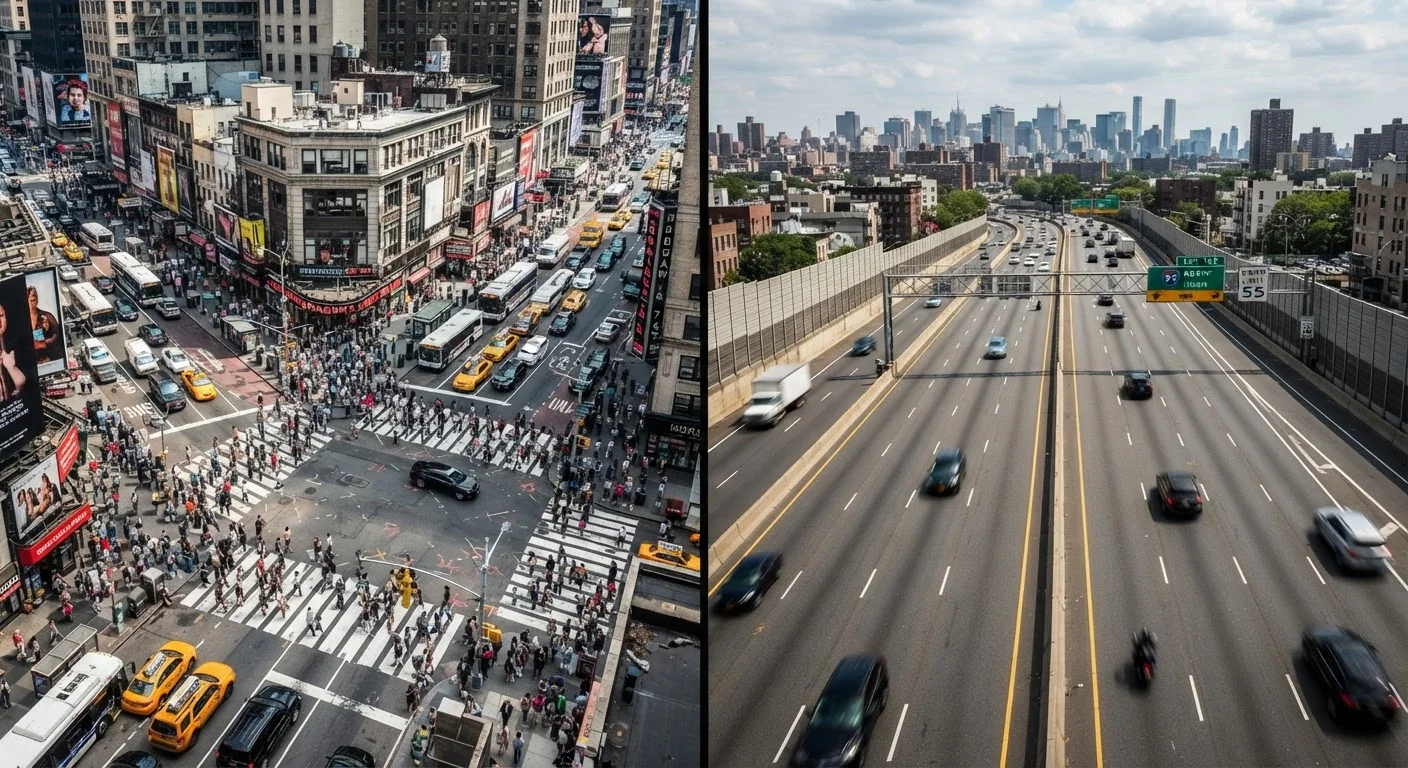
Option A
Highway Driving
The high-speed, sustained-attention environment.
Best for: Drivers covering long distances who need to manage speed, lane discipline, and safe following distance at 60+ mph.
Option B
City Driving
The low-speed, high-complexity urban challenge.
Best for: Drivers navigating dense traffic, pedestrians, cyclists, and frequent stops in unpredictable urban environments.
The Core Difference: Speed vs. Complexity
At its simplest, highway driving is a high-speed, relatively structured environment, while city driving is a low-speed, high-complexity one. But those surface-level differences conceal fundamentally different cognitive demands on the driver.
On a highway, the challenge is sustained attention over time. Speeds of 65-75 mph compress your reaction window dramatically - at 70 mph, you cover roughly 103 feet per second. A lapse in concentration or a misjudged following distance can have severe consequences. The environment is largely predictable: lanes are marked, entry and exit points are defined, and cross-traffic is eliminated. The dangers are speed-related - rear-end crashes, lane-drift incidents, and high-speed merging conflicts.
In a city, the challenge is constant, rapid decision-making under a much lower speed ceiling. Intersections, pedestrian crossings, cyclists, double-parked vehicles, delivery trucks, and unpredictable turning behavior all demand attention in quick succession. The environment changes block by block. Statistically, urban environments generate more frequent collisions, though highway crashes tend to be far more severe when they do occur.
Recognizing which mode you're in - and mentally shifting gears accordingly - is a skill in itself. For more on how scanning techniques differ across environments, see how experienced drivers scan the road.
| Criterion | Highway Driving | City Driving |
|---|---|---|
| Typical speed range | 55-80 mph | 15-45 mph |
| Primary hazard type | High-speed rear-end, lane drift | Intersection conflicts, pedestrians |
| Decision frequency | Lower - longer reaction windows | Very high - constant decisions |
| Crash severity (when occurs) | Generally higher | Generally lower |
| Crash frequency | Lower per mile driven | Higher per mile driven |
| Key skill required | Merging, following distance, lane discipline | Intersection awareness, scanning, anticipation |
| Recommended scan distance | 12-15 seconds ahead | 4-6 seconds ahead |
| Environment predictability | Higher - structured entry/exit points | Lower - frequent unexpected hazards |
Highway-Specific Skills Every Driver Should Know
Merging at speed is one of the most technically demanding routine driving tasks. A proper highway merge requires matching the speed of traffic on the main lanes before entering - not slowing at the end of the on-ramp. Most errors happen when drivers brake instead of accelerate, or attempt to merge without an adequate gap. Our detailed breakdown of merging onto a highway correctly covers gap selection and signaling in depth.
Following distance on a highway is commonly underestimated. At 65 mph, a minimum three-second gap is widely recommended - more in adverse conditions. Many drivers routinely follow at one second or less, which leaves almost no stopping margin. Tailgating at highway speeds is one of the leading contributors to rear-end crashes.
Lane discipline matters more at speed. Frequent unnecessary lane changes increase collision risk, particularly in heavy traffic. The left lane on most U.S. highways is intended for passing, not cruising - staying in it unnecessarily contributes to traffic congestion and aggressive driving by others.
Exit timing is also highway-specific. Missing an exit and attempting a last-second lane cut across multiple lanes is a significant hazard. Identifying exits early and moving gradually is far safer than reactive positioning.
~52%
Of fatal crashes occur on rural/highway roads
According to the National Highway Traffic Safety Administration, rural roads account for a disproportionate share of traffic fatalities relative to vehicle miles traveled.
103 ft/sec
Distance covered at 70 mph
At highway speeds, a vehicle travels approximately 103 feet every second, leaving a very narrow margin for error if following distance is insufficient.
3 seconds
Minimum recommended highway following gap
Safety guidance from driving authorities widely recommends a minimum three-second following distance on highways, increasing to four or more seconds in poor conditions.
City Driving: Managing the Unexpected
Urban driving demands a different mental posture: expect the unexpected at every intersection. A pedestrian stepping off the curb mid-block, a cyclist appearing from between parked cars, a door opening into traffic - city hazards are often invisible until the last moment.
Intersection behavior is where most urban crashes occur. Running a red light or misjudging a yellow is a major risk factor, but so is assuming that a green light means the intersection is clear. Cross-traffic violations are common enough that a brief scan before proceeding on a green is a sound habit, not an overreaction.
The space around parked cars deserves consistent attention. Dooring - when a parked car's door opens into a moving vehicle or cyclist - happens quickly. Maintaining a slight buffer from parked vehicles when traffic allows gives you reaction time.
Roundabouts, increasingly common in American cities, require their own subset of urban driving logic. If they still feel counterintuitive, how roundabouts actually work explains the yield rules and lane logic clearly.
Urban driving also intersects with conditions. Wet streets, reduced visibility at night, and slick intersections all compound city complexity. For a deeper look at how road surfaces change the equation, see adjusting for changing road surfaces.
Switching Between Environments Safely
Many drivers make the transition between highway and city multiple times in a single commute - often without consciously adjusting. That mental inertia is a real risk. Highway driving can dull the reactive alertness that city driving demands; city driving's stop-and-go rhythm can make the sustained vigilance of highway speeds feel less urgent.
A practical habit: treat each environment transition as a deliberate reset. When exiting a highway into urban traffic, consciously lower your expected speed, expand your scan range to include sidewalks and intersections, and shorten your focus from the distant horizon to the immediate block ahead. When entering a highway, shift your attention further down the road - experienced highway drivers typically scan 12-15 seconds ahead rather than the 4-6 seconds typical of city scanning.
Nighttime adds another layer of difficulty to both environments. why night driving is genuinely more dangerous explains how reduced visibility, glare, and fatigue compound the risks whether you're on an interstate or an urban surface street.
The drivers who handle both environments well share one trait: they adapt deliberately rather than assuming their habits from one setting will transfer cleanly to the other.
The content on this site is provided for informational purposes only and should not be considered a substitute for professional advice. While we strive to provide accurate and up-to-date information, we make no guarantees regarding its completeness or accuracy. Always consult a qualified professional for advice specific to your circumstances before making any decisions.