

Why a Tiered System Exists in the First Place
New teen drivers face a disproportionate crash risk that isn't simply about attitude or carelessness. Adolescent brains are still developing the cognitive functions involved in hazard perception, impulse control, and multi-tasking under pressure - all of which are essential behind the wheel. Combine that developmental reality with limited driving experience, and the statistical risk becomes clear.
According to the Insurance Institute for Highway Safety (IIHS), per mile driven, teen drivers ages 16-17 are nearly three times as likely to be involved in a fatal crash as drivers 20 and older. GDL programs were designed specifically to address this window of elevated risk by controlling when, with whom, and under what conditions new drivers practice before gaining independence.
~3x
Teen crash fatality rate vs. drivers 20+
Per mile driven, 16-17 year old drivers are nearly three times as likely to be involved in a fatal crash, according to the Insurance Institute for Highway Safety.
50
U.S. states with GDL laws
All 50 states and the District of Columbia have enacted some form of graduated driver licensing, though the specific requirements and restrictions differ significantly by state.
40-65 hrs
Typical supervised driving requirement
Many states require teen permit holders to log between 40 and 65 hours of supervised driving before advancing to an intermediate license.
Rather than treating licensure as a single event, GDL treats it as a process - one where skills and privileges are matched to demonstrated readiness.
Stage One: The Learner Permit
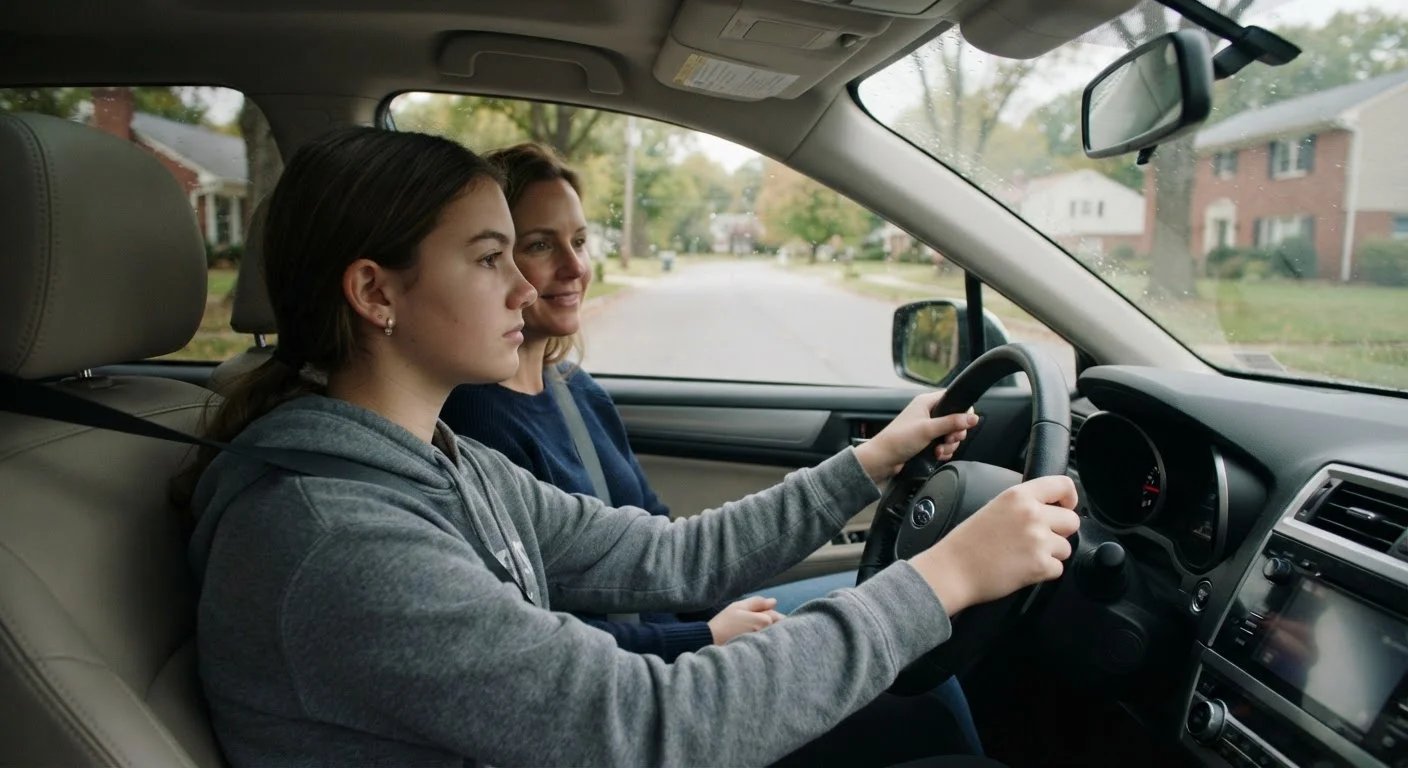
The first stage of GDL is the learner permit, sometimes called an instruction permit. At this stage, the teen may only drive with a licensed adult supervisor - typically a parent, guardian, or driving instructor - in the vehicle at all times. No solo driving is permitted under any circumstances.
Most states require a minimum age (commonly 15 or 15½) to apply for a learner permit, along with passing a written knowledge test covering traffic laws and road signs. The supervised driving requirement during this phase is significant: many states mandate 40 to 65 hours of practice, often including a set number of nighttime hours, before the teen can advance.
This stage is foundational. It's where basic vehicle control, lane discipline, and situational awareness are developed in low-stakes environments before progressing to higher-risk scenarios. See our guide to highway vs. city driving to understand the distinct skill demands teens will eventually need to master.
Stage Two: The Intermediate (Provisional) License
Once a teen passes the behind-the-wheel road test and meets the age and time requirements, they advance to the intermediate - sometimes called provisional - license. This is the most misunderstood stage of GDL, because the teen is now driving solo, but significant restrictions still apply.
The two most common restrictions at this stage are nighttime driving limits and passenger restrictions. Most states prohibit unsupervised driving after 10 or 11 p.m. for the first several months. Passenger restrictions typically prevent new drivers from carrying more than one unrelated teen passenger. Both rules target the situations most strongly linked to teen crash risk.
Passenger Restrictions Vary by State
Some states prohibit all non-family teen passengers during the first phase of the intermediate stage; others allow one. A few states have no explicit passenger restriction at all. Because requirements differ significantly, always check the specific rules for your state's GDL program through your state's motor vehicle authority.
The passenger restriction is particularly important: research has shown that crash risk for teen drivers increases with each additional teenage peer in the vehicle. Social pressure, distraction, and peer dynamics all contribute. The restriction isn't punitive - it's evidence-based.
During this stage, teens should also be building the maintenance awareness that will serve them throughout their driving life. Our article on car maintenance for new drivers covers the essentials without the overwhelm.
Stage Three: Full Licensure and What It Actually Represents
Full licensure - an unrestricted driver's license - is typically available once a driver reaches 18, or in some states, once they've held the intermediate license for a set period (often 12 months) with a clean record. At this point, nighttime and passenger restrictions are lifted.
What full licensure does not mean is that learning is over. New drivers, even those with a full license, benefit significantly from continued deliberate practice - particularly in higher-risk environments like highway merging, adverse weather, and heavy urban traffic. Adopting a defensive driving mindset is one of the most durable habits a new driver can build at this stage.
Parents and guardians also play a continuing role. Research suggests that parental rules and monitoring during the GDL period significantly influence how teens drive - even when no official enforcement is present. Setting clear household expectations reinforces what the law alone cannot always guarantee.
This article is for general informational purposes only. Specific GDL requirements vary by state; always verify the exact rules with your state's department of motor vehicles or equivalent licensing authority.
Frequently Asked Questions
GDL programs are designed to reduce crashes among new teen drivers by limiting their exposure to the highest-risk driving situations - like night driving and carrying multiple teen passengers - until they have more experience. Research consistently shows these staged restrictions lower teen crash fatalities.
Requirements vary by state, but many states require between 40 and 65 hours of supervised driving during the learner permit stage, often including a set number of nighttime hours. Parents or guardians typically verify and log these hours.
Most states restrict the number of non-family passengers a provisional license holder can carry, especially during the first 6-12 months of the intermediate stage. Some states prohibit any teenage passengers; others allow one. Check your state's specific rules.
Penalties vary by state but can include fines, license suspension, or being reset to an earlier licensing stage. Violations may also delay when the teen can advance to a full unrestricted license.
Most states lift GDL restrictions when a driver reaches 18, regardless of how long they've held a license. Some states base advancement on a combination of age, time in stage, and a clean driving record.
Yes. Studies by highway safety research organizations have found that comprehensive GDL laws are associated with meaningful reductions in fatal crash involvement among 16- and 17-year-old drivers. The strongest benefits come from states with the most complete sets of restrictions.
The content on this site is provided for informational purposes only and should not be considered a substitute for professional advice. While we strive to provide accurate and up-to-date information, we make no guarantees regarding its completeness or accuracy. Always consult a qualified professional for advice specific to your circumstances before making any decisions.