

Start here
Why Maintenance Matters From Day One
Build confidence
The Checks You Can Do Yourself
Know the schedule
Service Intervals: What Gets Done and When
Stay alert
Warning Signs You Should Never Ignore
Think long-term
Building Habits That Protect Your Car Long-Term
Why Maintenance Matters From Day One
A car is the second-largest expense most Americans carry, and how well you maintain it determines whether it stays reliable for years or starts generating costly surprises. For new drivers, the good news is that most of what keeps a car in good shape is straightforward - it just requires consistency rather than expertise.
Neglected maintenance doesn't usually announce itself dramatically. It tends to compound quietly: a low tire goes unchecked and wears unevenly, an oil change gets skipped once too often, and a small coolant leak becomes an overheated engine. Understanding the basics from the start puts you in control of that trajectory. For a broader look at the full scope of first-time ownership, see our first-time owner's guide.
The Checks You Can Do Yourself
Several maintenance checks require no tools, no training, and less than five minutes. Making these part of a monthly habit covers a significant portion of what keeps a car safe and roadworthy.
Owner's manual
The booklet that came with your car containing the manufacturer's specific guidance on maintenance schedules, fluid specifications, and warning indicators. It is the most authoritative source for your particular vehicle.
Tire pressure (PSI)
A measure of how much air is inside your tires, expressed in pounds per square inch. Correct pressure keeps handling safe and tire wear even - the right number for your car is on the door jamb sticker.
Oil viscosity
A rating that describes how thick or thin motor oil is, such as 5W-30. Your owner's manual specifies the correct grade; using the wrong type can reduce engine protection.
Service interval
The recommended time or mileage between routine maintenance tasks - for example, an oil change every 5,000 to 7,500 miles depending on your vehicle and oil type.
OBD-II code
A standardized diagnostic code stored by your car's computer when it detects a problem. A mechanic or auto parts store can read these codes with a scanner to identify what triggered a warning light.
Brake pad wear indicator
A small metal tab built into brake pads that makes a high-pitched squealing sound when the pad material wears thin, alerting you that brake service is needed.
- Tire pressure: Use an inexpensive pressure gauge to check all four tires (and the spare) monthly. The correct PSI is printed on the sticker inside your driver's door jamb. Under-inflated tires affect braking, fuel efficiency, and handling - particularly on wet or slippery roads.
- Engine oil level: With the engine off and cooled, pull the dipstick, wipe it clean, reinsert it fully, and read the level. If it's below the minimum mark, add the oil type specified in your owner's manual - do not mix types.
- Windshield washer fluid: A simple top-up that takes 30 seconds and directly affects visibility.
- Lights: Walk around the car periodically - or ask someone to help - to verify that headlights, brake lights, and turn signals are all working. A burned-out light is both a safety issue and a ticketable offense in most states.
- Wiper blades: Streaking or skipping means it's time to replace them. This is one of the simplest DIY tasks - most wiper blade packaging includes clear instructions.
Your Owner's Manual Is Free Expert Advice
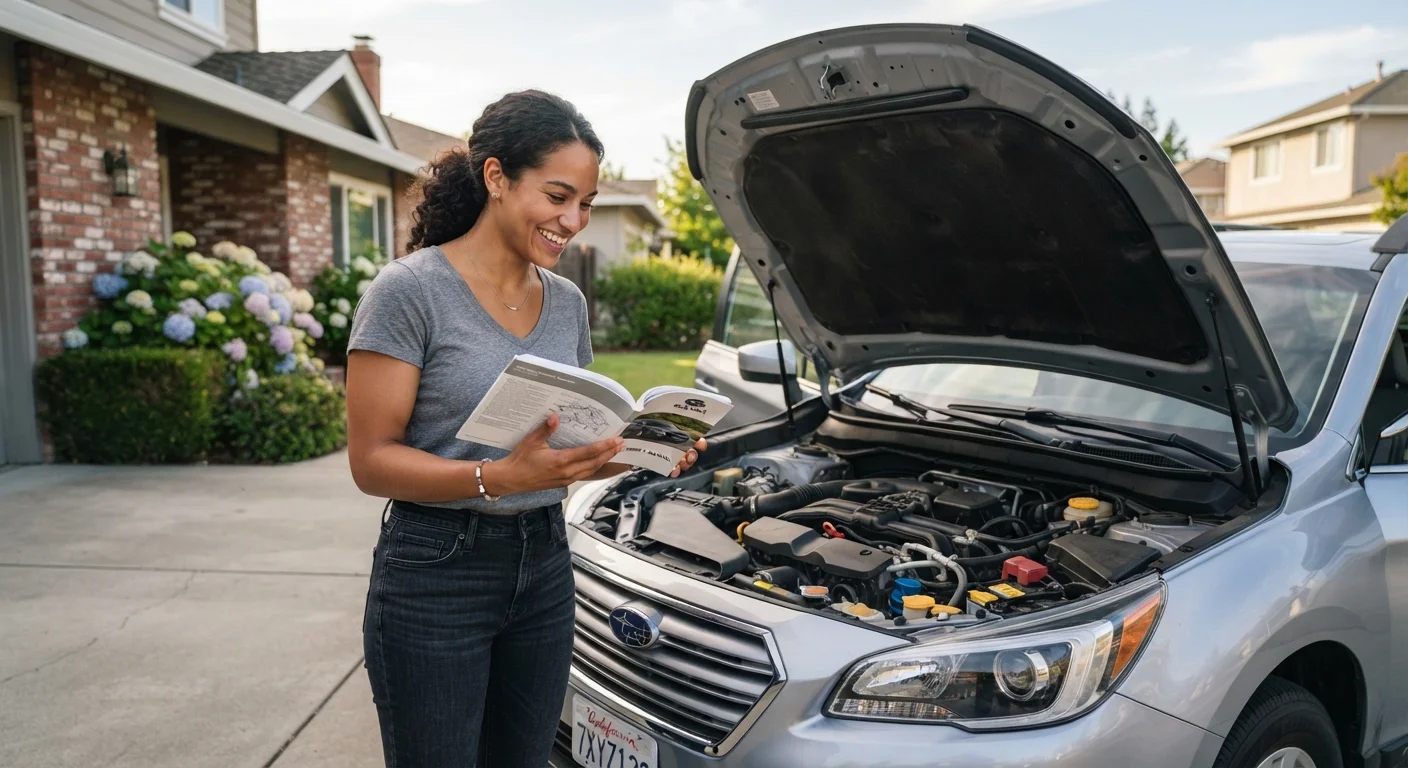
Many new drivers never open it, but the owner's manual contains your car manufacturer's exact recommendations for every maintenance task. If you don't have the physical copy, most automakers publish digital versions on their websites. It takes about 20 minutes to read the maintenance section - time well spent.
Service Intervals: What Gets Done and When
Beyond your own checks, certain services need to be performed at regular intervals by a qualified technician. Your owner's manual is the authoritative source - general estimates circulating online are starting points, not rules. For a closer look at how those common estimates often mislead drivers, see our piece on car maintenance myths.
Maintenance Schedules Vary by Vehicle
Intervals listed online or at quick-service shops are generalizations. Your specific make, model, engine type, and driving conditions all affect what your car actually needs and when. Always cross-reference any service recommendation against your owner's manual before acting on it.
| Service | General Interval (verify in manual) |
|---|---|
| Oil and filter change | Every 5,000-7,500 miles (conventional); 7,500-10,000+ miles (synthetic) |
| Tire rotation | Every 5,000-7,500 miles |
| Cabin and engine air filters | Every 15,000-30,000 miles |
| Brake inspection | At least annually, or when squealing begins |
| Coolant flush | Every 30,000-50,000 miles or per manufacturer guidance |
Understanding what tire rotation, balancing, and alignment each accomplish - and why they're separate jobs - helps you have more productive conversations with service technicians.
Warning Signs You Should Never Ignore
Dashboard warning lights exist for a reason. Learning what the most common ones mean - and what to do - is a basic ownership skill. A check engine light, a temperature gauge in the red, a battery warning, or a brake indicator all require prompt attention rather than a wait-and-see approach.
Never Ignore a Brake Warning Light
A brake system warning light - or persistent squealing and grinding when you brake - signals a condition that directly affects your ability to stop safely. Do not delay having this checked by a qualified mechanic. Driving with compromised brakes puts you and others at serious risk.
Beyond dashboard lights, pay attention to sounds and sensations: a pulling sensation when braking suggests uneven brake wear or a tire issue; vibration at highway speeds often points to a wheel balance or alignment problem; a knocking sound from the engine deserves immediate professional evaluation. If your car breaks down, knowing what to do matters just as much as knowing what went wrong - our guide on roadside emergencies walks through the steps.
Building Habits That Protect Your Car Long-Term
The most effective maintenance strategy for new drivers isn't mastering every mechanical detail - it's building a small number of reliable habits. Check the basics monthly. Follow your owner's manual service schedule. Keep a simple log of every service performed, including the date, mileage, and what was done. That log protects your warranty, simplifies future diagnosis, and supports resale value. Our guide on keeping a vehicle maintenance log explains exactly how to set one up.
As you grow more comfortable, you may want to evaluate which tasks are reasonable to handle yourself. That decision involves weighing your skill level, available tools, and the consequences of getting something wrong. Our DIY vs. professional maintenance guide offers a balanced framework for making that call. For now, confidence comes from knowing what to look for, understanding your schedule, and not waiting until something fails.
Car Ownership in America: Everything First-Time Owners Need to Know
A comprehensive guide covering registration, insurance, maintenance schedules, and roadside safety - essential reading for anyone stepping into car ownership for the first time.
Keeping a Vehicle Maintenance Log: What to Track and Why It Pays Off
A well-kept service history protects your warranty and resale value. This guide shows exactly what to record and how to build the habit from your very first service.
Under the Hood: A Plain-Language Guide to What Each System Does
Understanding what the cooling, fuel, brake, and exhaust systems actually do helps you communicate with mechanics and recognize warning signs before they become serious problems.
The Case For and Against DIY Car Maintenance
A balanced look at which maintenance tasks make sense to handle yourself and which ones genuinely require a professional - helpful for new drivers deciding where to draw the line.
Frequently Asked Questions
Check tire pressure at least once a month and before any long trip. Tires naturally lose about 1 PSI per month, and temperature swings accelerate that loss. The correct pressure is listed on a sticker inside your driver's door jamb - not on the tire sidewall.
The check engine light signals that your car's onboard diagnostic system has detected a fault - anything from a loose gas cap to a sensor issue. Don't ignore it. Have the code read at a shop to determine severity before deciding on next steps.
Consult your owner's manual for the manufacturer-recommended interval, which varies by vehicle and oil type. Many modern cars display an oil life indicator on the dashboard. Ignoring oil changes is one of the quickest ways to cause serious engine damage.
Yes - checking tire pressure, topping up washer fluid, replacing wiper blades, and checking engine oil level are all low-risk tasks most drivers can handle. For anything involving brakes, electrical systems, or structural components, a qualified mechanic should do the work.
A basic emergency kit should include jumper cables or a jump starter, a flashlight, a reflective triangle or flares, a basic first aid kit, and your roadside assistance information. See our guide on <a href="/autos-vehicles/car-ownership/roadside-emergencies-what-to-do-when-your-car-breaks-down">handling roadside emergencies</a> for more detail.
It can. Most manufacturer warranties require that you follow the recommended maintenance schedule and keep records of completed service. Gaps in documented upkeep can complicate warranty claims, so keeping a maintenance log is worth the small effort.
The content on this site is provided for informational purposes only and should not be considered a substitute for professional advice. While we strive to provide accurate and up-to-date information, we make no guarantees regarding its completeness or accuracy. Always consult a qualified professional for advice specific to your circumstances before making any decisions.