

Our Verdict
Rotation, balancing, and alignment are often bundled or confused, but each targets a fundamentally different mechanical issue. Understanding what each service actually does helps you have more informed conversations with your mechanic and avoid paying for something you don't need - or skipping something you do.
| Best for | Recommended |
|---|---|
| Drivers following a routine maintenance schedule | Tire Rotation |
| Those experiencing steering wheel vibration or shaking at speed | Wheel Balancing |
| Drivers noticing pulling to one side or uneven tread wear patterns | Wheel Alignment |
| After hitting a significant pothole or curb | Both Balancing and Alignment |
Three Services, Three Different Problems
Walk into almost any tire shop and you'll see rotation, balancing, and alignment listed side by side. That proximity leads many drivers to treat them as variations of the same task - but they're not. Each service addresses a different mechanical reality, involves different equipment, and becomes necessary under different circumstances.
Understanding the distinction isn't just useful trivia. It helps you follow your vehicle's maintenance schedule more accurately, ask better questions at the shop, and recognize warning signs before they become expensive repairs. As part of broader car ownership knowledge, it's one of the more practical things you can internalize.
| Tire Rotation | Wheel Balancing | Wheel Alignment | |
|---|---|---|---|
| What it corrects | Uneven tread wear across tires | Weight imbalance in wheel-tire assembly | Incorrect wheel angle relative to vehicle |
| Typical symptom if skipped | Tires wear out faster on one axle | Vibration or shimmy at highway speeds | Vehicle pulls left or right; uneven wear |
| Recommended interval | Every 5,000-7,500 miles | When vibration appears or new tires installed | Every 1-2 years or after impact events |
| DIY possible? | Yes, with jack stands and torque wrench | No - requires specialized balancing machine | No - requires alignment rack and laser tools |
| Time to complete | 30-60 minutes | 30-60 minutes per tire | 45-90 minutes |
| Impact on fuel economy | Indirect - extends tire life | Minor improvement when corrected | Measurable - misalignment increases rolling resistance |
Tire Rotation: Managing Wear Across All Four Tires
Tires don't wear evenly on their own. Front tires carry the weight of the engine and handle steering forces, so they typically wear faster - especially on front-wheel-drive vehicles where they also deliver power to the road. Rotation systematically moves each tire to a different position on the vehicle so that wear is distributed more evenly over time.
The common patterns - front-to-rear, cross-rotation, or the more complex patterns needed for directional or staggered tires - depend on your vehicle's drivetrain and tire type. A qualified mechanic can identify the correct pattern for your setup.
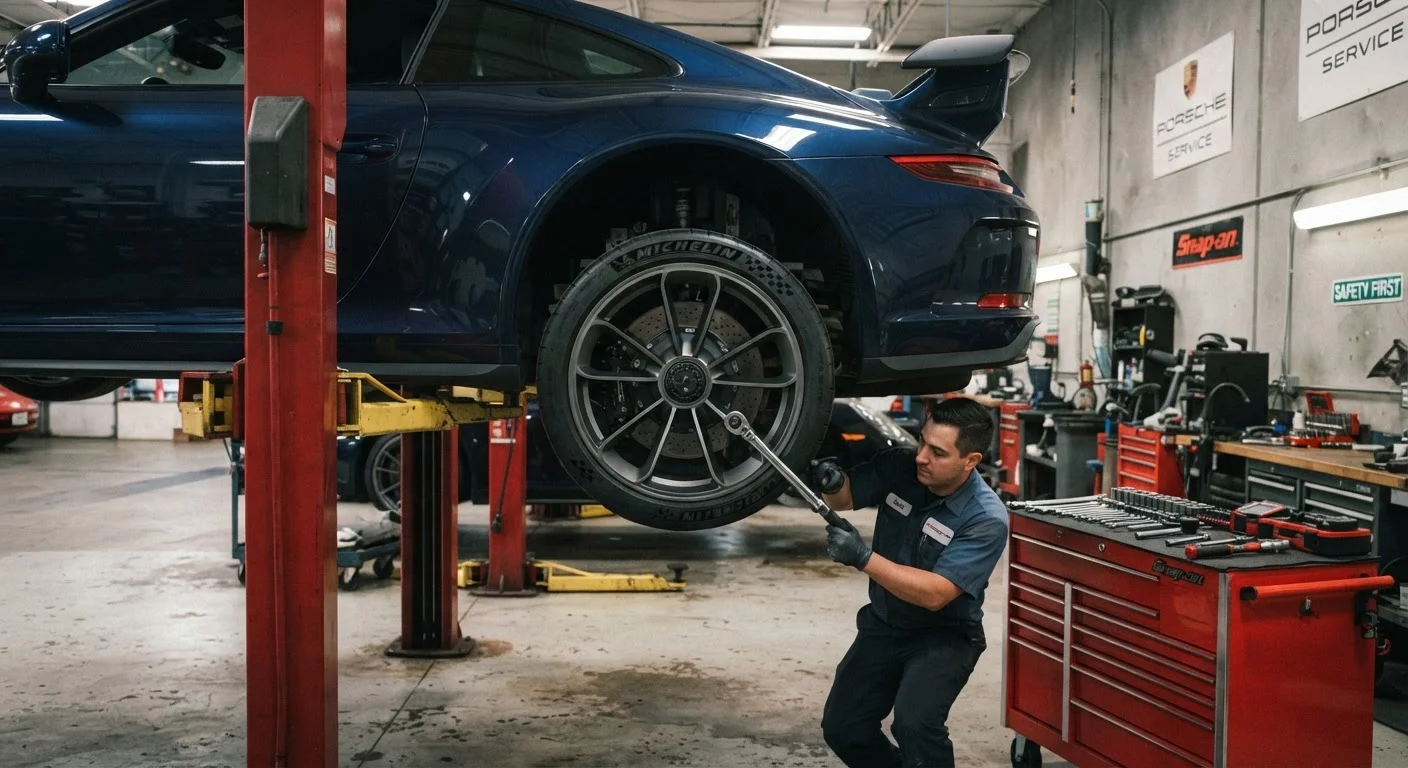
Rotation is one of the few tire services that some mechanically confident drivers handle themselves with the right equipment: a proper jack, jack stands rated for the vehicle's weight, and a torque wrench to tighten lug nuts to specification. That said, mistakes in this process can be dangerous, so if you're not experienced with safely lifting a vehicle, a professional shop is the right call. For a balanced look at what makes sense to handle yourself versus outsource, see the case for and against DIY car maintenance.
Check Your Owner's Manual First
Your vehicle's manufacturer sets specific service intervals for your drivetrain configuration - front-wheel drive, rear-wheel drive, and all-wheel drive vehicles have different rotation patterns and timing. The manual is the most reliable source for your specific car. A qualified mechanic can also advise based on your driving habits and conditions.
Wheel Balancing: Eliminating Vibration at Speed
Every wheel-and-tire assembly has minor weight variations - small inconsistencies in the rubber, the rim, or the valve stem that are invisible to the eye but significant at highway speeds. When a wheel spins at 60 or 70 mph, even a small imbalance creates a repeating vibration that you feel through the steering wheel, the seat, or the floorboard.
Balancing uses a specialized machine to spin the wheel and detect where weight is unevenly distributed. A technician then attaches small counterweights to the rim to compensate. This is not a DIY task - the machine required costs thousands of dollars and requires trained interpretation of its readings.
Balancing is typically needed when new tires are installed, when you notice vibration that wasn't there before, or after a significant impact like a pothole strike. It's also worth checking if a tire has been dismounted and remounted for any reason.
Don't Assume One Service Covers the Others
Shops sometimes bundle these services in promotional packages, which can create the impression they're the same job. Rotating your tires does not balance them, and balancing them does not align your wheels. Always confirm with your mechanic which specific service is being performed and why it's recommended for your situation.
Wheel Alignment: Correcting How Your Tires Meet the Road
Alignment refers to the geometric angles at which your tires contact the road surface, adjusted relative to each other and to the vehicle's frame. Three primary measurements matter: camber (the inward or outward tilt of the tire when viewed from the front), toe (whether the fronts of the tires point inward or outward), and caster (the angle of the steering axis). When these angles drift out of specification - due to hitting a curb, a hard pothole, or simple wear in steering and suspension components - the vehicle may pull to one side, the steering wheel may sit off-center, and tires may develop distinctive uneven wear patterns.
Alignment requires a calibrated rack and precision measuring equipment. A technician positions sensors on each wheel and reads the angles against your manufacturer's specifications, then adjusts the relevant suspension components to bring everything back into tolerance. This is not something to attempt without professional equipment.
If you're new to tracking which services your car needs and when, building a vehicle maintenance log makes it much easier to spot patterns and stay ahead of issues. Alignment is also worth checking before or after seasonal driving changes - see seasonal car care guidance for context on timing maintenance around weather.
5,000-7,500 mi
Typical tire rotation interval
Most vehicle manufacturers recommend rotation at this cadence, often aligned with oil change intervals, though always check your owner's manual.
~10%
Fuel efficiency loss from misalignment
The U.S. Department of Energy has noted that improper wheel alignment can reduce fuel efficiency by measurable margins due to increased tire rolling resistance.
The content on this site is provided for informational purposes only and should not be considered a substitute for professional advice. While we strive to provide accurate and up-to-date information, we make no guarantees regarding its completeness or accuracy. Always consult a qualified professional for advice specific to your circumstances before making any decisions.