

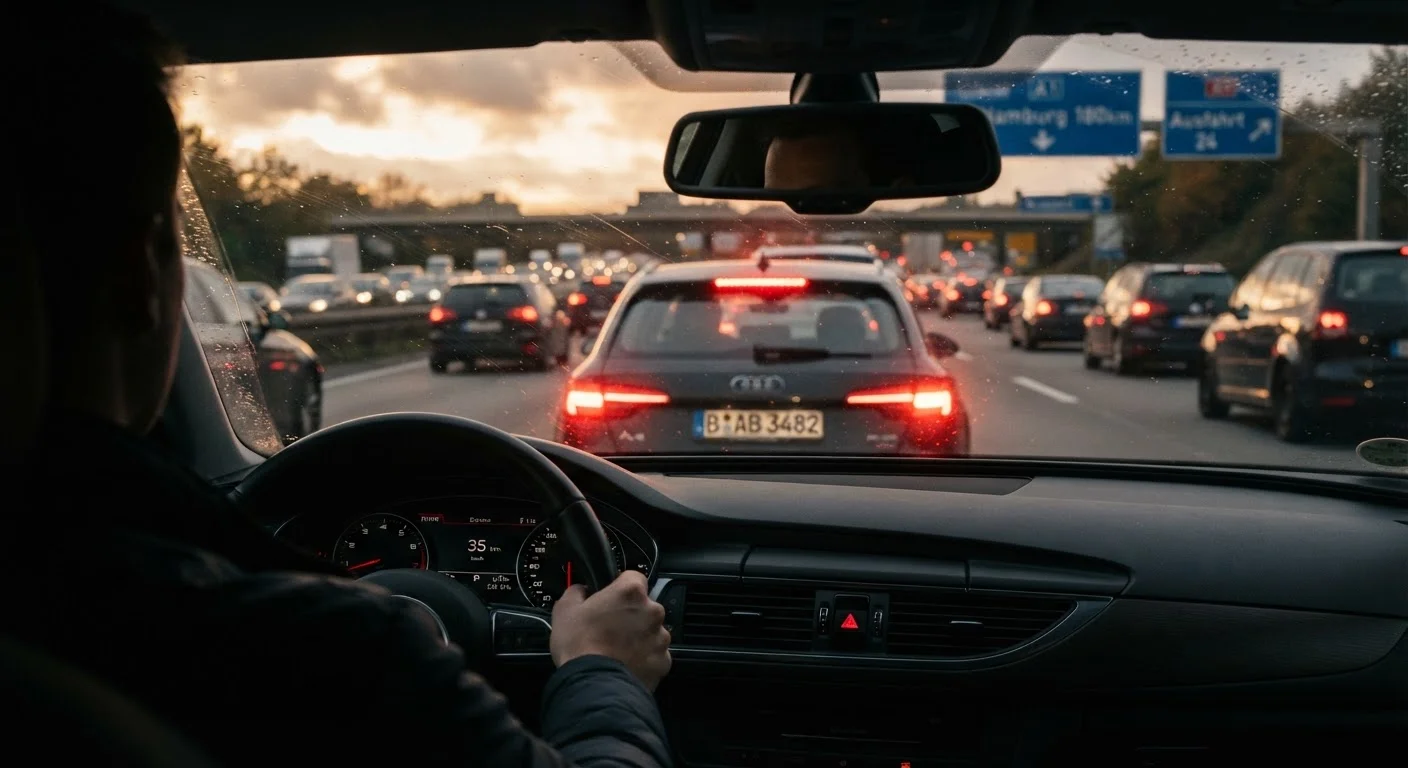
The Timeline Nobody Thinks About
A rear-end collision rarely feels sudden to investigators reconstructing the scene. There is almost always a gap - measured in seconds, sometimes fractions - where intervention was possible. Understanding that gap is the first step to not becoming a statistic.
The sequence typically goes like this: a lead vehicle brakes or stops; the following driver perceives the change; the brain processes it and sends a signal to the foot; the foot moves and presses the brake pedal; hydraulic pressure builds; and finally the vehicle begins to decelerate. At 60 mph, a car travels 88 feet per second. Even a one-second delay means 88 feet of closing distance before braking begins. At typical following gaps on American highways, that math leaves very little margin.
What makes this timeline dangerous is that most drivers dramatically underestimate it. They believe they're reacting faster than they are, that their brakes are stronger than they are, and that the car ahead won't stop as suddenly as it does. Each of those beliefs is a mistake - and together, they create crashes.
Common Mistakes That Set Up a Rear-End Crash
The following errors don't cause crashes in isolation - they compound. A driver who is both tailgating and distracted and traveling at highway speed on wet pavement has stacked multiple failure points with no margin to spare.
Following too closely for the actual stopping distance required at current speed.
Why it happens: Drivers calibrate following distance by feel rather than physics, and that intuition is consistently optimistic - especially at speeds above 45 mph.
Taking eyes off the road - even briefly - while in close proximity to other vehicles.
Why it happens: Glancing at a phone, navigation screen, or a passenger feels momentary, but at 60 mph, a two-second look translates to over 175 feet of unsupervised travel.
Overestimating braking capability - particularly on wet roads, with worn tires, or when towing.
Why it happens: Drivers develop a mental model of how quickly their car stops based on everyday low-stakes braking, which almost never approaches maximum deceleration effort.
Failing to anticipate stops by watching only the immediate vehicle ahead.
Why it happens: Tunnel vision on the lead car is a natural tendency, but it provides the least possible warning time - especially in heavy traffic where chain-braking happens rapidly.
Driving at a pace inconsistent with surrounding traffic flow, particularly when entering or slowing in fast-moving lanes.
Why it happens: Speed differential - not just absolute speed - drives crash energy. A vehicle that brakes sharply without warning in fast-moving traffic creates a mismatch that following drivers may not have time to resolve.
For a deeper look at how speed, vehicle weight, and road conditions interact with following distance, see our guide to gap management and following distance.
What the Data Reveals About These Crashes
~29%
Share of all U.S. crashes that are rear-end collisions
According to National Highway Traffic Safety Administration (NHTSA) research, rear-end crashes consistently represent roughly one in four to one in three reported collisions nationwide.
1.5 sec
Typical perception-reaction time before braking begins
Transportation safety research generally cites 1.5 seconds as a standard perception-reaction interval under normal conditions - longer when distracted or fatigued.
132 ft
Minimum stopping distance at 60 mph on dry pavement
This figure reflects reaction distance plus braking distance for a typical passenger vehicle with good tires - wet or worn-tire conditions extend it considerably further.
Speed differential is a concept many drivers overlook. A crash at a 15 mph speed differential - a moving vehicle striking one that has nearly stopped - transfers significant energy and causes serious injury even though neither vehicle was traveling at highway speed. Understanding this helps explain why low-speed highway slowdowns are disproportionately dangerous.
Road surface conditions compound every factor. Wet or icy roads extend braking distances substantially beyond dry-pavement baselines - sometimes by 50% or more depending on tire condition and vehicle type. Drivers who haven't adjusted their following distance for conditions are operating with false confidence. Adjusting your driving for wet and slippery surfaces covers exactly what changes under your tires and what you should do about it.
Scanning Further Ahead Changes the Equation
The single most effective behavioral change a driver can make is expanding their visual horizon. Drivers who only watch the car immediately in front have roughly one second of preview time at highway speeds. Drivers who scan several vehicles ahead - watching for brake lights, traffic compression, merging vehicles, and road hazards - can gain three to five seconds of additional warning.
That's the difference between a close call and a collision. Scanning techniques used by experienced drivers break down exactly where trained eyes move and why it's a learnable skill, not an innate one.
Distraction Multiplies Every Other Risk Factor
A distracted driver who is also tailgating on wet roads has stacked three compounding failure points simultaneously. Each one alone is manageable; together they leave virtually no recovery margin. If you notice you've been driving on autopilot or your attention has drifted, increasing your following distance immediately is the fastest single correction you can make.
Highway merge zones deserve special attention. A vehicle suddenly adjusting speed to merge into your lane changes the entire following-distance calculation in under a second. Understanding proper highway merging helps drivers anticipate these moments from both sides of the equation.
The content on this site is provided for informational purposes only and should not be considered a substitute for professional advice. While we strive to provide accurate and up-to-date information, we make no guarantees regarding its completeness or accuracy. Always consult a qualified professional for advice specific to your circumstances before making any decisions.