

The Most Common Mistake Home Cooks Make
Ask most beginner cooks why their chicken stuck to the pan or why their vegetables turned soggy instead of golden, and the answer almost always traces back to one thing: pan temperature. Specifically, putting food into a pan that wasn't hot enough - or occasionally one that was far too hot.
Heat isn't just a backdrop to cooking. It's the mechanism. The temperature of your pan at the moment food makes contact determines texture, color, moisture loss, and flavor development. Understanding this is one of the fastest ways to improve your cooking without changing a single ingredient.
For a broader look at how heat behaves across cooking methods, stovetop cooking techniques offers a practical overview of sautéing, frying, and beyond.
What Actually Happens at Different Heat Levels
Pan temperature isn't one-size-fits-all. Different heat ranges produce different results, and knowing which you need gives you real control over your cooking.
~280°F
Temperature where Maillard browning begins
Food science research identifies this as the approximate threshold where amino acids and sugars begin reacting to produce brown color and complex flavor.
2-3 min
Typical preheating time for a stainless pan
Most culinary educators recommend preheating stainless steel pans on medium heat for 2-3 minutes before adding oil for optimal nonstick behavior.
572°F
Common smoke point threshold for many refined oils
Refined oils like avocado oil can reach this range before smoking, while unrefined oils like extra-virgin olive oil smoke significantly earlier, around 375°F.
- Low heat (around 250-300°F): Ideal for melting butter slowly, warming sauces, or cooking delicate eggs without rubbery edges. Foods won't brown at this range, but they won't burn either.
- Medium heat (around 325-375°F): The workhorse zone. Good for sautéed vegetables, pancakes, fish fillets, and most everyday proteins. Enough heat to develop some color without scorching.
- Medium-high to high heat (400°F and above): This is searing territory. Steaks, scallops, and stir-fries benefit from this range because it triggers the Maillard reaction - the chemical process responsible for the deep brown crust and complex flavor on well-cooked meat.
The Maillard reaction begins around 280°F but accelerates significantly above 300°F. It only happens when the surface of the food is dry and the pan is hot enough to drive off moisture rapidly - which is why a cold or damp pan leads to steaming rather than browning.
How to Read Your Pan Without a Thermometer
You don't need special equipment to gauge pan temperature. A few simple cues tell you almost everything:
Preheat Before You Add Oil
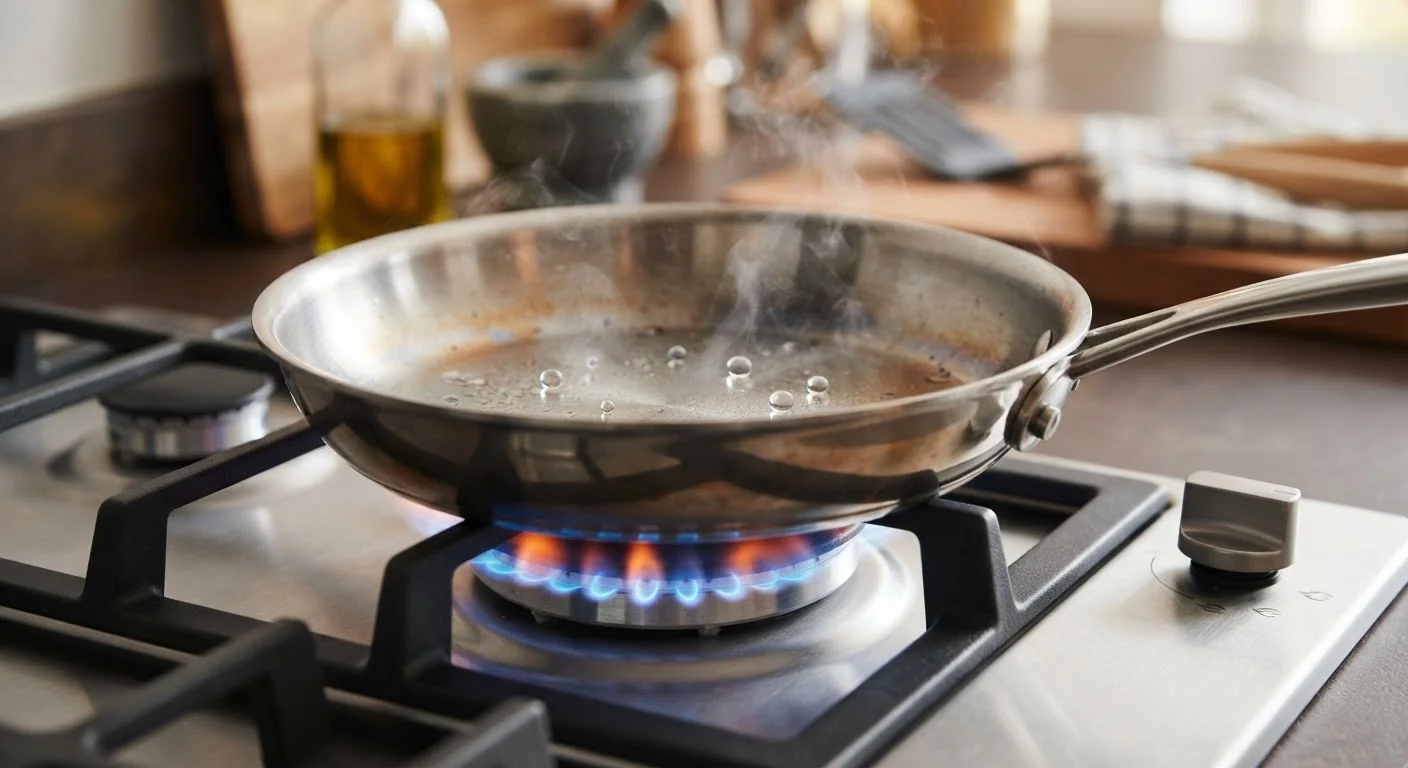
For stainless steel pans, heat the empty pan for 1-2 minutes over medium heat before adding oil. This closes microscopic pores in the metal's surface, reducing the chance that food will bond and stick. Then add oil and wait for it to shimmer before adding food. This sequence - pan first, then oil, then food - is one of the most reliable habits in everyday cooking.
- The water droplet test: Flick a few drops of cold water onto the surface. If they evaporate immediately in a hiss, the pan is warming but not ready. If the droplets bead up and roll across the surface without instantly evaporating - a phenomenon called the Leidenfrost effect - your pan is at a strong searing temperature.
- Oil behavior: Add oil after the pan is warm. When the oil shimmers and flows easily across the surface, you're ready to cook. If it smokes immediately, the pan is too hot and you should lower the heat and let it cool slightly. For more on how different oils respond to heat, see how cooking oils compare at different temperatures.
- The sound test: Food should sizzle immediately and assertively when it hits the pan. A quiet, reluctant sound means the pan isn't ready. A violent, aggressive spattering means it may be too hot.
Matching Temperature to the Food You're Cooking
One practical shift that improves results quickly: think about what the food needs before you turn on the burner, not after.
Proteins like steak and chicken thighs benefit from high initial heat to build a crust before finishing on lower heat. Eggs, on the other hand, cook best over medium-low - they're delicate proteins that seize and toughen when overheated. Onions being caramelized need medium-low heat sustained over time, while onions being sautéed for a stir-fry go in at high heat briefly.
Timing also matters beyond the pan itself. salting at the right moment works in tandem with heat - salt draws out moisture, which affects how quickly a crust forms when searing.
For a reference on internal temperatures and oven settings alongside stovetop heat, common cooking temperatures is a useful companion guide.
The underlying principle: learn what outcome you want, then work backward to the temperature that produces it. With a little practice, reading your pan becomes second nature.
Frequently Asked Questions
The water droplet test is the simplest method: flick a few drops of water into the pan. If they evaporate instantly, the pan is warm but not quite ready. If the droplets bead up and skitter around the surface (the Leidenfrost effect), the pan is at a good searing temperature. Steady sizzling when you add oil is another reliable signal.
Food most often sticks to stainless steel when the pan isn't hot enough before adding oil or food. Proteins bond to metal at lower temperatures but release naturally once a proper crust forms at higher heat. Preheating the pan adequately and letting food sit undisturbed until it releases on its own prevents most sticking.
For stainless steel and cast iron, briefly preheating an empty pan is fine and often recommended. However, nonstick pans should never be heated empty on high heat, as the coating can degrade and release fumes. Always add oil to a nonstick pan before significant heat builds up.
An overly hot pan will burn the exterior of food before the interior cooks through. Oil may smoke and break down, adding bitter flavors. For most home cooking, medium to medium-high heat is sufficient - very high heat is reserved for quick sears and stir-frying.
Yes, significantly. Cast iron heats slowly but retains heat exceptionally well. Stainless steel heats quickly but can have hot spots. Nonstick pans are efficient at lower temperatures but vulnerable to damage at high heat. Understanding your pan's behavior helps you adjust burner settings accordingly.
The content on this site is provided for informational purposes only and should not be considered a substitute for professional advice. While we strive to provide accurate and up-to-date information, we make no guarantees regarding its completeness or accuracy. Always consult a qualified professional for advice specific to your circumstances before making any decisions.