

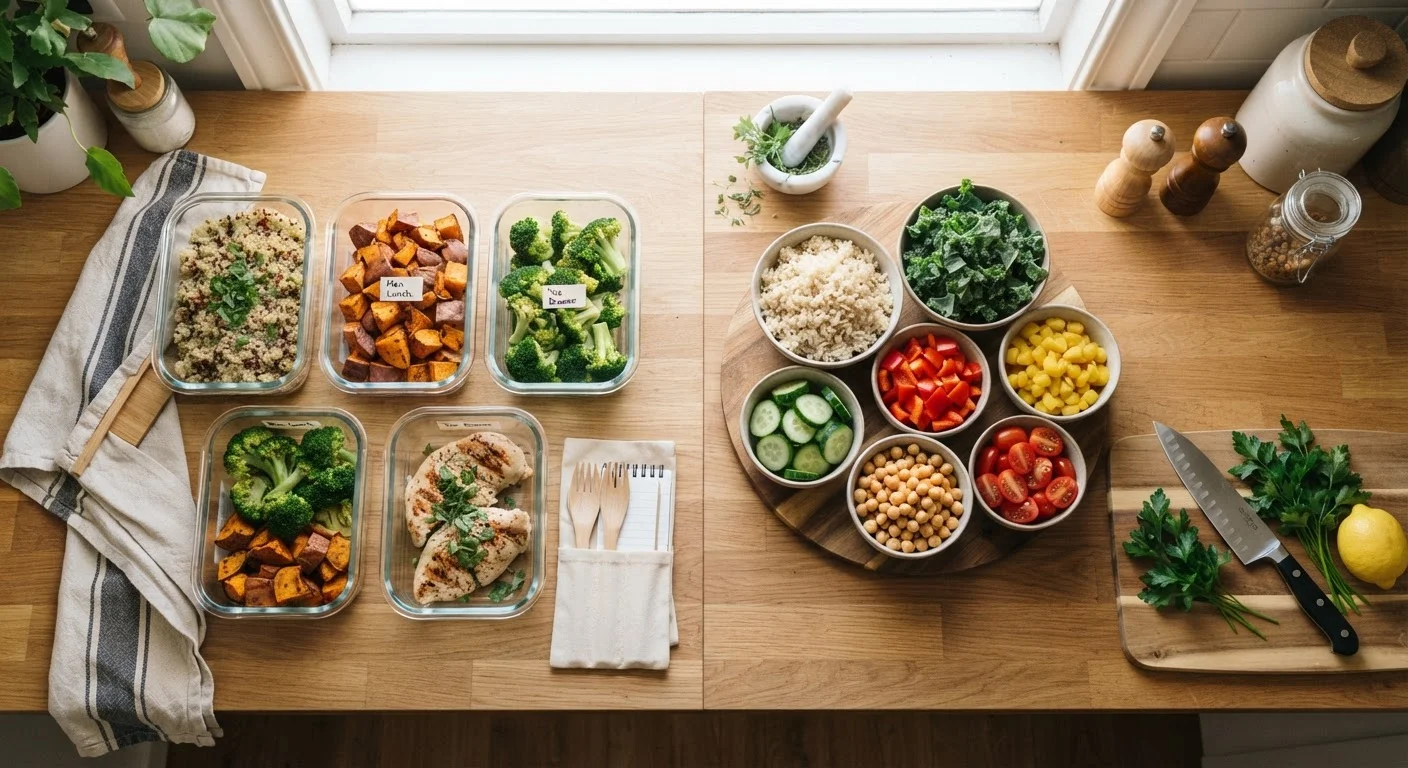
Option A
Batch Cooking
The all-in-one approach that puts dinner on autopilot.
Best for: People who want grab-and-go meals with zero weeknight decision-making.
Option B
Prepping Ingredients
The flexible foundation that keeps cooking options open.
Best for: People who want flexibility and variety without starting from scratch each night.
What Each Approach Actually Involves
These two strategies are often lumped together under the label "meal prep," but they involve different kitchen sessions and deliver different results. Understanding the distinction helps you choose the one that fits your actual life - not just an idealized version of it. For a deeper look at how these terms are used (and misused), see what meal prepping actually means.
Batch cooking means cooking full, complete dishes in large quantities - a pot of chili, a sheet pan of roasted chicken thighs, a big grain salad - then dividing them into individual containers for the days ahead. When dinner arrives, you reheat and eat. There's no assembly required.
Prepping ingredients means doing the time-consuming prep work - washing and chopping vegetables, marinating proteins, cooking grains, portioning snacks - without committing to finished dishes. Each evening, you pull from your prepped components and cook a fresh meal in a fraction of the usual time.
| Criterion | Batch Cooking | Prepping Ingredients |
|---|---|---|
| Weekly prep time | 2-3 hours, one session | 30-45 min prep + 15-20 min nightly |
| Weeknight effort | Reheat only | Light assembly and finishing |
| Meal variety | Limited - same dishes repeated | High - mix and match components |
| Food freshness | Can soften over days | Fresher - finished just before eating |
| Fridge storage life | 3-4 days typically | 5-6 days for many raw components |
| Best household size | Larger groups or families | Individuals or couples |
| Skill requirement | Low - scale a recipe up | Moderate - requires weeknight improvisation |
The Real Trade-Offs: Time, Freshness, and Flexibility
Batch cooking front-loads nearly all kitchen effort into one session, typically two to three hours on a weekend. The payoff is dramatic: weeknight meals require almost no active cooking. The trade-off is that food cooked days in advance can lose texture - soups stay great, but salads and crisped proteins can go soft. Variety also narrows; if you batch-cooked one pasta dish, you're eating that pasta dish several times.
Ingredient prep distributes effort differently. You spend 30-45 minutes washing, slicing, and portioning at the start of the week, then another 15-20 minutes each evening assembling and finishing. The reward is meals that taste noticeably fresher and a rotating menu you can adjust based on what sounds good that night. The cost is that weeknight cooking isn't fully eliminated - just shortened.
~2.5 hrs
Average weekly time spent cooking per U.S. adult
According to U.S. Bureau of Labor Statistics American Time Use Survey data, average daily cooking time is well under 30 minutes for many American households.
30-40%
Food waste reduction with structured meal planning
Research published in the journal Resources, Conservation and Recycling suggests that households using structured meal planning waste significantly less food than those without a plan.
Good knife work significantly accelerates ingredient prep. If chopping feels like the slowest part of your kitchen sessions, knife skills every home cook should understand can help you move faster and more safely.
Storage life matters too. Fully cooked dishes typically hold well for three to four days refrigerated. Prepped raw vegetables and grains can often last five to six days when stored correctly, giving you a longer usable window across the week.
How to Decide - and How to Combine Both
The honest answer for most households is that neither approach wins outright. The right choice depends on three factors: how predictable your evenings are, how many people you're feeding, and how much meal monotony you can tolerate.
If your schedule is consistent and you eat similar meals most days, batch cooking delivers the highest return. Cooking once and eating all week is a strategy that particularly suits people who commute, have young children, or find weeknight decision fatigue to be a real problem.
If your schedule is unpredictable - some nights you have 30 minutes, others you have none - ingredient prep gives you more resilience. You can cook a full fresh meal on easy nights and grab components for a quick grain bowl or wrap on rushed ones.
Many experienced home cooks land on a hybrid: batch one or two complete dishes (a soup, a protein) while also prepping raw components (cut vegetables, a jar of dressing, washed greens). This covers both bases without requiring you to commit entirely to one method. For a structured framework that integrates both, the weekly meal planning playbook walks through building a realistic system from scratch.
Understanding foundational cooking techniques - like how aromatics and heat build flavor - also helps you work faster in either approach. See building a flavor foundation for the fundamentals that make improvised weeknight cooking feel intuitive rather than stressful.
The content on this site is provided for informational purposes only and should not be considered a substitute for professional advice. While we strive to provide accurate and up-to-date information, we make no guarantees regarding its completeness or accuracy. Always consult a qualified professional for advice specific to your circumstances before making any decisions.