

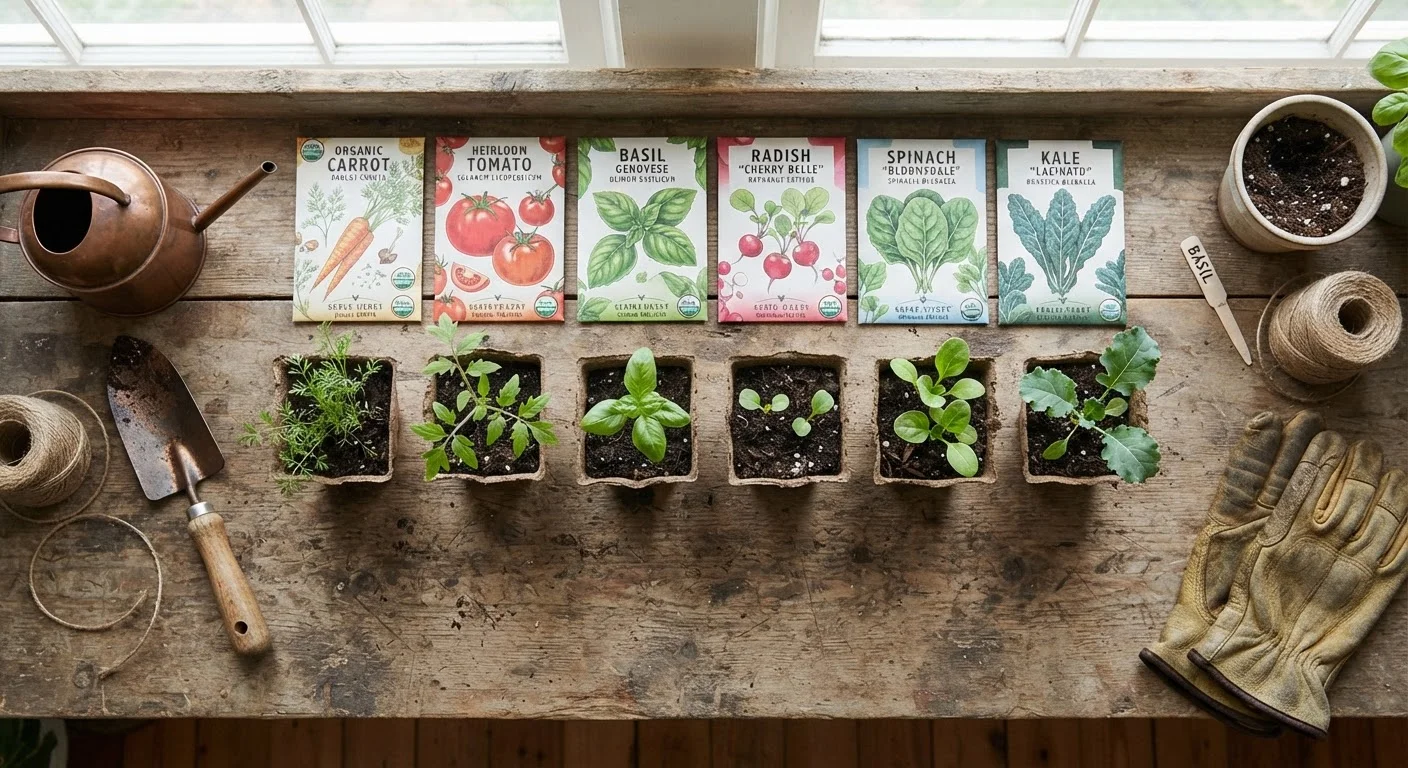
Option A
Starting from Seed
The patient, variety-rich approach to garden planning.
Best for: Gardeners who want maximum plant variety, lower per-plant cost, and enjoy the full growing process from germination onward.
Option B
Buying Transplants
The time-saving, lower-risk shortcut to productive beds.
Best for: Gardeners who want faster results, have short growing seasons, or are new to gardening and prefer a head start.
What the Timing Difference Actually Means
The most practical difference between seeds and transplants is when your growing clock starts. Warm-season crops like tomatoes and peppers need to be started indoors six to eight weeks before your last expected frost date - meaning a gardener in the Midwest might begin seed trays in late February for a May garden. Transplants skip that window entirely; you simply plant them out when conditions are right.
For cool-season crops - lettuce, kale, broccoli - the timing math shifts. Many of these can be direct-sown outdoors in early spring or fall, making seeds a perfectly practical choice without any indoor setup. Understanding your local frost dates is the real foundation of this decision. The USDA Plant Hardiness Zone Map and your local cooperative extension service are reliable free resources for that data.
To decode the numbers on a seed packet - including days to maturity, germination rates, and spacing - see our guide to reading seed packets. Those figures directly determine whether seeds are a realistic fit for your season length.
| Criterion | Starting from Seed | Buying Transplants |
|---|---|---|
| Cost per plant | Lower (pennies per seed) | Higher (dollars per plant) |
| Variety selection | Very broad | Limited to nursery stock |
| Time to planting outdoors | 6-10 weeks ahead required | Plant out immediately |
| Equipment needed | Trays, lights, seed-starting mix | Minimal - just garden tools |
| Risk of failure | Higher (germination not guaranteed) | Lower (plant already established) |
| Best for short seasons | Only if started early indoors | Yes - built-in head start |
| Root crops compatibility | Ideal - direct sow preferred | Poor - disturbs tap roots |
Cost, Effort, and What You're Actually Trading
Seeds are generally far less expensive per plant than nursery transplants. A packet containing 50 or more seeds often costs less than two individual seedlings at a garden center. However, that savings comes with real investments: grow lights or a very sunny south-facing window, seed-starting mix, trays, consistent watering, and several weeks of daily attention. Factor in those costs - especially artificial lighting - and the gap narrows considerably for small-scale gardeners.
Transplants shift the labor upstream to the grower and deliver a plant that's already past its most vulnerable stage. You're essentially paying for weeks of professional care. The tradeoff is lower variety selection and higher per-plant cost. For gardeners who are also navigating the raised bed vs. in-ground planting decision, transplants can simplify an already complex first-season setup.
6-8 weeks
Indoor seed lead time for warm-season crops
Most university extension guidelines recommend starting tomatoes and peppers indoors 6 to 8 weeks before the last expected frost date in your region.
2-4×
Typical transplant cost vs. seed cost per plant
General pricing comparisons across garden centers and seed catalogs suggest transplants often cost two to four times more per plant than starting from seed.
Effort also differs in texture. Seeds demand early-season discipline but are largely hands-off once they're in the ground. Transplants require more careful planting technique - proper hardening off, root handling, and watering support immediately after planting - but the overall timeline of responsibility is shorter.
Which Crops Belong in Each Category
Not every plant is equally happy being transplanted. Some have sensitive taproots or simply germinate so quickly that there's no advantage to starting them indoors. Treat the following as general guidance:
- Start from seed (direct sow): Carrots, beets, radishes, turnips, parsnips, beans, peas, corn, cucumbers, squash, and most herbs like dill and cilantro.
- Start indoors or buy as transplants: Tomatoes, peppers, eggplant, celery, and most annual flowers like petunias and snapdragons.
- Either works well: Broccoli, cabbage, cauliflower, kale, and lettuce - depending on your season length and preference.
This crop-specific logic is especially relevant if you're growing in a small space. Our article on vegetables suited to small spaces highlights compact varieties that often perform well as transplants in containers and narrow beds.
For a complete overview of the vegetable gardening process - from soil prep to harvest - the home vegetable gardening guide puts both starting methods in full context.
Don't Skip the Hardening-Off Step
Whether you start seeds indoors or buy transplants from a greenhouse, plants need a gradual transition to outdoor conditions. This process - called hardening off - involves setting plants outside for increasing periods over one to two weeks before full transplanting. Skipping this step can cause transplant shock, wilting, or sunscald even in otherwise healthy plants. A sheltered spot with indirect light is a good starting point for the first few days.
The content on this site is provided for informational purposes only and should not be considered a substitute for professional advice. While we strive to provide accurate and up-to-date information, we make no guarantees regarding its completeness or accuracy. Always consult a qualified professional for advice specific to your circumstances before making any decisions.