

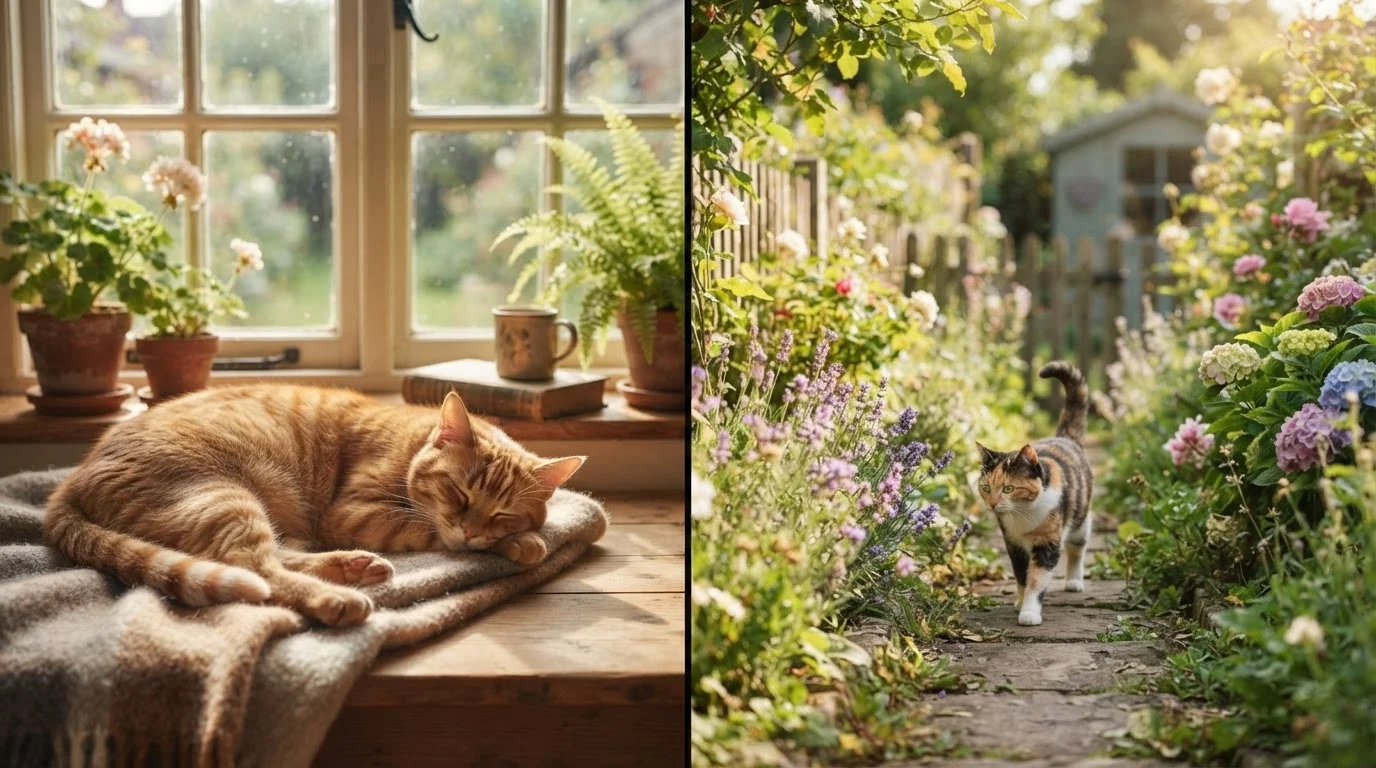
Option A
Indoor Cats
The protected, enrichment-dependent lifestyle.
Best for: Owners who want to minimize accident and disease risk and are prepared to actively provide mental and physical stimulation.
Option B
Outdoor Cats
The free-roaming, instinct-driven lifestyle.
Best for: Cats with strong roaming drives in low-traffic, low-predator environments where owners accept elevated exposure to external hazards.
The Lifespan and Safety Gap Is Real
Veterinary and animal welfare organizations consistently report that indoor cats live substantially longer than outdoor or free-roaming cats. While individual lifespans vary, the gap is driven by concrete, measurable hazards rather than speculation.
Outdoor cats face vehicle traffic, dog attacks, territorial fights with other cats, and encounters with wildlife predators. They are also far more exposed to infectious diseases - including feline leukemia virus (FeLV) and feline immunodeficiency virus (FIV), both spread through bite wounds - as well as intestinal parasites, fleas, ticks, and toxins like antifreeze or rodenticides left in neighborhoods.
Indoor cats are not risk-free, of course. Household hazards such as toxic plants, open windows without screens, and certain human foods are real concerns. But the sheer volume and severity of outdoor risks is meaningfully higher for most cats in most American communities. Your local environment matters: a cat in a rural area with low traffic and no known predator pressure faces different odds than one in a dense suburb.
| Criterion | Indoor Cats | Outdoor Cats |
|---|---|---|
| Average lifespan | Typically 12-18 years | Often 5-7 years (free-roaming) |
| Disease exposure | Low (FIV, FeLV, parasites rare) | High (bites, ticks, parasites common) |
| Injury risk | Low - mainly household hazards | High - traffic, predators, fights |
| Enrichment needs | High - owner must actively provide | Partially self-supplied by environment |
| Obesity risk | Higher without activity management | Lower with regular roaming activity |
| Environmental impact | Minimal - no wildlife predation | Significant - cats kill billions of birds annually |
| Owner control over diet | Full - known intake at all times | Partial - cats may hunt or scavenge |
The Hidden Cost of Keeping Cats Indoors
Safety is not the entire story. Indoor cats lose access to the environmental complexity that naturally occupied their ancestors: varied terrain, hunting sequences, novel smells, temperature changes, and the unpredictability of the outside world. Without deliberate substitutes, this deficit shows up as boredom, stress, and behavioral problems - excessive vocalization, destructive scratching, over-grooming, or aggression.
Obesity is also disproportionately common in indoor cats. Reduced activity combined with ad-libitum dry food feeding is a pattern that veterinarians flag routinely. Weight-related health problems - including diabetes and joint disease - can meaningfully reduce quality of life and longevity, which is a genuine counterpoint to the safety advantages of indoor living.
The solution is not to send cats outdoors but to take enrichment seriously. Keeping an indoor cat mentally stimulated takes consistent effort, but puzzle feeders, climbing structures, window perches, and regular interactive play sessions go a long way. Our guide to feline enrichment ideas covers approaches that go well beyond a toy mouse.
12-18 yrs
Typical indoor cat lifespan
Veterinary consensus places indoor cat median lifespans well above free-roaming cats, with many indoor cats living into their late teens.
5-7 yrs
Estimated free-roaming cat lifespan
Animal welfare organizations and veterinary sources commonly cite this range for unsupervised outdoor or feral cats in the United States.
~60%
US cats kept primarily indoors
American Pet Products Association surveys have consistently found a majority of owned US cats are kept mainly or entirely indoors.
The Middle Ground: Supervised and Contained Outdoor Access
Many cat owners find that structured outdoor access addresses enrichment needs without accepting the full risk profile of free roaming. Common approaches include:
- Leash and harness walks: Some cats adapt well to a properly fitted harness, allowing outdoor exploration under direct owner supervision.
- Catio enclosures: Screened outdoor enclosures - ranging from window-mounted boxes to large freestanding structures - let cats experience fresh air, sunlight, and outdoor sights and sounds safely.
- Cat-proofed garden fencing: Specialized roller or overhang fence systems can prevent cats from climbing out of a defined outdoor space, though no system is entirely escape-proof.
These options require upfront investment in time or money, but they represent a genuine compromise that veterinarians and behaviorists increasingly recommend. If you are setting up a new home for your cat, planning for one of these solutions from the beginning is far easier than retrofitting later.
Whatever setup you choose, keep vaccinations and parasite prevention current - even cats with limited outdoor access should be protected, and your vet can help calibrate the right protocol for your cat's specific exposure level.
Making the Right Call for Your Cat
No single answer applies to every household. A few factors are worth weighing carefully:
- Your cat's history and temperament
- A cat raised outdoors from kittenhood often has strong roaming behavior that is difficult to suppress without causing stress. Conversely, a cat raised indoors typically shows little desire to venture out.
- Your local environment
- Traffic volume, known predators (coyotes are increasingly common in suburban areas), local cat population density, and climate all affect real-world outdoor risk meaningfully.
- Your capacity to provide enrichment
- An honest assessment of how much time and space you can realistically dedicate to enrichment matters. An under-stimulated indoor cat is not necessarily better off than a well-managed outdoor one.
Discussing the specifics with your veterinarian is worthwhile - they can factor in your cat's health status, age, and your local disease landscape. Nutrition also plays a role in how well cats thrive in either setting; our overview of how cat nutrition actually works is a useful companion read.
The goal is a life that is both safe and genuinely good for your cat - and with the right information, that balance is achievable.
The content on this site is provided for informational purposes only and should not be considered a substitute for professional advice. While we strive to provide accurate and up-to-date information, we make no guarantees regarding its completeness or accuracy. Always consult a qualified professional for advice specific to your circumstances before making any decisions.